



















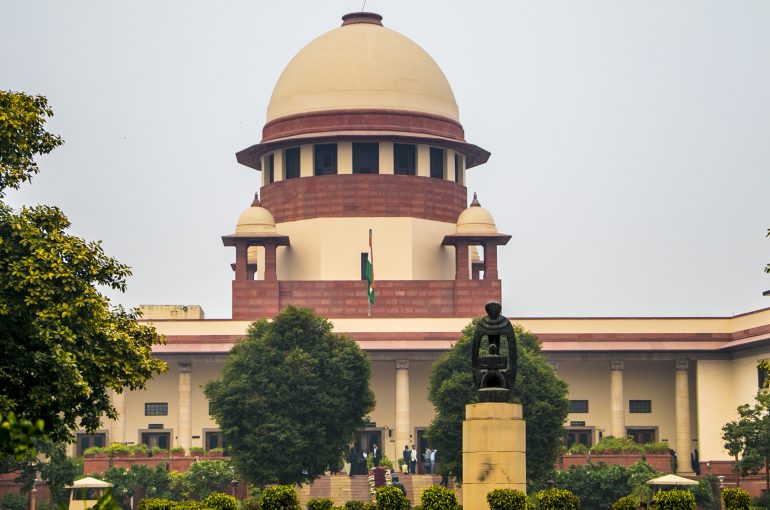
SUPREME COURT HOLDS STATE CANNOT DENY REGULARISATION OF LONG-SERVING CONTRACT STAFF APPOINTED ON SANCTIONED POST BY DUE PROCESS

Introduction
In a decision that fundamentally reshapes the discourse surrounding contractual public sector employment, the Supreme Court of India, through a Judgment delivered by Justice Vikram Nath and Justice Sandeep Mehta, has pronounced a substantial shift in constitutional jurisprudence. The case is titled Bhola Nath v. The State of Jharkhand and Others (SLP(C) No. 30762 of 2024, SLP(C) No. 28352 of 2024 and SLP(C) No. 3430 of 2025). This Appeal, decided on January 30, 2026, addresses a critical intersection between employment rights, constitutional guarantees and the State’s obligations as a model employer.
Factual Background
The narrative underlying this Judgment spans over thirteen years of public service rendered by three contractual employees: Bhola Nath, Uday Kant Yadav and Prakash Kumar. These individuals were recruited in September 2012 against 22 sanctioned positions of Junior Engineers (Agriculture) in Jharkhand’s Land Conservation Directorate. The recruitment process, initiated through an advertisement, explicitly stipulated that appointments would be temporary and contractual in nature, with no guarantee of regularization. The initial engagement was structured for one year, renewable subject to satisfactory performance.
From 2012 onwards, these employees received consistent extensions annually and their performance records remained unblemished. The Respondent-State granted multiple renewals spanning approximately a decade, during which these workers transferred to various postings, received performance assessments and underwent the same service conditions as regular employees. However, in 2023, when the State issued its final extension, it simultaneously communicated that no further renewal would follow. This abrupt cessation prompted the three employees to approach the High Court of Jharkhand through writ petitions seeking mandamus for regularization and challenging the Office Order dated February 28, 2023, which unilaterally stipulated the discontinuation of future extensions.
Contentions of the Parties
The Appellants advanced multifaceted arguments challenging the State’s decision. Their Counsel, Shri K. Parameshwar, submitted that despite contractual designation, the employees were appointed through a lawful recruitment process against sanctioned posts following proper selection procedures, including roster clearance. They emphasized over ten years of uninterrupted service with consistent positive performance evaluations. The Appellants contended that denying regularization after rendering such long-term service, while simultaneously treating them as regular employees in matters of transfers and increments, constituted arbitrary discrimination violating Article 14 of the Constitution.
Furthermore, the Appellants invoked principles of equity, fairness and the State’s constitutional obligation as a model employer. They argued that the contractual stipulations barring regularization claims were unconscionable agreements negotiated between parties of vastly unequal bargaining power, where a desperate job-seeker possesses minimal leverage against the State’s overwhelming institutional might. They also proposed that their continuous service generated legitimate expectations of regularization, particularly once opportunities for alternative employment diminished with age progression.
The State’s counsel countered that the engagement letters explicitly precluded any obligation to regularize appointees. They maintained that contractual terms, voluntarily accepted by the employees, could not be subsequently altered through judicial intervention, as doing so would constitute impermissible contract rewriting. The State further argued that contractual employees possess no enforceable rights to continuation or regularization absent an applicable statutory scheme.
Court’s Decision
The Supreme Court fundamentally departed from the High Court’s reasoning. The Court recognized that the High Court had adopted a mechanistic application of precedent without engaging substantive constitutional considerations. The Judgment emphasized that Article 14’s equality guarantee transcends contractual formalities. Drawing from established constitutional principles, the Court articulated that fundamental rights remain incapable of waiver, meaning that even if the State’s action violates Article 14, employees cannot forfeit constitutional protections through contractual acceptance. The Court referred to Central Inland Water Transport Corporation v. Brojo Nath Ganguly (1986) 3 SCC 156, establishing that unconscionable agreements entered between parties lacking genuine bargaining parity cannot be enforced.
A particularly influential passage employed the metaphor of a “lion and lamb” to characterize the structural inequality between the omnipotent State and a vulnerable employee-aspirant. The Judgment stressed that Constitutional Courts bear a duty to safeguard the vulnerable from exploitation, precluding mechanical reliance on contractual labels where they mask the State’s unfair exercise of power.
The Judgment further articulated new principles concerning perpetual contractual engagements. It held that once employees discharge public duties satisfactorily for extended periods, States cannot arbitrarily discontinue engagement solely through contractual nomenclature without recording reasoned decisions. The Judgment criticized the culture of “ad-hocism” wherein States perpetually engage workers under temporary or contractual designations to circumvent regularization obligations, effectively perpetuating precarious conditions.
Conclusion
The Judgment recognizes that contractual stipulations cannot shield arbitrary State action and that model employer obligations extend uniformly regardless of employment nomenclature. The Judgment restores constitutional conscience to employment relationships. The Court’s pronouncement that the State’s decade-long acceptance of uninterrupted service generates legitimate expectations and that abrupt discontinuance lacks rational justification establishes robust parameters against exploitative perpetual contractual engagements. This decision thereby reasserts that constitutional governance demands fairness, fundamentally repositioning contractual employees within the protective ambit of India’s constitutional framework while redefining the State’s fiduciary responsibilities toward those who serve the public interest.
YASH HARI DIXIT
LEGAL ASSOCIATE
THE INDIAN LAWYER AND ALIED SERVICES
Please log onto our YouTube channel, The Indian Lawyer Legal Tips, to learn about various aspects of the law. Our latest Video, titled “Understanding SARFAESI Act | Rights of Borrowers 2025, DRT, Supreme Court Judgments” can be viewed at the link below:

Leave a Reply