



















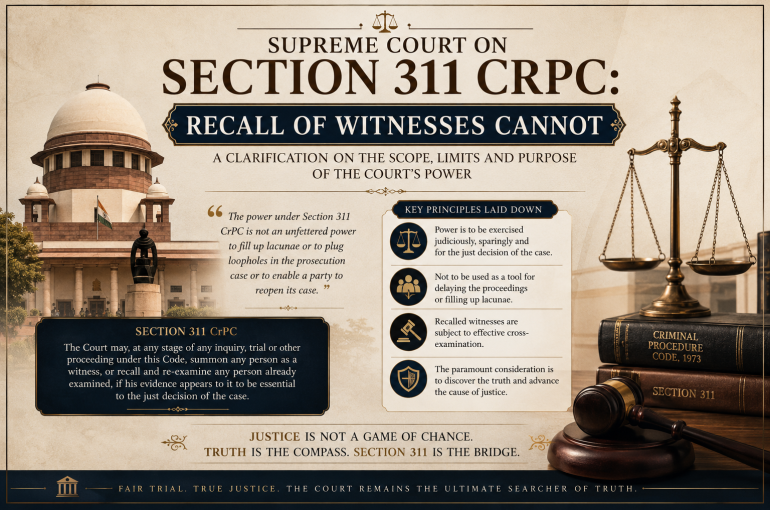
SUPREME COURT ON SECTION 311 CRPC: RECALL OF WITNESSES CANNOT BE ALLOWED AS A MATTER OF ROUTINE

INTRODUCTION
The Supreme Court’s recent Judgment in State of Tripura v. Panna Ahmed Criminal Appeal No. 2848 of 2026 is an important reminder that while courts have wide powers under Section 311 CrPC to recall witnesses, those powers cannot be used casually or to prolong criminal trials unnecessarily.
In my view, the Judgment strikes a fair balance between the rights of the Accused and the need to protect witnesses from repeated and avoidable appearances before the court.
BACKGROUND OF THE CASE
The case arose from a Rape Prosecution registered in 2016. During the trial, the Victim was examined and cross-examined on multiple occasions. She was later recalled, re-examined and again cross-examined.
Despite having these opportunities, the Accused filed another Application under Section 311 CrPC in 2023 seeking to recall the Victim once again. The ground taken was that certain questions relating to Call Detail Records (CDRs) had not been put to her earlier due to oversight.
While the Trial Court rejected the Application, the High Court allowed it. The matter eventually reached the Supreme Court.
WHAT DID THE SUPREME COURT HOLD?
The Supreme Court set aside the High Court’s Order and restored the Trial Court’s decision.
The Court reiterated that Section 311 CrPC undoubtedly gives wide powers to courts. However, those powers must be exercised carefully and only when the additional evidence is genuinely necessary for a just decision in the case. The provision cannot be used to fill gaps in a party’s case or to give a litigant a second opportunity after failing to ask the right questions earlier.
The Court noted that the Victim had already undergone extensive cross-examination over several hearings. Further, the Application seeking recall was filed nearly four years after the completion of her earlier cross-examination. No satisfactory explanation was offered for such a long delay.
The Court also found it significant that the CDRs relied upon by the defence were already part of the record and had been available throughout the Trial. Therefore, the defence had sufficient opportunity to question the Victim on those documents earlier.
IMPORTANCE OF THE JUDGMENT
One of the most notable aspects of the Judgment is the Court’s concern for victims and witnesses.
The Supreme Court observed that witnesses, particularly victims of serious offences, cannot be expected to repeatedly appear before courts and undergo multiple rounds of cross-examination. Such repeated recalls can cause unnecessary hardship and delay the conclusion of trials.
MY TAKE
As a lawyer, I believe the Judgment reinforces a principle that is often overlooked in criminal litigation. A fair trial is essential, but fairness does not mean endless opportunities.
Section 311 exists to help courts discover the truth and prevent miscarriage of justice. It is not meant to become a tool for correcting strategic mistakes, filling omissions or delaying proceedings that have already been pending for years.
SARTHAK KALRA
Senior Legal Associate
The Indian Lawyer & Allied Services
EDITOR’S COMMENTS
The Supreme Court has once again clarified that recall of a witness under Section 311 CrPC is an exception, not the rule. While courts must ensure that justice is done, they must also protect witnesses from unnecessary hardship and ensure that criminal trials reach their logical conclusion within a reasonable time.
The Judgment is a timely reminder that the criminal justice system must balance fairness with finality and that procedural powers cannot be allowed to become instruments of delay.
SUSHILA RAM VARMA
Advocate & Chief Consultant
The Indian Lawyer & Allied Services
Please log onto our YouTube channel, The Indian Lawyer Legal Tips, to learn about various
aspects of the law. Our latest Video, titled “What to do when false FIR/case filed against you?
How to deal with false cases” can be viewed at the link below:

Leave a Reply