



















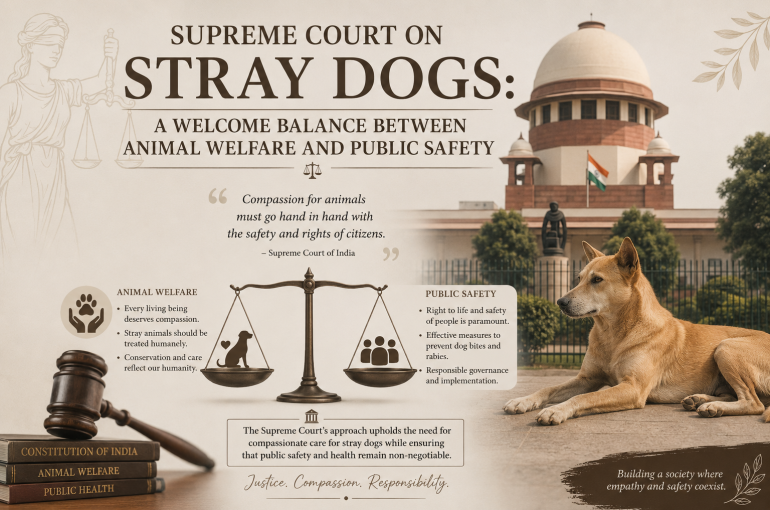
SUPREME COURT ON STRAY DOGS: A WELCOME BALANCE BETWEEN ANIMAL WELFARE AND PUBLIC SAFETY

INTRODUCTION
The Supreme Court’s recent Judgment in In Re: “City Hounded by Strays, Kids Pay Price” has reignited the debate on stray dog management in India. The issue has become increasingly important in light of the growing number of dog-bite incidents reported from schools, hospitals, residential areas, railway stations and other public places.
At the heart of the debate lies a difficult question: how do we balance animal welfare with public safety? In my view, the Supreme Court has attempted to answer this question through a practical and balanced approach.
WHAT WAS THE ISSUE BEFORE THE COURT?
The main controversy concerned the Animal Birth Control (ABC) Rules, 2023, which follow the Capture-Sterilise-Vaccinate-Release (CSVR) model. Animal welfare groups argued that once a stray dog is sterilised and vaccinated, it must be released back to the same location from where it was picked up.
The Court, however, had to consider whether this principle should also apply to places such as schools, colleges, hospitals, sports complexes, railway stations and bus terminals.
THE SUPREME COURT’S VIEW
The Court held that such institutional areas cannot be treated in the same manner as ordinary public streets. It clarified that stray dogs found within these premises need not be released back to the same location after sterilisation and vaccination.
According to the Court, interpreting the ABC Rules in a manner that requires the continued presence of stray dogs in schools, hospitals and similar institutions would defeat the very purpose of maintaining these spaces as safe environments for the public.
WHY THE JUDGMENT IS SIGNIFICANT
What makes this Judgment important is its emphasis on Article 21 of the Constitution.
The Court recognised that institutions such as schools and hospitals are frequented by children, patients, senior citizens and other vulnerable persons. The State therefore has a constitutional obligation to ensure their safety. The Judgment treats the issue not merely as one of animal welfare but also as a matter involving the right to life and personal safety.
In my opinion, this is the strongest aspect of the ruling. Public authorities cannot ignore repeated incidents of dog attacks in places where citizens should reasonably expect a safe environment.
THE JUDGMENT DOES NOT REJECT ANIMAL WELFARE
At the same time, the Judgment should not be misunderstood as being against animal welfare.
The Supreme Court has not dismantled the Animal Birth Control framework. It has not authorised indiscriminate removal of stray dogs from all public spaces. Rather, it has created a distinction between ordinary public areas and sensitive institutional premises where safety concerns are significantly higher.
This distinction allows the existing animal welfare framework to continue while addressing genuine public safety concerns.
ACCOUNTABILITY MATTERS
Another notable feature of the Judgment is its discussion on accountability.
The Court observed that groups seeking to maintain or feed stray dogs within institutional premises cannot do so without accepting responsibility. It even referred to the possibility of tortious liability where injury is caused in such circumstances.
This observation highlights an important principle: rights and responsibilities must go together.
A MESSAGE TO MUNICIPAL AUTHORITIES
The Judgment also serves as a reminder that the present situation is partly the result of poor implementation of the Animal Birth Control programme.
The Court noted that sterilisation and vaccination efforts have often been inconsistent and inadequate across the country. Had these programmes been implemented effectively over the years, the scale of the current problem might have been far smaller.
SARTHAK KALRA
Senior Legal Associate
The Indian Lawyer & Allied Services
EDITOR’S COMMENTS
As a lawyer, I believe this Judgment adopts a practical middle path. The Court has neither disregarded animal welfare concerns nor ignored public safety. Instead, it has recognised that while humane treatment of animals remains important, schools, hospitals and similar institutions cannot become places where citizens are exposed to avoidable risks.
The Judgment is ultimately a reminder that animal welfare and public safety are not competing values. Both must coexist. However, where the safety of children, patients and other vulnerable individuals is concerned, the law must ensure that public safety receives the protection it deserves.
SUSHILA RAM VARMA
Advocate & Chief Consultant
The Indian Lawyer & Allied Services
Please log onto our YouTube channel, The Indian Lawyer Legal Tips, to learn about
various aspects of the law. Our latest Video, titled “What to do when false FIR/case
filed against you? How to deal with false cases” can be viewed at the link below:

Leave a Reply