



















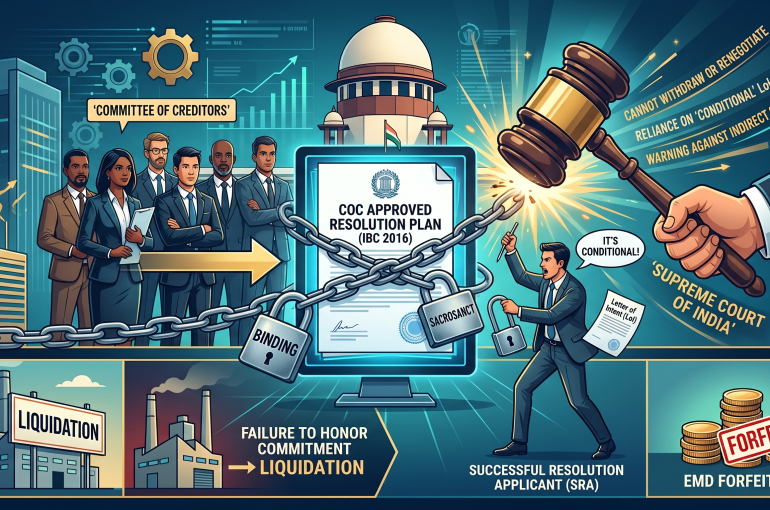
SUPREME COURT HOLDS ONCE COMMITTEE OF CREDITORS APPROVES RESOLUTION PLAN, SUCCESSFUL RESOLUTION APPLICANT CANNOT NEGOTIATE FURTHER

INTRODUCTION
In Sanjay Dave v. Andhra Bank Ltd. & Ors. (2026 INSC 580), decided on 27th May, 2026, the Supreme Court of India, comprising Justice K.V. Viswanathan and Justice Vipul M. Pancholi, addressed the binding nature of a Committee of Creditors (CoC) approved resolution plan under the Insolvency and Bankruptcy Code, 2016 (IBC). The Court held that once a resolution plan is approved by the CoC, a Successful Resolution Applicant (SRA) cannot attempt to withdraw or further negotiate by claiming that the Letter of Intent (LoI) issued by the Resolution Professional (RP) is “conditional”. The Judgment serves as a stern warning against SRAs using indirect subterfuge to delay time-bound insolvency resolutions, reaffirming the supremacy of the CoC’s commercial wisdom in deciding to liquidate a Corporate Debtor when an SRA fails to honor its commitments.
BRIEF FACTS
The Corporate Insolvency Resolution Process (CIRP) of M/s. Oracle Home Textiles Limited was admitted on 9th August, 2018. A Request for Resolution Plan (RFRP) was issued on 6th February, 2019. The Appellant (Promoter/Director) attended the 15th CoC meeting on 24th January, 2020, where third-party plans were discussed. He expressed interest on 11th February, 2020 and submitted a plan after an NCLT order was passed on 18th February, 2020.
The NCLT reserved orders regarding third-party litigations on 21st January, 2021. The pending litigations were repeatedly discussed in the presence of the Appellant during CoC meetings on 1st March, 2021, 10th March, 2021 and 29th April, 2021. An addendum to the Appellant’s plan was submitted on 5th May, 2021. During the 27th CoC meeting on 6th May, 2021, the CoC temporarily relaxed the 7-day timeline to submit a performance guarantee to 45 days due to the Pandemic.
The Appellant was informed on 10th May, 2021, that the CoC approved his plan with a 99.90% majority. At the 28th CoC meeting on 21st May, 2021, the Appellant requested a formal LoI, which was issued by the RP on 23rd May, 2021 and circulated via email on 24th May, 2021. On 29th May, 2021, the Appellant raised objections, claiming the LoI was “conditional” because it was subject to prospective NCLT orders. Despite stating he had no resistance during the 29th CoC meeting on 11th June, 2021, he failed to submit the accepted copy, resulting in a second LoI on 23rd June, 2021.
A third LoI was issued on 23rd July, 2021, reinstating the original 7-day requirement for the performance guarantee since the 45-day extension had lapsed. During the 31st CoC meeting on 26th July, 2021, the CoC discussed invoking RFRP provisions for non-acceptance. Consequently, on 2nd August, 2021, the RP forfeited the Appellant’s Earnest Money Deposit (EMD) of Rs. 1,00,00,000/-. The Appellant challenged this forfeiture on 27th August, 2021.
The CIRP period expired on 21st February, 2023. On 5th June, 2023, the CoC voted to liquidate the Corporate Debtor with a 99.61% majority. The Adjudicating Authority allowed the liquidation on 30th April, 2024. The NCLAT subsequently dismissed the Appellant’s appeals on 29th October, 2024. The Appellant approached the Supreme Court against the NCLAT order which was dismissed on 27th May, 2026.
ISSUES OF LAW
The principal issues before the Court were whether an LoI issued by an RP can be categorized as “conditional” merely because it is subjected to the outcome of pending litigations and whether an SRA can rely on such conditions to negotiate further or withdraw an approved plan. Additionally, the Court examined the legality of the EMD forfeiture and whether the CoC could validly resolve to liquidate the Corporate Debtor under Section 33 of the IBC prior to the formal confirmation of the resolution plan by the Adjudicating Authority.
ANALYSIS OF THE JUDGMENT
The Supreme Court categorically rejected the Appellant’s contention that the LoIs were conditional. The Court observed that stipulating an LoI is subject to a judicial body’s final decision does not render it conditional, as all resolution plans are inherently subservient to the Adjudicating Authority’s final orders.
A significant aspect of the Judgment was the application of the doctrine of “approbate and reprobate” (acquiescence). The Court noted that the Appellant was fully aware of the pending litigations and had expressly agreed to the litigation risks and procedural timelines across various CoC meetings. Relying on precedents, the Court held that a party cannot “blow hot and cold” to secure an advantage, categorizing the Appellant’s objections as a calculated subterfuge to indirectly withdraw from the plan.
Reaffirming the sanctity of CoC approvals, the Court relied on its landmark decision in Ebix Singapore (P) Ltd. v. Educomp Solutions Ltd. (CoC), (2022) 2 SCC 401. The Court reiterated that the insolvency framework leaves no room for an SRA to effect further modifications, withdrawals or unregulated negotiations once a plan is approved by the CoC.
The Court also upheld the EMD forfeiture, noting it fully aligned with Clause 1.9.4 of the RFRP due to the Appellant’s failure to submit the performance guarantee. Addressing the initiation of liquidation, the Court referenced Section 33(2) of the Code and its Explanation (which came into force on 16.08.2019). Aligning with Manish Kumar v. Union of India, (2021) 5 SCC 1, the Court emphasized that the CoC is statutorily empowered to take the commercial, non-justiciable decision to liquidate the Corporate Debtor at any time before the plan is confirmed.
CONCLUSION
The Supreme Court dismissed the appeals holding that once a plan is approved by the CoC it cannot be changed and directed the Liquidator to proceed with the liquidation of the Corporate Debtor.
ANIKET KUMAR PARCHA
Legal Associate
The Indian Lawyer & Allied Services
Editor’s Comments
The Judgment is a powerful reminder that an SRA cannot utilize fabricated grievances over “conditionalities” to delay the implementation of an approved resolution plan. By reaffirming the irrevocability of CoC-approved plans and the paramount status of the CoC’s commercial wisdom, the Court underscored that the strict timelines and procedural integrity of the IBC must be strictly maintained. The Supreme Court also underscored the importance of adhering to the time-lines that have been laid down in the IBC
Sushila Ram Varma
Advocate and Chief Consultant
The Indian Lawyer & Allied Services
Please log onto our YouTube channel, The Indian Lawyer Legal Tips, to learn about various aspects of the law. Our latest Video, titled “What to do when false FIR/case filed against you? How to deal with false cases” can be viewed at the link below:
https://www.youtube.com/watch?v=3-eTdcXE4M4
Leave a Reply