



















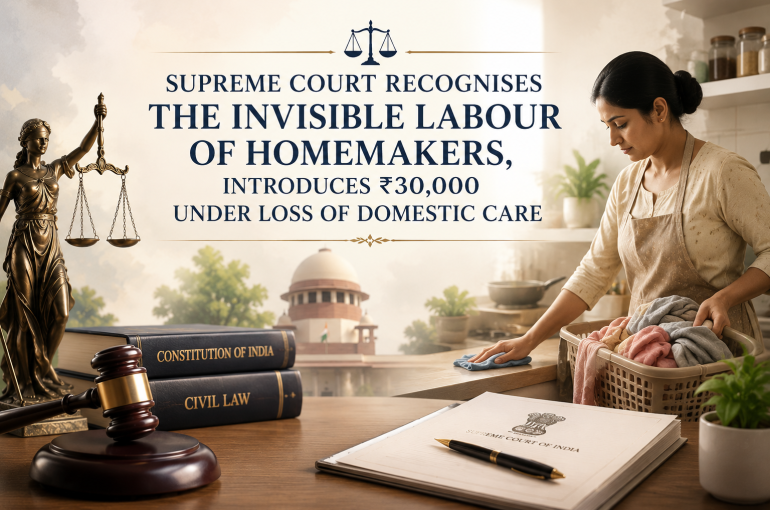
SUPREME COURT RECOGNISES THE INVISIBLE LABOUR OF HOMEMAKERS, INTRODUCES ₹30,000 UNDER ‘LOSS OF DOMESTIC CARE’

INTRODUCTION
In Shishu Pal @ Shish Ram & Ors. v. Surjeet & Ors., decided on 11 June 2026, the Supreme Court delivered a Judgment that goes beyond the usual exercise of calculating compensation in a motor accident claim. The Court used the opportunity to address a larger issue that has existed for decades: how should the law value the contribution of a homemaker?
While the Judgment has attracted attention because of the Court’s direction to award an additional sum of ₹30,000 under the head of “Loss of Domestic Care“, the real significance of the decision lies elsewhere. It lies in the Court’s recognition that the work performed by homemakers is not merely emotional or familial in nature but also has substantial economic value.
FACTS OF THE CASE
The case arose from a motor vehicle accident that took place on 25 November 2001. The Deceased, who was a homemaker, lost her life due to the rash and negligent driving of a vehicle. Her legal heirs approached the Motor Accident Claims Tribunal seeking compensation.
The Tribunal awarded compensation of ₹2.42 lakh. Dissatisfied with the amount, the Claimants approached the Punjab and Haryana High Court seeking enhancement. After nearly two decades, the High Court enhanced the compensation to ₹8.43 lakh. Even then, the Claimants believed that the compensation did not adequately reflect the loss suffered by the family and therefore approached the Supreme Court.
THE QUESTION BEFORE THE COURT
The issue before the Supreme Court was not merely whether the compensation awarded was sufficient. The larger question was whether the existing method of calculating compensation in the case of a deceased homemaker truly recognised her worth and value to the family.
Unlike a salaried employee, a homemaker does not earn a fixed income. Courts therefore generally rely upon notional income while calculating compensation. However, the Supreme Court observed that this approach often results in undervaluing the role of a homemaker because much of her contribution cannot be measured through conventional financial standards.
HOMEMAKER AS A “NATION BUILDER”
One of the most striking aspects of the Judgment is the language employed by the Court.
Justice Sanjay Karol observed that it is ironic to describe a homemaker as a dependant when, in reality, the entire household often depends upon her efforts. The Court noted that homemakers support earning members, raise children, care for elderly family members and provide stability to the family structure. Their contribution may not appear in salary slips or economic data, but its impact is undeniable.
The Court went so far as to describe homemakers as “nation builders”, observing that they lay the foundation upon which future generations are shaped.
WHY THE COURT INTRODUCED THE ₹30,000 HEAD
The Court found that existing heads of compensation did not adequately account for the practical and economic loss suffered by families after the death of a homemaker.
While compensation for consortium addresses emotional loss, it does not recognise the value of domestic management, caregiving, guidance to children and support provided to other family members. The Court observed that these contributions are distinct and deserve independent recognition.
To address this gap, the Court introduced a new head of compensation called “Loss of Domestic Care“. It directed that where the death of a homemaker results in loss of household management, maternal support and spousal or parental care, a composite amount of ₹30,000 per month should be added while calculating compensation. The Court further directed that this figure should increase by 10% every three years.
In this case, finally, a payment of Rs. 62,77,900/ was granted to the Claimants, after taking into account the “Loss of Domestic Care”.
MY VIEW
In my opinion, the most important part of this Judgment is not the ₹30,000 figure itself. The amount may increase in future cases and different benches may refine the methodology. What is likely to endure is the principle underlying the decision.
For far too long, domestic work has been treated as something that naturally happens within a household rather than as labour that creates real value. The Supreme Court has attempted to correct that imbalance. By recognising “Loss of Domestic Care” as a separate component of compensation, the Court has acknowledged a reality that every family already understands: that the absence of a homemaker creates a vacuum that cannot be measured merely through emotional loss.
CONCLUSION
The decision in Shishu Pal @ Shish Ram & Ors. v. Surjeet & Ors. is likely to become an important precedent in motor accident compensation cases involving homemakers. More importantly, it sends a broader message that unpaid domestic work deserves recognition and respect.
The Judgment is not merely about awarding an additional ₹30,000. It is about recognising the countless contributions that take place within a home every day and acknowledging that those contributions have real value, both for the family and for society as a whole.
SARTHAK KALRA
Senior Legal Associate
The Indian Lawyer & Allied Services
EDITOR’S COMMENTS
This Judgement has finally given the homemaker her dues in monetary terms. The Judges, by respectfully referring to the homemaker as ‘nation builders’ have established the importance of the homemaker who makes this possible for the other members of the family to achieve their goals while she suppresses or very often sacrifices her career options for the sake of her family. Though Rs. 30,000 may not be an adequate benchmark when putting a monetary value on a homemaker’s worth, it is still the beginning of establishing a convention that not only respects a homemaker but also puts a valuation to her life which the insurance companies are reluctant to do.
SUSHILA RAM VARMA
Advocate & Chief Consultant
The Indian Lawyer & Allied Services
Please log onto our YouTube channel, The Indian Lawyer Legal Tips, to learn about
various aspects of the law. Our latest Video, titled ,”DO HUSBANDS HAVE A RIGHT TO MAINTENANCE UNDER INDIAN LAW ?” can be viewed at the link below:

Leave a Reply