



















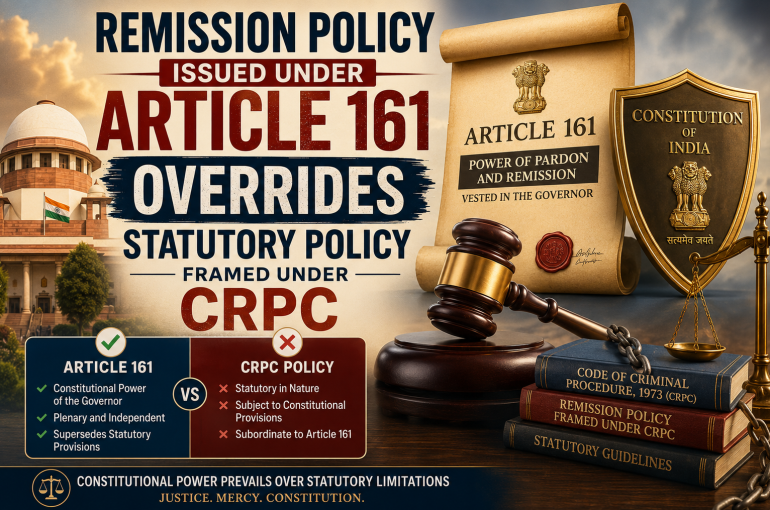
REMISSION POLICY ISSUED UNDER ARTICLE 161 OVERRIDES STATUTORY POLICY FRAMED UNDER CRPC

Introduction
In a significant pronouncement made in the case of Parveen Kumar @ Parveen Chauhan v. State of Haryana, Special Leave Petition (Criminal) No. 9920 of 2026, decided on 1st July 2026, the Court clarified the interplay between constitutional clemency powers and statutory remission schemes. The Supreme Court has held that a remission policy issued by a state government under Article 161 of the Constitution cannot be overridden by a later policy framed under the Code of Criminal Procedure, 1973. The judgement was delivered by a Bench of Justices Sanjay Karol and N. Kotiswar Singh.
Brief facts of the case
The Petitioner, a life convict, had been convicted in 2009 for the murder of a 12-year-old child. After serving over fourteen years in custody, he applied for premature release. Both the Haryana Government and the Punjab and Haryana High Court turned down his application, prompting him to approach the Supreme Court.
The core question before the Court was which of two competing state policies would govern his eligibility for remission; the “Policy Regarding Release of Life Convicts, 2002″ dated 12 April 2002 or the subsequent Policy dated 13 August 2008 titled “Premature Release of Life Convicts, 2008.” The authorities had insisted that the stricter 2008 policy applied, under which the convict would need to serve twenty years of actual imprisonment and twenty-five years including remission before becoming eligible, a threshold he had not yet met.
The heart of the dispute was whether the 2002 Policy, which derived its authority from Article 161 of the Constitution (the Governor’s power to grant pardons, reprieves and remissions) or from Section 432 of the CrPC (a purely statutory power). If the 2002 Policy was constitutional in character, a subsequent statutory policy could not extinguish the benefit it conferred on convicts sentenced while it was in force.
Analysis
The Petitioner relied on the earlier three-judge bench ruling in State of Haryana v. Jagdish (2010), which had recognised a similarly worded 1993 Haryana remission scheme as flowing from the Governor’s constitutional powers under Article 161. He also argued that the latter two-judge bench decision in State of Haryana v. Raj Kumar (2021) which had held that both the 2002 and 2008 policies were merely statutory in nature, traceable to the CrPC, could not bind the Court, since it conflicted with the larger bench ruling in Jagdish.
The State, on the other hand, contended that a policy properly traceable to Article 161 would ordinarily override one enacted under the CrPC but argued that Raj Kumar had correctly held both the 2002 and 2008 Policies to be statutory, meaning the later Policy would supersede the earlier one by the ordinarily rule that a subsequent enactment prevails.
The Bench sided with the Petitioner, it noted a crucial textual distinction between the two policies, the 2009 Policy explicitly required that papers be placed before the Chief Minister for orders under Section 432 of CrPC, revealing its statutory character, whereas the 2002 Policy carried no such stipulation, situating it within the constitutional ambit of Article 161.
Building on this distinction, the Court articulated a broader constitutional principle, a statutory policy, however framed, cannot override the exercise of power under Article 161, because that power is distinct, independent and uninfluenced by any statutory power. This reasoning draws on the well-established constitutional position, traceable to the Constitution Bench in Maru Ram v. Union of India (1981) 1 SCC 107, that clemency powers under Section 432, 433 and 433-A and cannot be curtailed by ordinary legislation or executive instructions issued thereunder.
Applying this framework, the Bench held that the earlier decision in Raj Kumar (2021), insofar as it treated both the 2002 and 2008 Policies as purely statutory, was rendered per incuriam for having failed to consider and for contradicting, the binding three-judge bench ruling in Jagdish (2010). Since the 2002 Policy was found to be materially identical in substance to the constitutional scheme recognised in Jagdish, the subsequent 2008 statutory Policy could not displace it for convicts governed by the earlier scheme.
Having found merit in the Appellant’s case, the Court directed the Haryana Government to reconsider his remission application afresh, in light of the principles laid down in the judgement, within four weeks from the date of the judgement. It further directed that a copy of the order be transmitted to the Chief Secretary, Government of Haryana, within four days for necessary action.
Adv. Shomdeepta Chanda
The Indian Lawyer & Allied Services
Editor’s Comments
The ruling reinforces a consistent thread running through Indian remission jurisprudence, also seen in cases like Jagdish and more recent High Court decisions that reformative and constitutional considerations under Articles 72/161 cannot be diluted through subsequent executive policies that impose additional statutory hurdles. For convicts whose eligibility for premature release is anchored to policies in force at the time of their conviction, the judgement offers an important safeguard, benefits flowing from a constitutionally-rooted remission scheme survive later, more restrictive executive policies, unless those benefits are withdrawn through an equally constitutional process.
Sushila Ram Varma
Advocate & Chief Consultant
The Indian Lawyer & Allied Services
Please log onto our YouTube channel, The Indian Lawyer Legal Tips, to learn about various aspects of the law. Our latest Video link is in below:

Leave a Reply