



















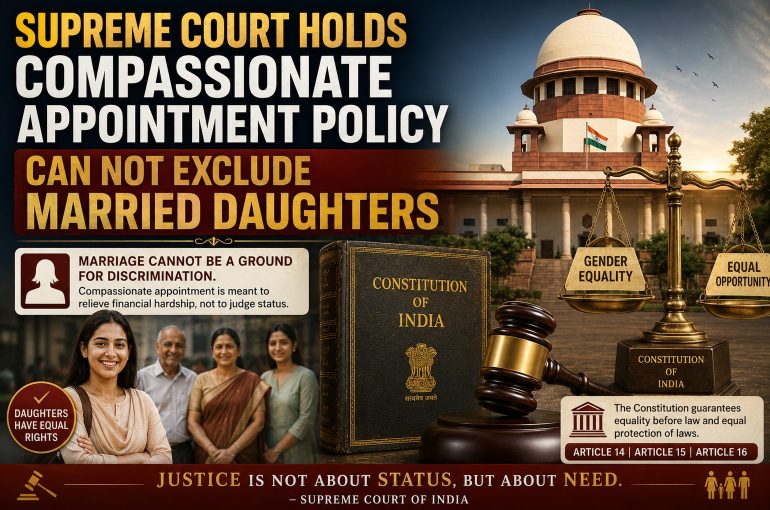
SUPREME COURT HOLDS COMPASSIONATE APPOINTMENT POLICY CAN NOT EXCLUDE MARRIED DAUGHTERS

INTRODUCTION
The Hon’ble Supreme Court of India recently tackled a crucial question regarding gender equality in employment policies. In Sayara Khatoon @ Shayara Khatoon & Anr. v. The State of Bihar & Ors., decided on July 23, 2026, a two-judge Bench comprising Hon’ble Justices M.M. Sundresh and Prasanna B. Varale delivered a landmark verdict. The Court made it clear that policies differentiating between sons and daughters for compassionate appointments are unconstitutional. The judgment firmly rejected the outdated societal presumption that a daughter automatically severs ties with her parental family upon marriage.
BRIEF FACTS
At the heart of the dispute was a claim for compassionate appointment by Appellant No. 2, following the death of her father.
The High Court of Judicature at Patna had initially rejected the Appellants’ request for this appointment.
The High Court’s rejection was based on an objection raised by the brother of Appellant No. 1 and a specific policy formulated by the Government of Bihar.
This Bihar government policy, dated December 10, 2014, restricted compassionate appointment eligibility for daughters to only those who are divorced or deserted.
The Appellants argued before the Supreme Court that the brother had previously provided a “no objection certificate,” eliminating the first ground for rejection.
The Appellants also argued that the 2014 policy’s restriction on daughters violates Article 14 of the Constitution of India, 1950.
ISSUES OF LAW
The Apex Court primarily locked its focus onto these pivotal questions:
1.Does a government policy restricting compassionate appointment to only divorced or deserted daughters violate constitutional principles?
2.Is there any valid legal presumption that a daughter ceases to be a part of her parental family after marriage?
ANALYSIS OF THE JUDGMENT
Taking a sharp stance against discriminatory state policies, the Supreme Court laid down several hard-hitting observations:
1.Gender Discrimination is Unconstitutional: The Supreme Court reiterated its established stance that any classification differentiating a daughter from a son is, per se, unconstitutional. The Court found that the Bihar government’s policy restricting eligibility exclusively to divorced or deserted daughters cannot be sustained in the eye of the law.
2.Rejection of Societal Presumptions: The State attempted to defend the policy by arguing that a daughter is ordinarily expected to leave her parental home upon marriage. The Court firmly struck down this rationale, stating that there cannot be a legal presumption that a daughter severs ties with her parental family to reside with her husband in her matrimonial home after marriage.
3.Consideration of Ground Realities: The Court took note of the specific facts of the case, highlighting that the Appellant stated she had been living with her parental family and had the support of her entire family, including her mother and brother, even though her divorce was not formally recognized by law. Furthermore, the Court acknowledged that the brother’s initial objection no longer survived.
4.Hyper-Technicality Defeats Justice: The Court observed that adopting a hyper-technical approach cannot be a valid ground to deny the consideration of a legitimate claim for compassionate appointment.
CONCLUSION
Finding immense merit in the Appeal, the Hon’ble Supreme Court firmly stepped in to correct the High Court’s misstep. Consequently, the Apex Court set aside the High Court’s impugned Order and the initial rejection of the compassionate appointment claim. The Court directed the Respondent State of Bihar to consider the Appellant’s case for compassionate appointment on its merits within a period of eight weeks from the date of receiving a copy of the order. This verdict sends a powerful message that state employment policies cannot perpetuate archaic patriarchal notions, ensuring that married daughters are not unfairly excluded from compassionate appointment schemes
ANIKET KUMAR PARCHA
Legal Associate
The Indian Lawyer & Allied Services
Editor’s Comments
_______
Sushila Ram Varma
Advocate and Chief Consultant
The Indian Lawyer & Allied Services
Watch our Latest Video. Click on the link below

Leave a Reply