



















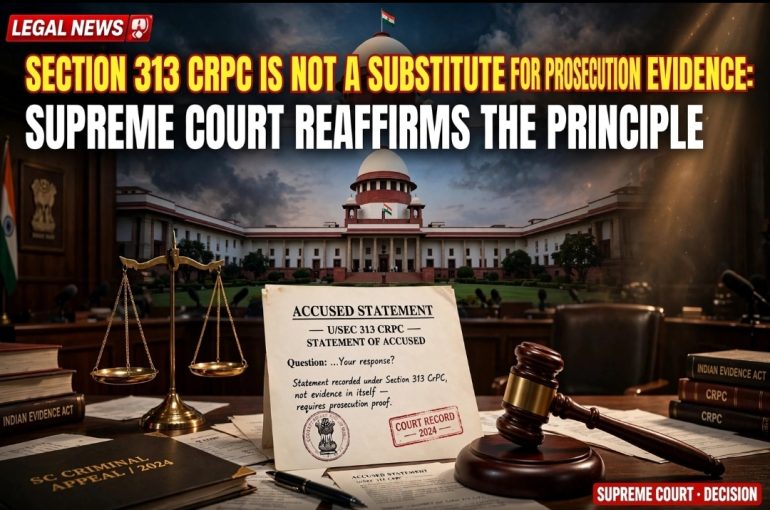
SECTION 313 CRPC IS NOT A SUBSTITUTE FOR PROSECUTION EVIDENCE: SUPREME COURT REAFFIRMS THE PRINCIPLE

INTRODUCTION
Recently, the Hon’ble Supreme Court of India gave a significant ruling which clarifies the fundamental principles of circumstantial evidence and the limits of drawing adverse inferences against an accused under Section 313 of the Code of Criminal Procedure, 1973 (CrPC). In the case of Santosh Gurung v. State of Sikkim (Criminal Appeal No. 107 of 2018), Hon’ble Mr. Justice Ujjal Bhuyan and Hon’ble Mr. Justice Atul S. Chandurkar settled a difficult evidentiary issue concerning incomplete chains of circumstantial evidence on October 1, 2026. The Judgment clearly states that although an Accused’s failure to provide a reasonable explanation in their Section 313 statement can act as an additional link, it cannot be used to fill the gaps left by the Prosecution or serve as a substitute for substantive evidence. This decision acts as a firm warning that convictions cannot be sustained on conjectures or when foundational circumstances are not conclusively proven.
BRIEF FACTS
The disagreement began when a minor girl was reported missing on November 6, 2013, after allegedly accompanying her maternal uncle (Appellant) to purchase vegetables. A Missing Report was filed on November 12, 2013, but the Appellant was traced much later in Siliguri. Following his arrest, the police registered a First Information Report on May 13, 2014, charging him with raping and murdering the victim. The Prosecution relied entirely on circumstantial evidence, particularly the “last seen” theory and the recovery of bones and articles based on the Appellant’s disclosure statement under Section 27 of the Evidence Act. Despite glaring forensic discrepancies such as the DNA report indicating the recovered bones were of human male origin and did not match the victim’s family, the Sessions Court convicted the Appellant on April 20, 2016, sentencing him to life imprisonment. The High Court of Sikkim later upheld this conviction. Since the circumstantial evidence was doubtful, the case was taken to the Supreme Court.
ISSUES OF LAW
The Supreme Court’s evaluation centered on fundamental principles of criminal jurisprudence:
- Whether the prosecution successfully established a complete chain of circumstantial evidence, particularly regarding the “last seen” theory and forensic discoveries, to conclusively prove the guilt of the accused beyond a reasonable doubt?
- Whether an accused’s silence or failure to offer a proper explanation under Section 313 of the Code of Criminal Procedure can be used as a substantive basis for conviction when the primary chain of circumstantial evidence is broken and incomplete?
ANALYSIS OF THE JUDGMENT
The Supreme Court took a decisive stance against convicting an accused on incomplete circumstantial evidence, laying down the following significant observations:
- The Break in the Last Seen Theory: The Court noted that the “last seen” theory requires the time gap to be so small that it excludes any possibility of another person committing the crime. Here, witnesses were uncertain if the Appellant and Victim left together and there was a massive six-month gap between the Victim going missing and the discovery of the remains, rendering the theory unsafe.
- Unreliable Recoveries in Public Spaces:The Court highlighted a critical issue with the evidence recovered at the Appellant’s instance. The recovery spot was an area frequently visited by cattle herders and fodder collectors. While an accessible place does not automatically vitiate evidence, the fact that it was ordinarily visible required the recovery to be examined with extreme caution.
- Contradictory Forensic and DNA Evidence: The Bench noted that the scientific evidence actively contradicted the Prosecution’s case. The DNA report confirmed that the recovered bones were of male origin, whereas the victim was a female and the forensic lab could not ascertain the origin of blood found on the recovered shawl.
- The Limited Role of Section 313 Statements: Setting aside the lower courts’ reliance on the appellant’s lack of explanation, the Supreme Court clarified the law regarding Section 313 of the CrPC. An accused’s silence or failure to explain can only act as an additional link when the primary incriminating circumstances stand fully established. It cannot shift the burden of proof or substitute the substantive evidence that the Prosecution failed to bring on record.
CONCLUSION
Concluding that the mechanical acceptance of circumstantial evidence could disproportionately harm an accused, the Supreme Court struck down the lower courts’ rigid approach.
ANIKET KUMAR PARCHA
Legal Associate
The Indian Lawyer & Allied Services
EDITOR’S COMMENT
In the above judgment the Court after considering all facts and noticing the grave discrepancies and gaps in the evidence upheld the principle that suspicion, however grave, cannot take the place of legal proof. It further ruled that while an accused has a duty to explain incriminating facts under Section 313, this duty arises only after the Prosecution proves a complete chain of circumstances. This Judgment stands as a robust precedent reinforcing criminal law’s true objective: ensuring that guilt is proved beyond a reasonable doubt and that convictions are not based on broken chains of circumstantial evidence.
SUSHILA RAM VARMA
Advocate & Chief Consultant
The Indian Lawyer & Allied Services
Watch our latest video

Leave a Reply