



















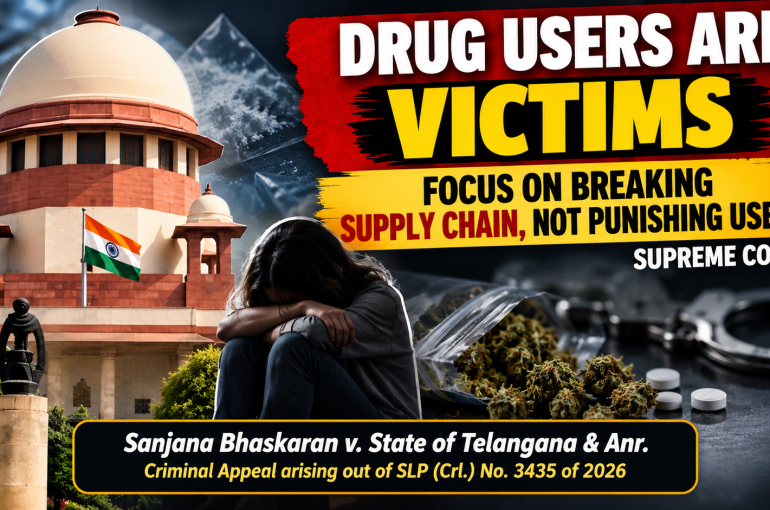
DRUG USERS ARE VICTIMS, NOT THE REAL TARGET: SUPREME COURT SAYS FOCUS MUST BE ON BREAKING THE SUPPLY CHAIN RATHER THAN PUNISHING USERS

INTRODUCTION
In Sanjana Bhaskaran v. State of Telangana & Anr., Criminal Appeal arising out of SLP (Crl.) No. 3435 of 2026, the Supreme Court of India delivered an important Order on 9 October 2026, emphasising the need for a more sensitive approach towards individuals caught in drug-related cases. The Bench comprising Justice J.B. Pardiwala and Justice K. Vinod Chandran observed that drug users may themselves be victims of the narcotics supply chain and that the focus of law enforcement should be on curbing the availability of drugs and dismantling that chain, rather than merely punishing the end user.
The Order highlights the consequences of prosecuting individuals where the evidence of their involvement is doubtful. It also raises an important question about the purpose of criminal justice: whether punishment alone can address drug use or whether enforcement must focus on those responsible for supplying narcotics.
BRIEF FACTS
The Appellant was arrayed as the Fourth Accused in a case registered under the Narcotic Drugs and Psychotropic Substances Act, 1985 (NDPS Act). The Prosecution alleged that she had received a packet containing dried leaves and buds, subsequently identified as marijuana, from two Co-Accused persons near an educational institution.
The Police had received information that two individuals were coming to sell marijuana near a college. A police team, accompanied by independent witnesses, reached the location and kept watch. When the two individuals arrived on a scooter, the Appellant allegedly approached them, received a cover and placed it in her bag. The police apprehended all three persons.
The two alleged sellers were found with a substantially larger quantity of marijuana, and the Co-Accused disclosed the identity of their alleged supplier. The Appellant also tested positive for marijuana use.
However, the Supreme Court noted that, according to the Police Officers’ own statements, no contraband had been recovered from the Appellant or from the bag she was carrying. The Prosecution case against her rested substantially on the statements attributed to the Co-Accused and her own alleged confession.
ISSUES OF LAW
The principal question was whether the Appellant’s prosecution under the NDPS Act could continue when no contraband had been recovered from her and the allegations concerning her involvement rested on the statements of the Co-Accused and her alleged confession.
The Court also considered whether prosecuting an alleged drug user in such circumstances served any useful purpose, particularly when the broader objective should be to curb the supply and availability of narcotics.
ANALYSIS OF THE JUDGMENT
The Supreme Court examined the circumstances surrounding the alleged recovery and expressed concern over the manner in which the Police had proceeded. It observed that, when the Police saw the Appellant placing the cover in her bag, she should have been informed of her right to be searched before a Magistrate, following which the search could have been conducted with her consent.
The Court further noted that the allegation that the Appellant had voluntarily produced the cover raised doubts about whether she was aware that it contained contraband. The absence of any recovery from her and the reliance on the statements attributed to the Co-Accused and the Appellant weighed against continuing the prosecution.
The Court then made a broader observation about the treatment of drug users within the criminal justice system. It described the Appellant as being, in one sense, a victim at the end of the supply chain. According to the Court, prosecuting such individuals and keeping them in custody pending trial could have adverse consequences, including the possibility of their developing prison associations that might draw them further into the narcotics supply chain.
The Court observed that “Curbing availability and breaking the supply chain shall be the focus and not merely punishing the user, who is actually the victim.”
This observation reflects the distinction between targeting the supply of narcotics and prosecuting an individual whose alleged involvement is not supported by sufficient evidence. The Court did not hold that every drug user is immune from prosecution. Rather, its reasoning was grounded in the particular facts of the Appellant’s case and the absence of convincing evidence of conscious possession.
The Supreme Court accordingly quashed the Appellant’s arraignment in the Sessions Case. It also declined to subject her to a de-addiction process, finding no complicity on her part in the alleged conscious possession of narcotics. The Court clarified that it had not examined the cases against the other Accused Persons.
SARTHAK KALRA
Senior Legal Associate
The Indian Lawyer & Allied Services
EDITOR’S COMMENTS
The decision in Sanjana Bhaskaran is significant for its emphasis on a sensitive and evidence-based approach to drug-related offences. It draws attention to the risks of treating an alleged user in the same manner as those engaged in supplying narcotics, particularly where the evidence of conscious possession is doubtful.
The Supreme Court’s observations underline that effective enforcement requires more than prosecuting the person found at the end of the supply chain. Preventing the availability of drugs and identifying those responsible for their distribution must remain central objectives.
The Judgment does not dilute the NDPS Act or establish a general exemption for drug users. Instead, it reinforces the need to assess each case on its own facts, respect procedural safeguards and ensure that criminal prosecution serves a legitimate purpose rather than causing avoidable harm.
SUSHILA RAM VARMA
Advocate & Chief Consultant
The Indian Lawyer & Allied Services
Please log onto our YouTube channel, The Indian Lawyer Legal Tips, to learn about various aspects of the law. Our latest Video, titled “Alert video ⚠️ What Happens Before FIR? | Know Your Rights” can be viewed at the link below:
https://www.youtube.com/watch?v=ZpfYspZoY28

Leave a Reply