



















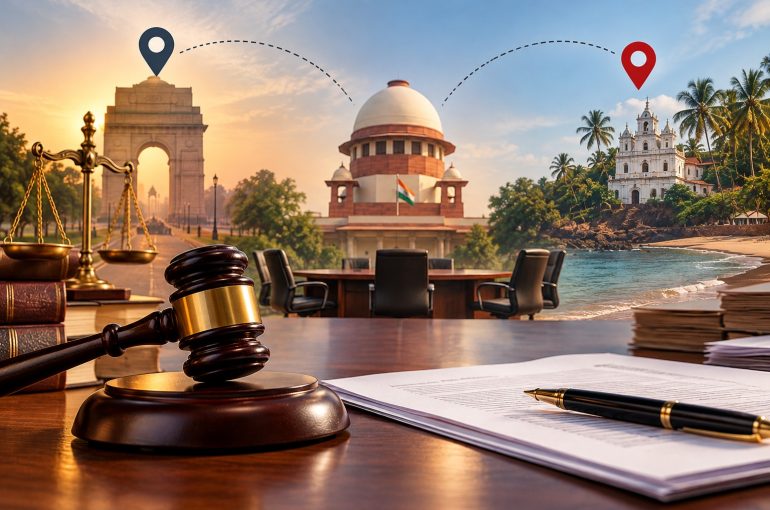
SUPREME COURT EXPLAINS DIFFERENCE BETWEEN VENUE OF ARBITRATION AND JURIDICAL SEAT

INTRODUCTION
In Arcis Clean Energy Pvt. Ltd. v. Parashva Innovation, 2026 INSC 1109, decided on 12 October 2026, the Supreme Court of India, comprising Justice Manoj Misra and Vijay Bishnoi, examined that the distinction between the seat and venue of arbitration may appear technical, but it can determine which court has the authority to supervise arbitral proceedings.
The Judgment addresses the interpretation of contractual clauses referring to different locations for Arbitration and the significance of an exclusive jurisdiction clause. It reiterates that determining the juridical seat requires a comprehensive reading of the agreement rather than reliance upon a single provision. The ruling is particularly relevant to commercial contracting, where uncertainty regarding the seat may lead to avoidable jurisdictional disputes.
BRIEF FACTS
The dispute arose from a Franchise Agreement dated 3 August 2023 between Arcis Clean Energy Pvt. Ltd. and Parshva Innovation. Clause 32 provided for the resolution of disputes through negotiation, followed by Arbitration if settlement could not be achieved within thirty days of notice. However, Clauses 32.4 and 32.5 referred to different locations for Arbitration. Clause 32.4 mentioned Delhi as the location of Arbitration, while Clause 32.5 stated that the arbitration proceedings would be held in Goa. Further, Clause 38 conferred exclusive jurisdiction upon competent courts in Goa.
On 25 March 2025, Parshva Innovation proposed the appointment of a Sole Arbitrator. Arcis Clean Energy rejected the proposal on 19 April 2025, after which the Respondent approached the Delhi High Court under Section 11(6)[1](Appointment of Arbitrators) of the Arbitration and Conciliation Act, 1996.
The High Court appointed an Arbitrator on 11 November 2025. Challenging this Order, the Appellant argued that Goa was the juridical seat and the Delhi High Court lacked jurisdiction. The Respondent maintained that Delhi was the intended seat because the arbitration clause 32.4 expressly referred to it.
ISSUES OF LAW
- Whether the Delhi High Court had jurisdiction to appoint an Arbitrator under Section 11(6) of the Arbitration and Conciliation Act, 1996.
- Whether the place mentioned for conducting arbitration necessarily constitutes its juridical seat.
- Whether an exclusive jurisdiction clause in the main Agreement can assist in determining the seat when the arbitration clause mentions multiple locations.
ANALYSIS OF THE JUDGMENT
The Court reiterated that the juridical seat and the venue of arbitration serve different purposes. The seat determines the courts exercising supervisory jurisdiction over arbitral proceedings, whereas the venue may merely identify where hearings take place. Relying upon Indus Mobile Distribution Private Limited v. Datawind Innovations Private Limited and Swastik Gases (P) Ltd. v. Indian Oil Corporation Ltd., the Court emphasized that the designation of a place does not automatically make it the juridical seat.
The Court considered Arif Azim Company Limited v. Micromax Informatics FZE, which followed the principles in BGS SGS SOMA JV v. NHPC Limited. These decisions establish that a venue may be treated as the seat when only one place is designated, the proceedings are anchored to that place and no significant contrary indication suggests otherwise.
In the present case, both Delhi and Goa appeared in the Arbitration Clause. Delhi, therefore, could not automatically be treated as the juridical seat. The Court had to examine the other contractual provisions to identify the Parties’ intention.
The decisive factor was the combined effect of Clauses 32.4, 32.5 and 38. While Clause 32.4 mentioned Delhi, Clause 32.5 specified Goa and Clause 38 expressly conferred exclusive jurisdiction upon courts in Goa. The Court read these provisions together rather than allowing one clause to override the others. It concluded that Goa was intended to be the juridical seat, while Delhi was merely a venue.
The Court also relied upon Mankastu Impex (P) Ltd. v. Airvisual Ltd., observing that the expression “place of arbitration” alone does not conclusively establish the seat. The Parties’ intention must be gathered from the Agreement as a whole.
The Court held that Clause 38 remained relevant in determining the seat of Arbitration, as the Arbitration Clause mentioned both Delhi and Goa. Accordingly, it set aside the Delhi High Court Order, holding that Goa was the juridical seat and permitting the parties to approach the competent High Court.
CONCLUSION
The Judgment in Arcis Clean Energy Pvt. Ltd. v. Parshva Innovation highlights how contractual wording can determine the judicial authority responsible for supervising arbitration. By identifying Goa as the juridical seat and Delhi as the venue, the Supreme Court reaffirmed the importance of interpreting contractual provisions collectively.
The decision offers a practical lesson for lawyers and commercial parties that the Arbitration Clauses should clearly distinguish the seat from the venue and remain consistent with Jurisdiction Clauses elsewhere in the Agreement.
Ultimately, the Judgment demonstrates that the place where a dispute is heard is not necessarily the place whose courts possess the authority to oversee it. Precision in drafting is therefore essential to preventing jurisdictional uncertainty and preserving arbitration as an effective mechanism for dispute resolution.
TRISHMA KASHYAP
Legal Associate
The Indian Lawyer & Allied Services
Please log onto our YouTube channel, The Indian Lawyer Legal Tips, to learn about various aspects of the law. Our latest Video, titled “Alert video ⚠️ What Happens Before FIR? | Know Your Rights” can be viewed at the link below:
https://www.youtube.com/watch?v=ZpfYspZoY28
[1] Where, under an appointment procedure agreed upon by the parties.(a)a party fails to act as required under that procedure; or(b)the parties, or the two appointed arbitrators, fail to reach an agreement expected of them under that procedure; or(c)a person, including an institution, fails to perform any function entrusted to him or it under that procedure, a [the appointment shall be made, on an application of the party, by the arbitral institution designated by the Supreme Court, in case of international commercial arbitration, or by the High Court, in case of arbitrations other than international commercial arbitration, as the case may be] [Substituted by Act No. 33 of 2019, dated 9.8.2019.] to take the necessary measure, unless the agreement on the appointment procedure provides other means for securing the appointment.

Leave a Reply