



















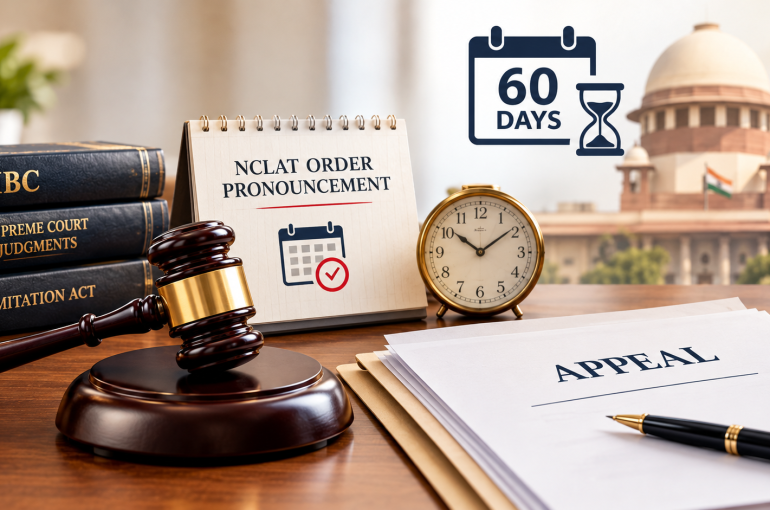
LIMITATION FOR A SECTION 62 IBC APPEAL STARS FROM PRONOUNCEMENT OF NCLAT ORDER, NOT FROM RECEIPT OF CERTIFIED COPY

Introduction
On 14 October 2026, a Bench of Justice S.V.N. Bhatti and Justice N.V. Anjaria of the Supreme Court held that the limitation period for an appeal under Section 62 of the Insolvency and Bankruptcy Code, 2016 (“IBC”) begins on the date the National Company Law Appellate Tribunal (“NCLAT”) pronounces its order. It does not begin on the date the appellant receives the certified copy. The Court also clarified how far Section 12(2) of the Limitation Act, 1963 helps a litigant who waits before applying for that copy.
Statutory Framework
Section 62 of the IBC provides for an appeal to the Supreme Court on a question of law arising from an NCLAT order. The statutory period is 45 days and the Supreme Court may permit a further 15 days where sufficient cause is shown. The outer limit is therefore 60 days. Section 12(2) of the Limitation Act, 1963 excludes the time requisite for obtaining a copy of the order appealed against when computing limitation.
Factual Background
The Revenue challenged an NCLAT order before the Supreme Court. It applied for a certified copy of the Order on 6 September 2023 and received it on 11 October 2023. The Appeal was filed on 21 November 2023. The Revenue argued that limitation should be reckoned from the date it received the Certified Copy, which would have placed the Appeal within time.
Reasoning of the Court
The Court rejected this contention. It held that the expression “date of receipt of the order” in Section 62(1) cannot mean the date on which a party chooses to apply for and collect a certified copy. If limitation stayed suspended until a litigant collected the copy, the period would become fluctuating and indefinite and the choice of when to start the clock would rest with the appellant.
The Court observed that the Revenue’s reading would nullify both the 45-day period and the 15-day condonable period and would make the right of appeal depend on an uncertain duration. Such a result is inconsistent with the structure of the IBC, which is built around strict timelines.
The Court relied on its earlier decisions in V. Nagarajan v. SKS Ispat and Power Limited and CA Ramchandra Dallaram Choudhary v. Adani Infrastructure and Developers Private Limited, 2026 LiveLaw (SC) 611, which held that limitation under Section 61 of the IBC runs from the date of pronouncement.
The Court drew a distinction under Section 12(2) of the Limitation Act. The time spent in applying for and obtaining the certified copy can be excluded. The period of inaction before the application is made cannot be excluded. A litigant who waits before applying for the copy bears the consequence of that wait.
Computation in the Present Case
Applying these principles, the Court worked out the position as follows:
| Period | Days |
| Elapsed before applying for the certified copy (counted) | 35 |
| Registry time to supply the certified copy, 6 Sept to 11 Oct 2023 (excluded) | 35 |
| Elapsed after receiving the copy, 11 Oct to 21 Nov 2023 (counted) | 41 |
| Total counted period | 76 |
| Absolute ceiling under Section 62 (45 + 15) | 60 |
| Delay beyond the ceiling | 16 |
Although the 35 days taken by the Registry to supply the copy were excluded, the Revenue had let 35 days pass before applying. It was left with only 10 days of the original 45-day period when it received the copy and a maximum of 15 further days that could be condoned, making 25 days in all. The Appeal, filed 41 days after receipt, fell 16 days beyond the absolute ceiling of 60 days. It was dismissed as barred by limitation.
Practical Implications
The decision carries several lessons for litigants and counsel in IBC matters:
- Limitation must be calendared from the date of pronouncement of the NCLAT order, not from the date the certified copy is received.
- The application for the certified copy should be made immediately. Each day before the application is counted against the appellant and only the time the Registry requires to supply the copy is excluded.
- The 60-day outer limit under Section 62 cannot be extended. The Court has no jurisdiction to condone delay beyond the 15 days permitted by the statute, so every day of delay matters when the margin is thin.
- Preparation of the appeal should proceed in parallel with the application for the certified copy, so that the appeal can be filed promptly once the copy is available.
Shomdeepta Chanda
Associate
The Indian Lawyer & Allied Services
Editor’s Comment
The judgment reaffirms that the IBC’s emphasis on time-bound resolution extends to the appellate stage. By tying the start of limitation to pronouncement and confining Section 12(2) to the time actually needed to obtain the copy, the Court has removed the scope for a litigant to postpone the limitation clock by delaying the application. Appeals filed on the footing that limitation begins on receipt of the certified copy now carry a serious risk of dismissal in matters pertaining to IBC as the Supreme Court has emphatically stated that IBC proceedings are time bound in nature and if the court allows the appellant to take advantage of his delay in procuring a certified copy, the said will not be entertained.
Sushila Ram Varma
Advocate & Chief Consultant
The Indian Lawyer & Allied Services
Please log onto our YouTube channel, The Indian Lawyer Legal Tips, to learn about
various aspects of the law. Our latest Video, titled “Alert video ⚠️ What Happens Before FIR? | Know Your Rights” can be viewed at the
link below:

Leave a Reply