



















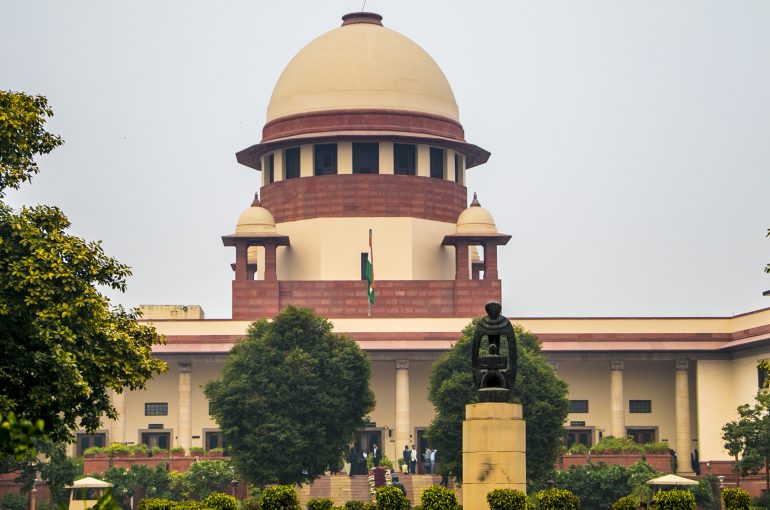
CHILD TRAFFICKING| SUPREME COURT LAYS DOWN GUIDELINES TO EVALUATE EVIDENCE OF VICTIMS

Introduction
The Supreme Court of India’s Judgment in K.P. Kirankumar @ Kiran v. State by Peenya Police, (Criminal Appeal arising out of SLP (Crl.) No. 11287 of 2025) is a significant pronouncement on child trafficking and commercial sexual exploitation. The Two Judge Bench comprising Hon’ble Mr. Justice Joymalya Bagchi and Hon’ble Mr. Justice Manoj Misra delivered the Judgment on 19 December 2025. The Court used this case not only to affirm the conviction of the traffickers but also to lay down a victim-centric approach in appreciating the testimony of minor survivors of sexual exploitation.
Factual Background
On 22 November 2010, Peenya Police, Bengaluru, received specific information from NGO workers Tojo and Dominic that minor girls were being confined for prostitution in a rented house at T. Dasarahalli, Peenya. Acting on this tip, the officers organized a raid, and sent NGO worker Jaikar with Manjunath as decoy customers to the premises. Another witness negotiated with the Appellant for sexual access to the minor victim, handed over marked currency notes and then alerted the police officers, who entered with the raiding party and rescued the girl.
On search, police recovered the same currency notes from A‑1, seized a mobile phone and cash from A‑2 (the appellant’s wife) and contraceptives, all of which were documented under a panchnama. An FIR was registered at Peenya Police Station under Sections 366A, 372, 373 and 34 of the Indian Penal Code (IPC), read with Sections 3, 4, 5, 6 and 9 of the Immoral Traffic (Prevention) Act, 1956 (ITPA) and a chargesheet followed under the same provisions (except Section 9 ITPA).
Both the Trial Court and the High Court had convicted Appellants under Sections 366A, 373 and 34 IPC read with Sections 3, 4, 5 and 6 ITPA and the High Court had refused to interfere with sentence, finding no mitigating circumstances.
Court’s Decision
The Supreme Court affirmed these concurrent findings, holding that the evidence of the Victim was cogent, credible and substantially corroborated and that the minor inconsistencies highlighted by the Defence did not dent the core prosecution case. The Court emphasized that, in trafficking cases, victims often come from socio‑economically vulnerable backgrounds and are trapped within complex, layered networks of organized crime, making linear, perfectly consistent narratives practically impossible.
Justice Bagchi laid down guidelines for appreciating the testimony of minor trafficking victims, highlighting their vulnerability, the diffused structure of trafficking networks and the phenomenon of second victimisation when recounting abuse before authorities. Drawing from State of Punjab v. Gurmit Singh (1996) 2 SCC 384, the Court reiterated that if the victim’s evidence inspires confidence, courts should not insist on corroboration or discard it for minor discrepancies. The Court also accepted the school certificate recording the victim’s date of birth as 24 April 1994 and relying on Jarnail Singh v. State of Haryana (2013) 7 SCC 263, held that school records under Rule 12 of the JJ Rules have greater probative value than ossification tests for determining minority.
On Section 15(2) ITPA, the Court referred to Bai Radha v. State of Gujarat (1969) 1 SCC 43 and held that non‑strict compliance with the search procedure is an irregularity, not illegality, unless it results in failure of justice. In the present case, the presence of PW‑8, PW‑12, and the landlord’s wife (PW‑14, though hostile at trial) as witnesses to the search was treated as substantial compliance with the statutory requirement. Finding the chain of evidence complete, the Supreme Court upheld the conviction and sentence, dismissing the Appeal.
Conclusion
This Judgment stands out as a robust affirmation of a victim‑centric approach in trafficking and sexual exploitation cases, particularly where the survivor is a minor. By explicitly recognizing socio‑economic vulnerability, the psychological impact of sexual exploitation and the realities of organized crime, the Court moved decisively away from rigid, hyper‑technical evidentiary expectations that have historically disadvantaged survivors.
Equally important is the Court’s insistence that procedural safeguards under special statutes like ITPA must be applied to advance, not frustrate, the statute’s protective purpose and that technical lapses cannot be weaponized to shield traffickers. This Judgment thus reinforces India’s constitutional promise to protect children from exploitation and provides clear guidelines to trial courts on handling evidence, age determination and procedural objections in trafficking prosecutions.
YASH HARI DIXIT
LEGAL ASSOCIATE
THE INDIAN LAWYER AND ALLIED SERVICES
Please log onto our YouTube channel, The Indian Lawyer Legal Tips, to learn about various aspects of the law. Our latest Video, titled “Child Custody Laws India 2025 | Mother vs Father Rights Explained | Advocate Sushila Ram Varma” can be viewed at the link below:

Leave a Reply