



















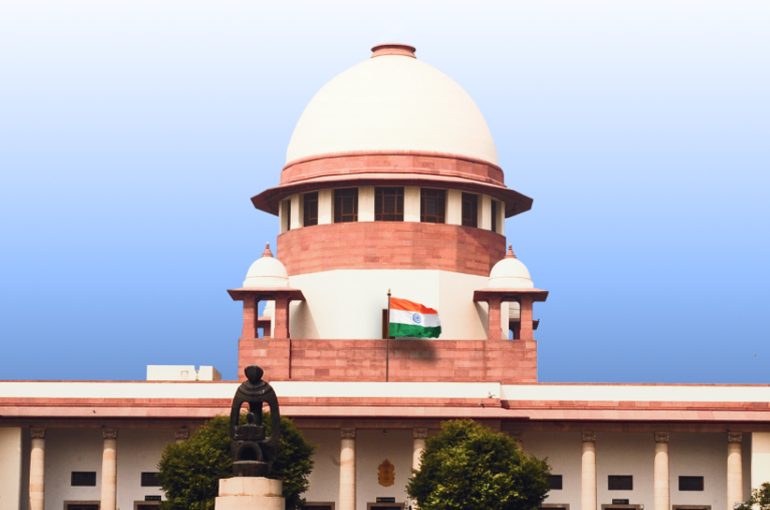
MENSTRUAL HEALTH RECOGNISED AS A FUNDAMENTAL RIGHT BY THE SUPREME COURT

INTRODUCTION
In a significant constitutional adjudication, the Supreme Court of India, by its Judgment dated 20 January 2026, in Dr. Jaya Thakur v. Government of India & Ors., Writ Petition (Civil) No. 1000 of 2022, decisively affirmed that menstrual health and hygiene are integral to the fundamental rights to life, dignity, equality and education. The Judgment was delivered by a Division Bench comprising Justice J.B. Pardiwala and Justice R. Mahadevan.
The Court held that the absence of gender-segregated toilets and access to menstrual hygiene management (MHM) measures constitutes a constitutional barrier to education, particularly for adolescent girls and violates Articles 14, 21 and 21A of the Constitution
BRIEF FACTS
The Writ Petition was filed by Dr. Jaya Thakur, a social worker, invoking Article 32 of the Constitution in public interest. The Petition sought directions to the Union of India, States and Union Territories to:
• Provide free sanitary pads to all girls studying between Classes VI to XII;
• Ensure separate and functional toilets for girls in government aided and residential schools;
• Provide adequate sanitation staff for maintenance of toilets; and
• Implement structured awareness programmes to destigmatize menstruation and promote menstrual hygiene.
The Petitioner highlighted that lack of menstrual hygiene infrastructure leads to absenteeism and school dropouts, thereby undermining the right to education of girl children, especially those from socio-economically disadvantaged backgrounds
ISSUES OF LAW
The Supreme Court framed, inter alia, the following key constitutional questions:
1) Whether the non-availability of gender-segregated toilets and menstrual absorbents violates Article 14 by denying equality to adolescent girls?
2) Whether the right to dignified menstrual health forms part of Article 21?
3) Whether lack of menstrual hygiene facilities impairs the right to participation and equality of opportunity under Article 14?
4) Whether such deprivation violates the right to education under Article 21A and the Right of Children to Free and Compulsory Education Act, 2009?
ANALYSIS OF THE JUDGMENT
Menstrual Health as a Component of Human Dignity under Article 21
The Court unequivocally held that menstrual health is inseparable from the right to live with dignity. Drawing from constitutional morality and international human rights norms, it observed that dignity cannot be reduced to mere survival but must include conditions enabling privacy, bodily autonomy and self-respect during menstruation.
The Bench emphasized that compelling a girl child to attend school without safe menstrual facilities forces her to choose between education and dignity, which is constitutionally impermissible
Substantive Equality under Article 14
Rejecting a purely formal notion of equality, the Court adopted a substantive equality framework. It held that menstruation creates a gender-specific disadvantage and treating all students alike without addressing this reality perpetuates discrimination.
The Judgment clarified that affirmative state action is constitutionally mandated where structural barriers impede the effective enjoyment of rights. Denial of menstrual hygiene facilities disproportionately impacts adolescent girls and therefore violates Article 14.
Right to Education under Articles 21 and 21A
The Court reaffirmed that the right to education is not satisfied by mere enrolment. Meaningful access requires conditions that enable regular attendance and participation. Evidence placed before the Court demonstrated that lack of MHM facilities directly contributes to absenteeism and school dropouts.
Importantly, the Court held that menstrual hygiene management constitutes a financial and infrastructural barrier within the meaning of Sections 3 and 19 of the RTE Act. Accordingly, provision of such facilities is not discretionary but forms part of the mandatory “norms and standards” for schools
Intersectionality and Vulnerability
The Judgment accords special attention to girls with disabilities, recognizing that the intersection of gender and disability compounds exclusion. The absence of accessible toilets and sanitation facilities results in systemic exclusion from education, aggravating social and economic marginalization.
The Court stressed that constitutional guarantees must be interpreted through an intersectional lens, ensuring that no child is left behind due to layered vulnerabilities.
CONCLUSION
The decision in Dr. Jaya Thakur v. Government of India marks a transformative moment in Indian constitutional jurisprudence, where menstruation is finally acknowledged not as a private inconvenience but as a constitutional concern. By locating menstrual health within Articles 14, 21 and 21A, the Supreme Court has affirmed that education cannot be detached from dignity, equality and bodily autonomy.
The Judgment sends a clear message: a lack of menstrual hygiene infrastructure is not an administrative lapse but a constitutional violation. In doing so, the Court ensures that menstruation ceases to be a reason for exclusion and that a period truly ends a sentence; not a girl’s education.
SUSHILA RAM VARMA
Advocate & Chief Consultant
The Indian Lawyer & Allied Services
Please log onto our YouTube channel, The Indian Lawyer Legal Tips, to learn about various aspects of the law. Our latest Video, titled “Understanding SARFAESI Act | Rights of Borrowers 2025, DRT, Supreme Court Judgments” can be viewed at the link below:

Leave a Reply