



















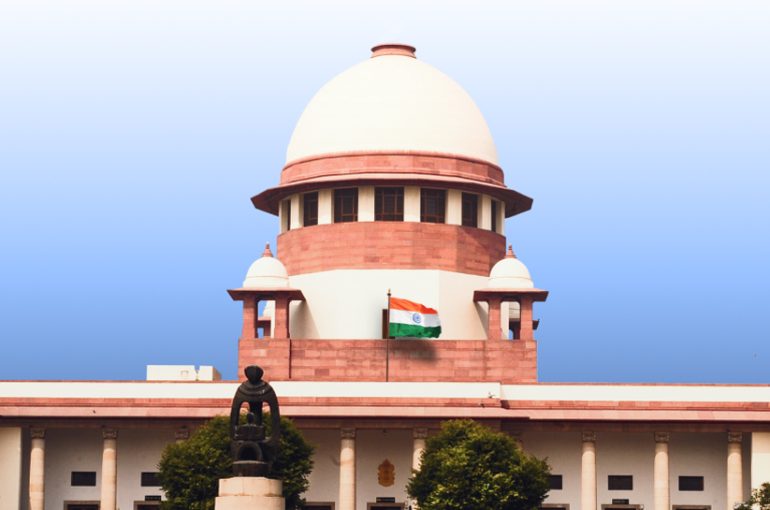
POSH ACT | SUPREME COURT HOLDS WOMAN CAN APPROACH ICC OF HER DEPARTMENT AGAINST HARASSMENT BY EMPLOYEE OF ANOTHER WORKPLACE

Introduction
The Supreme Court of India delivered a significant decision in Dr. Sohail Malik v. Union of India & Another, (Civil Appeal No. 404 of 2024), on 10th December 2025. The Bench consisted of Justice J.K. Maheshwari and Justice Vijay Bishnoi and the Judgment addressed whether an Internal Complaints Committee (ICC) constituted in one government department can investigate sexual harassment allegations against an employee working in another department under the Sexual Harassment of Women at Workplace (Prevention, Prohibition and Redressal) Act, 2013 (POSH Act).
Factual Background
The controversy arose from an incident on 15 May 2023 at Krishi Bhawan, New Delhi, where Dr. Sohail Malik, a 2010-batch IRS officer posted as OSD (Investigation), CBDT, was alleged to have sexually harassed a 2004-batch IAS officer serving as Joint Secretary in the Department of Food and Public Distribution. The aggrieved officer lodged FIR No. 53/2023 on 16 May 2023 under Sections 354, 354D, 506 and 509 IPC, with a later chargesheet including Sections 201, 204 IPC and Section 67 of the IT Act, 2000. In parallel, she filed a complaint under Section 9 of the POSH Act before the ICC constituted in her department on 24 May 2023, leading to a notice dated 13 June 2023 summoning the Appellant for hearing on 22 June 2023. The Appellant challenged this before the Central Administrative Tribunal (CAT), which dismissed his plea; the Delhi High Court upheld the CAT’s order, resulting in the present Civil Appeal before the Supreme Court.
Court’s Decision
The Supreme Court dismissed the Appeal and upheld the jurisdiction of the ICC constituted at the aggrieved woman’s workplace to inquire into the complaint. The Court framed, inter alia, the issues whether such ICC can investigate a complaint against an officer of another department and whether the words “where the respondent is an employee” in Section 11 mandate that proceedings be held only at the Respondent’s workplace.
Textual and Contextual Interpretation
Examining Section 11(1), the Court held that the term “where” is used in a conditional sense (“if” or “whenever”) and not as a reference to place or location. Section 11(1), read as a whole, delineates different procedural routes depending on whether the Respondent is an employee governed by service rules, a person without service rules or a domestic worker whose case is to be forwarded to the police and does not create a territorial or departmental bar on ICC jurisdiction. The Court reiterated that a provision must be construed as an integrated whole and not by isolating a single phrase, relying on established principles that text and context must both guide interpretation, especially in social welfare legislation. It therefore rejected the Appellant’s attempt to derive a jurisdictional limitation from a conditional expression meant only to trigger the appropriate procedural regime.
Purposive Approach and the POSH Framework
Drawing on precedents such as Vishaka, Medha Kotwal Lele and later interpretive decisions, the Court underscored that the POSH Act is a rights-based, remedial statute meant to operationalise constitutional guarantees of equality, non-discrimination and dignity for women at the workplace. A construction which forces a Complainant to pursue proceedings only in the Respondent’s department, often unfamiliar and structurally distant, would raise barriers to reporting and undermine the preventive and redressal objectives of the Act. The Court noted that the wide definition of “workplace” in Section 2(o), particularly clause (v) regarding any place visited in the course of employment, supports inquiries being conducted where the incident occurs and where the woman works. It further held that Section 13(3) expressly contemplates that the ICC may recommend action to the “employer or the District Officer”, thereby accommodating situations where the Complainant’s ICC in one establishment makes findings that must be acted upon by another employer controlling the Respondent.
Two-Stage Inquiry and Employer Cooperation
The Judgment harmonised POSH procedures with civil service disciplinary rules by recognising a two-stage model: the ICC at the Complainant’s workplace conducts the statutory inquiry under the POSH Act, while the Respondent’s employer later initiates disciplinary action under applicable service rules based on the ICC’s report. Thus, the fact-finding and assessment of sexual harassment are anchored where the incident occurred, but employment consequences are imposed by the department with disciplinary control over the respondent. The Court also stressed the duties under Section 19, especially clauses (d), (f) and (h), which obligate every employer to provide facilities to ICCs, supply information, assist in securing attendance and initiate criminal or disciplinary action where appropriate. In this framework, departments cannot refuse cooperation on the ground that the ICC belongs to another ministry and in the present case, no prejudice to the Appellant from the chosen forum was demonstrated.
Conclusion
This decision constitutes a major clarification of ICC jurisdiction in inter-departmental sexual harassment cases under the POSH Act. By affirming that the ICC at the aggrieved woman’s workplace can validly inquire into complaints even when the Respondent serves in a different department, the Court has ensured that jurisdictional technicalities cannot be used to dilute statutory protections. At the same time, the Court’s recognition of a two-stage mechanism, which is POSH inquiry at the Complainant’s workplace followed by disciplinary action by the Respondent’s employer, preserves the contours of service jurisprudence while advancing gender justice. The ruling will likely guide future cases across government and other organised sectors, reinforcing that workplace safety, access to remedies and institutional cooperation are central to the POSH regime, regardless of departmental boundaries.
YASH HARI DIXIT
ASSOCIATE
THE INDIAN LAWYER AND ALLIED SERVICES
Please log onto our YouTube channel, The Indian Lawyer Legal Tips, to learn about various aspects of the law. Our latest Video, titled “Rights of Husband in False Matrimonial Cases | 498A Misuse | 2025 Judgments Explained|” can be viewed at the link below:
Leave a Reply