



















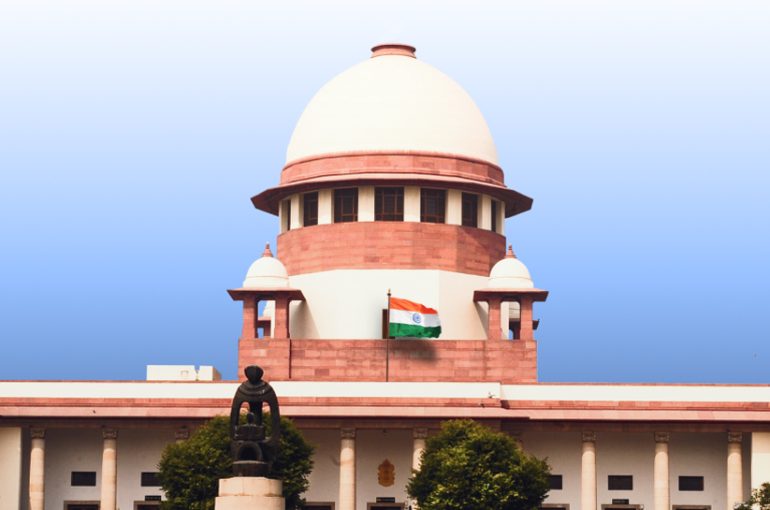
SUPREME COURT HOLDS GOVERNMENT CAN EXCLUDE CANDIDATES WITH HIGHER QUALIFICATION FROM POST REQUIRING LOWER QUALIFICATION

On January 16, 2026, the Supreme Court of India dismissed a batch of appeals challenging the constitutional validity of the Bihar Pharmacists Cadre Rules, 2014 (as amended by the 2024 Amendment Rules). The case titled MD. Firoz Mansuri & Ors. v. The State of Bihar & Ors., SLP (C) No. 12236 of 2025) was heard by a Two Judge Bench comprising Justice Satish Chandra Sharma and Justice M. M. Sundresh. This Judgment represents a significant pronouncement on the intersection of professional regulation, recruitment policy and constitutional law in India.
Factual Background
The dispute emerged from a long-standing controversy regarding eligibility criteria for recruitment to the post of Pharmacist (basic category) in Bihar. In October 2014, the Government of Bihar notified the Bihar Pharmacists Cadre Rules, establishing that the minimum educational qualification for direct recruitment to basic category posts would be Intermediate/10+2 (Science) pass combined with a Diploma in Pharmacy from a government-recognized institution, along with mandatory registration with the Bihar State Pharmacy Council. However, Appendix-I to these Rules contained a note permitting Bachelor of Pharmacy (B.Pharma) and Master of Pharmacy (M.Pharma) degree holders to apply, creating textual ambiguity about whether higher qualifications could substitute for the diploma requirement.
The Pharmacy Council of India subsequently notified the Pharmacy Practice Regulations, 2015, which prescribed Diploma in Pharmacy or Bachelor in Pharmacy as acceptable qualifications for Pharmacists. This central regulation created tension with the Bihar Rules, as both categories of professionals became eligible to practice pharmacy under national guidelines, yet recruitment remained restricted to diploma holders under state rules. When recruitment notifications issued between 2019 and 2023 explicitly restricted applications to diploma holders, numerous B.Pharma and M.Pharma graduates filed writ petitions before the Patna High Court challenging this exclusion.
Contentions of Parties
The Appellant’s primary contention centered on repugnancy: they submitted that Rule 6(1) conflicted with the Pharmacy Act, 1948 and the Pharmacy Practice Regulations, 2015, which both recognize Bachelor and Diploma qualifications as equivalent for professional practice. The Appellants further contended that “minimum qualification” must be interpreted as a threshold below which candidates cannot fall, not as an essential barrier excluding those with higher qualifications. They challenged the Cadre Rules under Articles 14 and 16 of the Constitution, arguing the discrimination lacked any rational basis, particularly when no empirical evidence supported the claim that diploma holders were better suited for hospital pharmacy than degree holders.
The State of Bihar countered that fixing minimum qualifications for recruitment falls within the exclusive domain of the employer and lies outside judicial review unless demonstrably arbitrary. The State emphasized that Diploma and Bachelor courses have fundamentally different structures and objectives: diploma holders undergo 500 hours of compulsory hospital-based practical training (with 250 hours specifically on dispensing), while degree holders receive only 150 hours of optional training. The State contended this justified preferring diploma holders for hospital posts. They argued that degree holders were not excluded absolutely but only required to also possess a diploma, thus creating no violation of fundamental rights.
Court’s Decision
The Supreme Court dismissed the Appeals, upholding the Cadre Rules as constitutionally valid. The Court rejected the repugnancy argument, holding that the Pharmacy Act and Regulations operate in the distinct field of professional regulation and registration, while the Cadre Rules operate in the domain of public employment. The Court noted that whereas the Act creates a pool of eligible professionals, it does not guarantee every registered pharmacist a right to public employment. Section 42 of the Act only prohibits the appointment of unregistered individuals; it does not mandate appointment of all registered categories. Thus, no conflict arises unless the State appoints someone lacking minimum technical qualifications, which it did not.
On the substantive issue of qualification equivalence, the Court reaffirmed established precedent that employers possess exclusive discretion to determine eligibility criteria for public posts. The Court observed that while degree holders may possess higher academic qualifications in abstract terms, the diploma and degree courses are distinct qualifications with different objectives and skill sets. The lateral entry provision does not render degrees “higher qualifications” in the relevant sense; it merely reflects curriculum design. Citing decisions including Jyoti K.K. v. Kerala Public Service Commission (2010) 15 SCC 596, Zahoor Ahmad Rather v. Sheikh Imtiyaz Ahmad (2019) 2 SCC 404 and Puneet Sharma v. HPSEB (2021) 16 SCC 340, the Court stressed that courts cannot substitute their assessment of qualification suitability for the employer’s policy judgment.
The Court further noted that diploma holders face limited employment avenues compared to degree holders, who have access to positions as Assistant Engineers, Executive Engineers and comparable roles unavailable to diploma holders. Thus, the policy preference served a rational purpose of protecting employment opportunities for a comparatively disadvantaged category. The Judgments emphasized that no absolute exclusion applied to degree holders; they remained eligible upon acquiring the essential diploma qualification.
Conclusion
The Judgment represents a definitive pronouncement that recruitment policy lies within the exclusive domain of state employers, subject only to review for arbitrariness or violation of fundamental rights. The decision reinforces that professional regulation through central statutes and employment policy through state rules operate in distinct fields without necessary conflict. The Court validated Bihar’s policy choice to prioritize diploma holders for hospital pharmacy positions based on their specialized training focus and limited employment alternatives. This Judgment will likely influence recruitment policies across states regarding technical and professional cadres, clarifying that higher qualifications do not automatically qualify for posts where specific lower qualifications are prescribed, absent express statutory provisions treating them as equivalent. For aspirants holding degrees but lacking diplomas, the ruling closes judicial recourse and leaves policy recalibration to legislative amendment.
YASH HARI DIXIT
LEGAL ASSOCIATE
THE INDIAN LAWYER AND ALIED SERVICES
Please log onto our YouTube channel, The Indian Lawyer Legal Tips, to learn about various aspects of the law. Our latest Video, titled “Understanding SARFAESI Act | Rights of Borrowers 2025, DRT, Supreme Court Judgments” can be viewed at the link below:

Leave a Reply