



















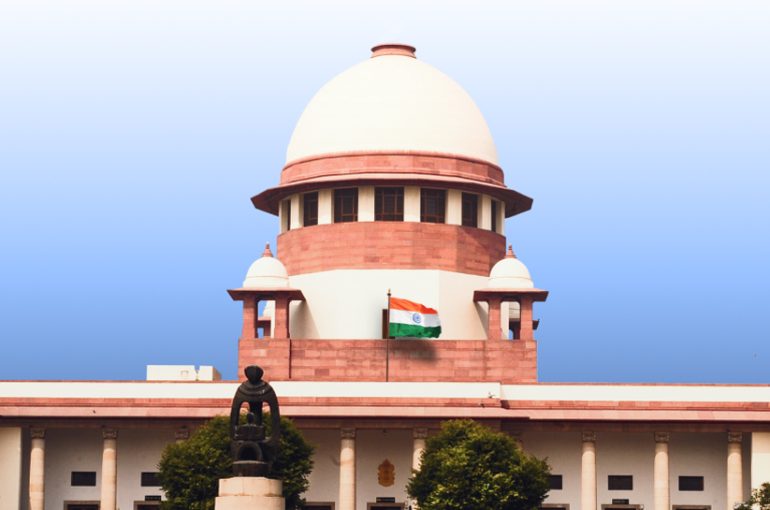
SUPREME COURT HOLDS INQUIRY AND STATES THAT RELIANCE ON A.I GENERATED JUDGEMENTS IS MISCONDUCT

INTRODUCTION
In Gummadi Usha Rani & Anr. v. Sure Mallikarjuna Rao & Anr., SLP (C) No. 7575 of 2026, decided on 27 February 2026, the Supreme Court of India, comprising Justice Pamidighantam Sri Narasimha and Justice Alok Aradhe, expressed serious institutional concern over the use of Artificial Intelligence–generated, non-existent judicial precedents in court orders.
The Court observed that reliance on fabricated or synthetic judgments undermines the integrity of the adjudicatory process and clarified that such conduct, if established, may amount to misconduct rather than a mere adjudicatory error.
BRIEF FACTS
The dispute originated from a Civil Suit for injunction filed by the Respondents. During the pendency of the Suit, the Trial Court appointed an Advocate Commissioner to inspect and record the physical features of the property.
The Petitioners, who were Defendants in the Suit, challenged the Advocate Commissioner’s Report by filing objections. The Trial Court dismissed those objections through an Order dated 19 August 2025, while relying on certain judicial precedents to support its reasoning. These included Subramani v. M. Natarajan (2013) 14 SCC 95, Chidambaram Pillai v. SAL Ramasamy (1071) 2 SCC 68, Lakshmi Devi v. K. Prabha (2006) 5 SCC 551 and Gajanan v. Ramdas (2015) 6 SCC 223.
The Petitioners subsequently contended that the Judgments cited by the Trial Court were non-existent and fabricated. Upon examination, the Andhra Pradesh High Court observed that the cited decisions were Artificial Intelligence-generated and not genuine judicial precedents. While cautioning against such reliance, the High Court nevertheless decided the matter on merits and dismissed the Revision Petition.
Aggrieved by the High Court’s decision, the Petitioners approached the Supreme Court.
ISSUES OF LAW
The principal issue before the Supreme Court was the legal and institutional implications of courts relying upon AI-generated or fabricated judicial precedents while adjudicating disputes.
The Court also considered whether interim measures were necessary to prevent further reliance on such material in the pending proceedings.
ANALYSIS OF THE ORDER
The Supreme Court noted that the case raises a significant institutional concern not merely regarding the correctness of the decision but regarding the process through which the decision was reached. The Court emphasized that reliance on non-existent or AI-generated judgments in judicial orders directly impacts the credibility and integrity of the judicial system.
Importantly, the Court made a strong observation that a decision founded on such fabricated precedents cannot be treated as a simple mistake in decision-making. Instead, it may constitute misconduct attracting legal consequences.
Recognizing the broader ramifications of the issue, the Court issued Notice in the Special Leave Petition and directed that the Trial Court shall not proceed on the basis of the Advocate Commissioner’s Report during the pendency of the matter.
Given the wider institutional implications, the Court also issued Notice to the Attorney General of India, the Solicitor General of India and the Bar Council of India, indicating that the matter requires comprehensive consideration at the highest level.
To assist the Court in examining the issue, Senior Advocate Shyam Divan was appointed as amicus curiae.
CONCLUSION
This Order highlights the judiciary’s growing concern about the misuse of Artificial Intelligence tools in legal processes, particularly when such tools generate inaccurate or fictitious legal authorities. By recognizing that reliance on fabricated precedents threatens the integrity of adjudication, the Supreme Court has signalled the need for strict scrutiny and accountability in the use of technological tools within the justice system.
The Court’s decision to involve the highest constitutional law officers and the Bar Council underscores the systemic importance of the issue. The case is likely to shape future guidelines on the responsible use of AI in legal research and judicial decision-making, ensuring that technological innovation does not compromise the reliability of the justice delivery process.
SUSHILA RAM VARMA
Advocate & Chief Consultant
The Indian Lawyer & Allied Services
Our Chief Consultant, Mrs. Sushila Ram Varma, Advocate was recently interviewed in a podcast by the CEO Magazine for Women’s day. You can see the same in the link below-

Leave a Reply