



















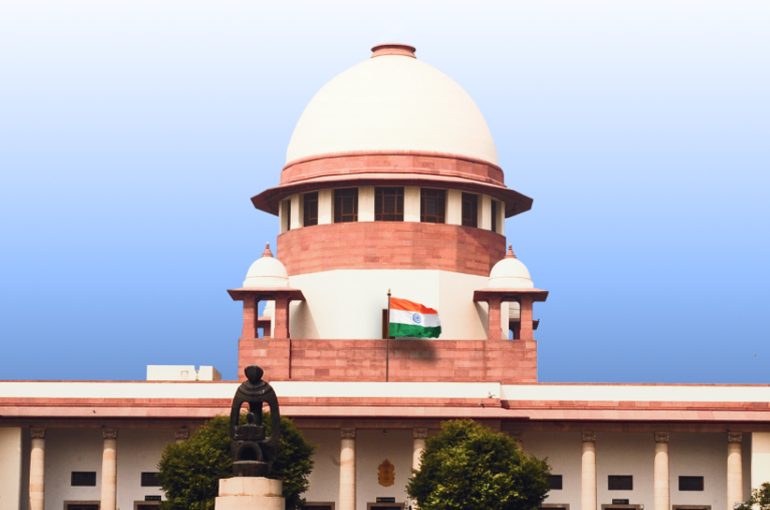
SUPREME COURT HOLDS INSOLVENCY AND BANKRUPTCY CODE CANNOT BE GUIDING PRINCIPLE FOR RESTRUCTURING OWNERSHIP AND CONTROL OF TELECOM SPECTRUM

Introduction
In State Bank of India v. Union of India & Ors. (Civil Appeal No. 1810 of 2021 along with connected appeals), the Supreme Court addressed whether telecom service providers (TSPs) can invoke the IBC moratorium to avoid/hold up payment of license dues to the Department of Telecommunications (DoT), by treating spectrum as an ‘asset’ capable of being dealt with in insolvency. The case was decided by the Bench comprising Justice Pamidighantam Sri Narasimha and Justice Atul S. Chandurkar.
Factual background
The immediate controversy arose from the insolvency proceedings involving the Aircel Group entities (Aircel Limited, Aircel Cellular Limited, Dishnet Wireless Limited), which held Unified Access Service Licences (UASL) granted by DoT under license agreements dated 05.12.2006. Domestic lenders led by State Bank of India extended large credit facilities (aggregate stated as ₹13,729 crores) and Aircel also acquired spectrum usage rights in multiple bands through auctions held in 2010, 2014, 2015 and 2016 (payment stated as ₹6,249.27 crores).
When the corporate debtors failed to pay license-related dues and DoT attempted recovery, the companies initiated voluntary CIRP under Section 10 of the IBC, which was admitted by NCLT, Mumbai in March 2018, and a moratorium followed. DoT filed its claim in the CIRP (stated as ₹9,894.13 crores) towards Annual Licence Fee and Spectrum Usage Charges under the license agreements. A resolution plan (UV Asset Reconstruction Company) was approved by the CoC and sanctioned by the NCLT in June 2020, which DoT challenged before NCLAT.
In parallel, after the Supreme Court’s Judgment in Union of India v. Association of Unified Telecom Service Providers of India ((2020) 3 SCC 525), the Court took note of the argument that insolvency moratorium prevented recovery of significant DoT dues and framed questions about spectrum’s nature and whether it could be dealt with under IBC, referring those issues to NCLAT for determination. NCLAT returned findings that (among other things) spectrum is a natural resource held in trust, but also treated spectrum usage rights as an intangible asset of the corporate debtor capable of being dealt with in insolvency, while simultaneously insisting that spectrum cannot be used without payment of dues. Those conclusions led to cross-appeals by financial creditors/RPs and by the Union of India (DoT).
Court’s decision
The Supreme Court held that spectrum allocated to TSPs and shown in their books as an asset cannot be subjected to proceedings under the Insolvency and Bankruptcy Code, 2016. The Court reasoned that, under the IBC framework, “assets” taken into control/custody (Section 18) and included in liquidation estate (Section 36) are premised on the corporate debtor having ownership rights and the Code itself excludes assets owned by third parties and certain contractual arrangements that only permit use without transfer of title. It found that merely because accounting standards permit recognizing “control of future economic benefits” as an asset in financial statements does not establish legal ownership in the spectrum or spectrum usage rights and absent transfer of title, ownership does not vest in the TSP.
The Court also adopted a reconciliatory approach between statutory regimes, stressing that telecommunications law (Telegraph Act/Wireless Telegraphy regime/TRAI framework and the regulatory architecture around licensing, trading and dues) occupies a distinct province and IBC cannot be used to “rewrite” rights and liabilities concerning a national natural resource. It relied on public law principles and precedent indicating that insolvency fora are not meant to adjudicate or override sovereign/statutory controls over natural resources, drawing support from the reasoning associated with Embassy Property Developments on limits of insolvency jurisdiction in public law domains.
On the operative outcome, the Court: (i) dismissed the appeals by SBI and other appellants supporting the NCLAT’s approach to treating spectrum as an insolvency asset, and (ii) allowed Civil Appeal No. 6546 of 2021 (Union of India/DoT) “in part”, while directing parties to bear their own costs.
Conclusion
This Judgment decisively separates the insolvency regime from the State’s control over spectrum by holding that spectrum (even if reflected as an “asset” in a TSP’s accounts) is not an IBC-processable asset for CIRP/liquidation purposes. The ruling reinforces that the right to use spectrum remains rooted in a sovereign/statutory licensing framework and cannot be restructured through IBC mechanisms in a manner that dilutes the public trust character of spectrum or the regulatory conditions governing its use and transfer.
YASH HARI DIXIT
LEGAL ASSOCIATE
THE INDIAN LAWYER AND ALIED SERVICES
Please log onto our YouTube channel, The Indian Lawyer Legal Tips, to learn about various aspects of the law. Our latest Video, titled “FALSE AND MISLEADING ADVERTISING LAWS IN INDIA: Legal Analysis 2026 by Adv Sushila Ram Varma” can be viewed at the link below:
Leave a Reply