



















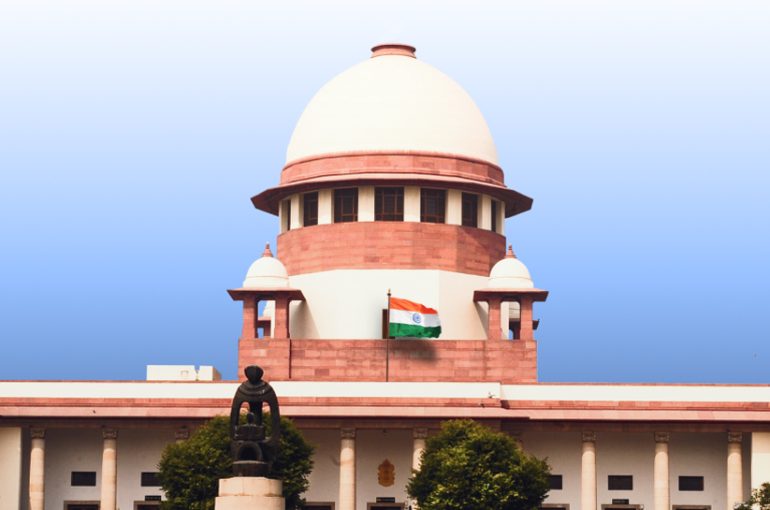
SUPREME COURT UPHOLDS INCLUSIVITY FOR UPSC EXAMINATIONS; ISSUES DIRECTIONS REGARDING SCREEN READERS, SCRIBES AND SUBSTANTIVE EQUALITY

The Supreme Court of India delivered a significant Judgment in the case titled ‘Mission Accessibility V. Union of India & Ors.’ Writ Petition (Civil) No. 206 of 2025, heard and decided by Justices Vikram Nath and Sandeep Mehta on December 3, 2025. The Petition was filed by Mission Accessibility, a non-governmental organization working for the advancement of the rights of persons with disabilities. The case addresses crucial issues regarding accessibility and inclusion of visually impaired and disabled candidates in the Union Public Service Commission’s Civil Services Examination, advocating for the constitutional mandate of equality and substantive inclusion.
Factual Background
The Petitioner approached the Supreme Court seeking to enforce the rights of persons with disabilities to equal opportunity, as guaranteed under the Constitution of India and the Rights of Persons with Disabilities Act, 2016. The primary concern centered on the Civil Services Examination conducted annually by the Union Public Service Commission. Specifically, the Petition highlighted two critical accessibility barriers faced by disabled candidates. First, candidates with visual impairments were required to furnish the details of their scribe at the time of application submission, leaving no flexibility for later changes. Second, disabled candidates lacked access to modern assistive technology; particularly laptops equipped with screen reader software and accessible digital question papers, which could significantly ease their examination experience.
The Petition was originally heard on May 6, 2025, following which the Department of Personnel and Training was impleaded as Respondent. Subsequently, hearings occurred on May 9, 2025, and October 31, 2025, where Respondent No. 2 – UPSC submitted an additional affidavit dated September 12, 2025, demonstrating evolving recognition of the accessibility concerns raised.
Contentions of the Parties
The Petitioner contended that the mandatory requirement of furnishing scribe details at the application stage was arbitrary, unreasonable and violated Articles 14, 16 and 21 of the Constitution. The Organization argued that this requirement prevented candidates from adjusting their arrangements in response to changed circumstances and infringed upon their equal opportunity rights. The Petitioner’s Counsel raised specific concerns regarding the lack of clarity on grounds for allowing or disallowing scribe change requests, absence of prescribed timelines for disposing such requests and the need for documented evidence supporting change requests. These technical observations were aimed at ensuring administrative fairness and predictability.
UPSC, conversely, initially resisted immediate implementation of screen reader facilities, citing inadequate logistical infrastructure. The Commission argued that since it depends entirely on state governments, district authorities, schools and colleges for examination infrastructure, deployment of such technology required substantial advance preparation. However, following the Court’s direction, UPSC filed an additional affidavit on September 12, 2025, taking an in-principle decision to introduce screen reader software for visually impaired candidates.
Court’s Decision and Analysis
The Court acknowledged the significant policy advancement represented by UPSC’s in-principle decision to introduce screen reader software. However, the Judgment recognized a critical gap between policy formulation and practical implementation and articulated a nuanced understanding of the tension between expanding accessibility and maintaining examination security, emphasizing that these objectives need not conflict but rather require thoughtful coordination.
The Court invoked the constitutional philosophy that equality demands the removal of barriers that prevent individuals from standing on equal footing rather than mere formal equality. This principle of substantive equality required transforming the constitutional promise into lived reality for disabled candidates.
Regarding scribe change requests, the Court endorsed a more flexible approach, directing UPSC to permit changes until at least seven days before the examination with objective consideration and reasoned orders within three working days. This direction balanced administrative feasibility with candidate flexibility.
For screen reader accessibility, rather than mandating immediate implementation, the Court issued nuanced directions requiring UPSC to file a comprehensive compliance affidavit within two months detailing specific timelines, operational modalities, testing protocols and implementation feasibility. The Court also directed UPSC to coordinate with the Department of Empowerment of Persons with Disabilities and the National Institute for the Empowerment of Persons with Visual Disabilities to formulate uniform guidelines ensuring standardization and security.
The Judgment imposed corresponding obligations on the Union government to provide administrative and technical support for expeditious implementation, recognizing that accessibility requires coordinated action across multiple agencies and state authorities.
Conclusion
The Court rejected the notion that examination integrity and accessibility are inherently conflicting values, instead viewing them as complementary objectives requiring institutional coordination and thoughtful planning. The Judgment exemplifies progressive constitutionalism by translating abstract constitutional guarantees into concrete institutional obligations with defined timelines and accountability mechanisms.
More significantly, the Judgment’s emphasis on implementation rather than mere policy pronouncements signals the Court’s commitment to ensuring that disability rights constitute enforceable entitlements. By requiring a detailed compliance roadmap and listing the matter for review in February 2026, the Court established meaningful judicial supervision of bureaucratic performance. This approach acknowledges that constitutional rights of marginalized groups often remain theoretical without determined implementation monitoring.
YASH HARI DIXIT
LEGAL ASSOCIATE
THE INDIAN LAWYER AND ALLIED SERVICES
Please log onto our YouTube channel, The Indian Lawyer Legal Tips, to learn about various aspects of the law. Our latest Video, titled “Rights of Husband in False Matrimonial Cases | 498A Misuse | 2025 Judgments Explained|” can be viewed at the link below:

Leave a Reply