



















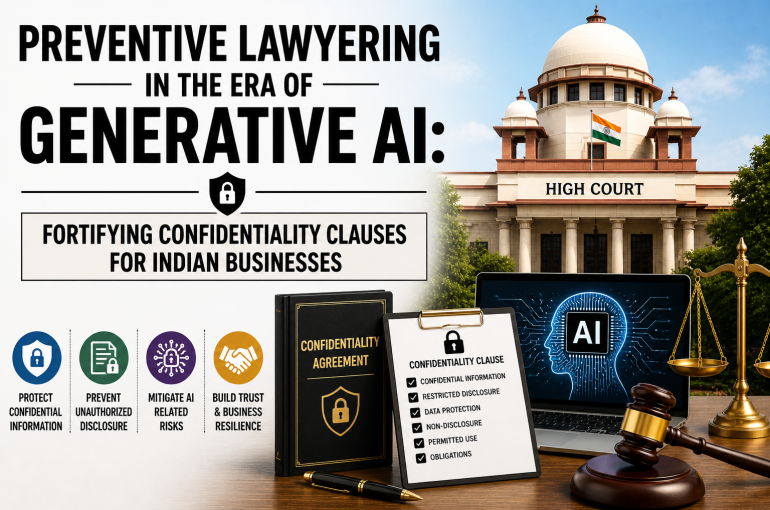
PREVENTIVE LAWYERING IN THE ERA OF GENERATIVE AI: FORTIFYING CONFIDENTIALITY CLAUSES FOR INDIAN BUSINESSES

INTRODUCTION
The High Court of Delhi, in Christian Louboutin SAS & Anr. v. M/s The Shoe Boutique – Shutiq [CS (COMM) 583/2023], issued a historical ruling on 22 November 2023, being one of the first Indian judicial rulings to have had contact with Generative Artificial Intelligence (AI). Although it is mostly a case of trademark violation, the comments made by the Court on Large Language Models (LLMs) such as ChatGPT is a much-needed wake-up call to corporate India. The decision unwillingly highlights one of the contemporary business facts: the necessity of preventive attorneys and an immediate redesign of confidentiality and intellectual property (IP) in the era of generative AI.
BRIEF FACTS
The case occurred after the world-famous high-end footwear designer, Christian Louboutin, sued to obtain an injunction against M/s The Shoe Boutique (Shutiq) on the ground that Shutiq was producing and marketing shoes containing exactly the same registered trademarks as that of Louboutin that being the signature Red Sole and the spiked shoe shapes. Throughout the hearings, the Counsel on the side of the Defendant tried to use the answers provided by ChatGPT, an artificial intelligence chatbot, in defense of the claim that the designs by Louboutin were not fully original and that the brand shared its reputation with other companies in the market. The Defendant aimed to utilize this AI-created data as the reason to dispute the monopoly of intellectual property of the Plaintiff.
ISSUES OF LAW
The Court needed to decide on whether the Defendant violated the registered trademarks of the Plaintiff and misrepresented their goods to be of the Plaintiff. More importantly, in the context of the changing technology law, the Court was forced to determine whether the answers produced by the use of the Artificial Intelligence tools, such as ChatGPT, could be trusted as a legal or factual evidence to prove or weaken the intellectual property rights in a court of law.
ANALYSIS OF THE JUDGMENT
The Court relies on the specific interpretation of how modern algorithmic models work to make his arguments. Justice Prathiba M. Singh categorically rejected the application of ChatGPT since AI cannot substitute human intellect and the adjudicatory process in the court. The Court observed that AI responses are probabilistic, are highly dependent on the individual prompts that the user is entering, and constrained by the nature of their training data. Another problem highlighted by the Court was the problem of AI hallucinations, where chatbots generate fake or incorrect data, making them unreliable when it comes to establishing both legal and factual precedents.
Even though the Court expressed its apprehension over the trustworthiness of the evidence, the technological observations have extensive implications on the confidentiality of corporations. The Court identified an enormous business risk by making a judicial admission to the fact that AI models use user prompts and rely on external training data. Users feed the proprietary code, trade secrets, or client information into a publicly accessible LLM when the employee creates reports or fixes a software, the information is sent to a third-party server, effectively eliminating the confidentiality of such information.
Such an engagement of law and technology demands an ordered preventative lawyering. Pre-AI Non-Disclosure Agreements (NDAs) will no longer be relevant in business. To safeguard their IP, companies must draft foolproof contracts that would clearly state what is meant by unauthorized disclosure to mean the steps involved in entering data into a public or unauthorized AI model. Moreover, the agreements with suppliers should be revised, so that the information of clients should not be used by third-party agencies to develop their own proprietary algorithms, and Acceptable Use Policies associated with AI should be explicitly implemented into employment agreements.
CONCLUSION
The Court finally decided to support Christian Louboutin, awarding an injunction against the Defendant and prohibiting it to produce or sell the breaching footwear. The Court obviously concluded that the data generated by AI could not be used as grounds to present legal arguments or to infringe on proven intellectual property rights.
But the wider heritage of this ruling goes way beyond infringement of trademarks. The Delhi High Court has indirectly sent a warning to corporate entities by revealing the mechanical realities of the manner in which AI processes information. Using reactive litigation as a commercial approach to remedy an AI-driven data leak once it occurs is a losing policy. The most feasible course of action is proactive: Indian enterprises should now audit and strengthen their contractual infrastructure to make sure that their confidentiality and IP provisions are crafted to survive the invisible challenges of the generative AI age.
ANIKET KUMAR PARCHA
Legal Associate
The Indian Lawyers & Allied Services
Please log onto our YouTube channel, The Indian Lawyer Legal Tips, to learn about various aspects of the law. Our latest Video, titled “What to do when false FIR/case filed against you? How to deal with false cases” can be viewed at the link below:

Leave a Reply