



















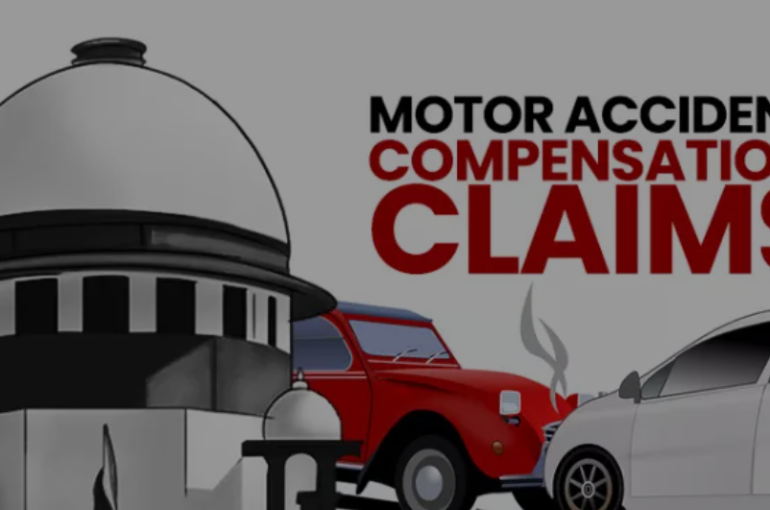
SHARED FAULT, SHARED JUSTICE: THE DOCTRINE OF CONTRIBUTORY NEGLIGENCE REVISITED

INTRODUCTION
In Parmila & Ors. v. Rajender & Ors, 2026 INSC 420, (decided on 23 April 2026), the Supreme Court of India, speaking through Justices Vikram Nath, Sandeep Mehta and Vijay Bishnoi, the Supreme Court’s decision marks a significant intervention in the law governing motor accident compensation and the Doctrine of Negligence. The Court examined whether lower forums had erred in attributing exclusive negligence to one party in a fatal road accident and whether failure to consider key issues such as contributory negligence and validity of a driving license vitiated the adjudication.
BRIEF FACTS
The case arose from a tragic road accident dated 13 January 2009, involving a car and a Haryana Roadways bus. Hari Om (driver) and Sher Singh, occupants of the car, died on the spot after a head-on collision allegedly caused by the rash and negligent driving of the bus.
Three claim Petitions were filed before the Motor Accident Claims Tribunal (MACT), Bhiwani in Haryana. Compensation of ₹50,00,000/- each were claimed by the Legal Heirs of the deceased persons. Additionally, a separate claim of ₹2,00,000/- was filed for damage to the vehicle by the Father of the deceased Hari Om, namely Shri Baljeet Singh.
The Tribunal dismissed all claims, holding that the accident resulted solely from the negligence of Hari Om. This finding was upheld by the Punjab and Haryana High Court. Aggrieved, the Claimants approached the Supreme Court via a Special Leave Petition under Article 136 of the Constitution.
ISSUES OF LAW
- Whether the findings of exclusive negligence against the deceased driver were legally sustainable?
- Whether the courts below failed to consider the principle of contributory negligence in a head-on collision?
- Whether non-adjudication of a framed issue (valid driving license of the bus driver) vitiated the decision?
- Whether the absence of testimony from the bus driver affected the evidentiary evaluation?
ANALYSIS OF THE JUDGEMENT
Rejection of One-Sided Negligence
The Supreme Court expressed clear dissatisfaction with the Tribunal and High Court’s approach of attributing entire liability to one party without examining the role of the other driver. It emphasized that in head-on collisions, a balanced assessment is essential. The Court noted that negligence in motor accident cases must be determined through a comparative evaluation of conduct, rather than a simplistic attribution.
Importance of Contributory Negligence
A significant takeaway from the Judgment is the Supreme Court reaffirmation of the Doctrine of Contributory Negligence. It observed that in cases involving collisions between two vehicles, the possibility of shared responsibility cannot be lightly disregarded and a balanced assessment of the conduct of all parties is essential. The Court further noted that failure to consider contributory negligence reflects an inadequate appreciation of the evidence on record. This reasoning is consistent with the settled principles under the Motor Vehicles Act, 1988, where liability is not necessarily absolute but may be apportioned in accordance with the degree of fault attributable to each party.
Evidentiary Gap: Non-Examination of the Bus Driver
The Supreme Court placed considerable emphasis on the fact that the bus driver, Respondent No.1, did not enter the witness box, despite being the most crucial witness to explain the manner in which the accident occurred. As the person directly involved, his testimony would have been vital in clarifying the sequence of events and assessing negligence. The absence of such evidence created a significant evidentiary gap, which ought to have been duly considered by the Tribunal. The failure to take this omission into account ultimately weakened the factual foundation of the findings recorded by the courts below.
Failure to Decide a Material Issue
One of the most critical errors identified was the Tribunal’s failure to decide whether the bus driver had a valid driving license. The Supreme Court held that once an issue is framed, it must be adjudicated with reasons and ignoring such an issue leads to incomplete and legally flawed adjudication. This aspect was especially relevant because the Claimants alleged that the driver was still under trainingHigh Court’s Oversight
The High Court, while affirming the Tribunal’s decision, failed to independently examine the issue of the validity of the driver’s license and the implications arising from the driver’s non-examination. The Supreme Court criticized this approach as a mechanical affirmation, lacking the depth and scrutiny expected of a reasoned Appellate review.
Remand for Fresh Consideration
Recognizing these deficiencies, the Supreme Court set aside the Impugned Judgments of High Court and remanded the matter to the Tribunal for fresh adjudication. It directed that all issues be properly addressed, that the parties be afforded a full and fair opportunity to present their case and that the findings be reasoned, comprehensive and in accordance with law.
CONCLUSION
The Judgment supports the principle that justice in motor accident claims lies in thorough, balanced and reasoned adjudication. By emphasizing contributory negligence, evidentiary responsibility and the duty to decide all framed issues, the Supreme Court has strengthened procedural fairness in compensation jurisprudence.
The decision serves as a reminder that liability cannot be imposed in absolutes without careful scrutiny, especially in cases involving multiple factors. Ultimately, the ruling promotes a more balanced and equitable approach to determining fault and awarding compensation in motor accident cases.
TRISHMA KASHYAP
Legal Associate
The Indian Lawyer & Allied Services
Please log onto our YouTube channel, The Indian Lawyer Legal Tips, to learn about various aspects of the law. Our latest Video, titled “What to do when false FIR/case filed against you? How to deal with false cases” can be viewed at the link below:
Leave a Reply