



















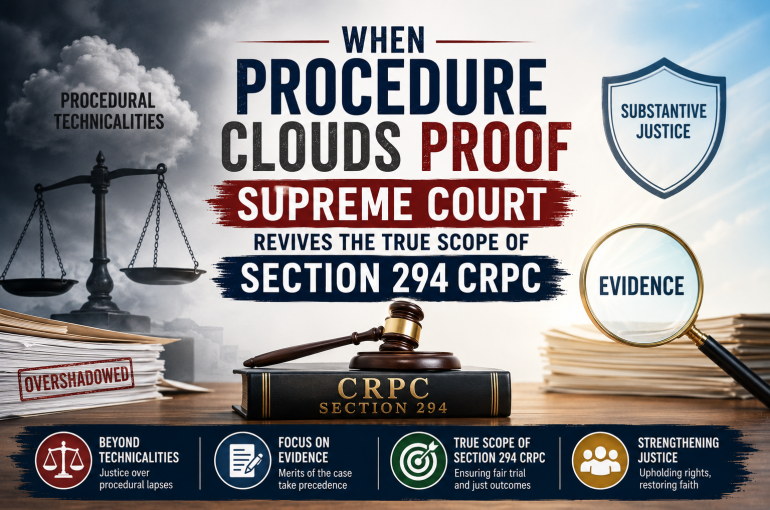
WHEN PROCEDURE CLOUDS PROOF: SUPREME COURT REVIVES THE TRUE SCOPE OF SECTION 294 CRPC

INTRODUCTION
In R. Ganesh v. State of Tamil Nadu, Criminal Appeal arising out of SLP (Crl.) No. 1383 of 2026, decided on 27 April 2026, the Supreme Court of India, comprising Justice J.K. Maheshwari and Justice Atul S. Chandurkar, clarified the scope and purpose of Section 294 of the Code of Criminal Procedure, 1973, which deals with admission and denial of documents. The Court held that Section 294 CrPC concerns documentary evidence and dispensation of formal proof and cannot be confused with Section 296 CrPC relating to affidavit evidence of a formal character.
Setting aside the Madras High Court’s Order, the Court emphasised that Applications under Section 294 must be examined in light of the statutory purpose of simplifying proof of undisputed documents, rather than being rejected on erroneous legal reasoning.
BRIEF FACTS
The Appellant had filed an Application under Section 294[1] CrPC during the pendency of a Criminal Appeal before the III Additional District Judge, Tiruchirappalli, seeking permission to mark certain documents as exhibits. These documents, according to the Appellant, formed part of the Prosecution records and charge-sheet.
The Trial Court rejected the Application and the Madras High Court affirmed the rejection in revision proceedings. While dismissing the Petition, the High Court relied upon the Supreme Court decision in State of Punjab v. Naib Din, which interpreted Section 296[2] CrPC dealing with affidavit evidence of a formal nature.
Aggrieved by this approach, the Appellant approached the Supreme Court.
ISSUES OF LAW
The principal issue before the Supreme Court was whether the High Court correctly interpreted Section 294CrPC while rejecting the Appellant’s application, and whether reliance upon Section 296 CrPC and the Judgment in Naib Din was legally sustainable.
ANALYSIS OF THE JUDGMENT
The Supreme Court undertook a close examination of Section 294 CrPC and clarified that the provision serves a specific procedural purpose, dispensing with unnecessary formal proof of documents whose genuineness is not disputed by the opposing side. The Court observed that once a document forms part of the record and is included in the list of documents filed by either the Prosecution or the Accused, the Court must call upon the opposite party to admit or deny its genuineness. If genuineness is not disputed, such document may be read in evidence without formal proof of signatures.
The Court found that the High Court had fundamentally misconstrued the legal framework by importing principles applicable to Section 296 CrPC. It observed that Section 296 concerns evidence of a formal character tendered through affidavit, whereas Section 294 specifically deals with documentary evidence and admission of documents. The two provisions operate in entirely different fields.
A significant aspect of the Judgment is the Court’s observation that while dealing with applications under Section 294, courts must uphold the “spirit of the provision” namely the avoidance of unnecessary technical formalities where genuineness of documents is not genuinely in dispute. The Court clarified that the inquiry under Section 294 is not whether documents can mechanically be marked as exhibits, but whether their genuineness is admitted, denied or requires proof.
The Supreme Court also noted that the documents sought to be relied upon by the Appellant appeared, prima facie, to form part of the Prosecution’s own charge-sheet records. Although the CBI disputed this factual assertion, the Court held that such objections could appropriately be raised before the concerned court during reconsideration of the application.
Another important aspect of the Judgment is the Court’s response to the argument that the Application was filed merely to delay the Criminal Appeal. The Court observed that while such concerns may exist, they cannot justify rejection of a legally maintainable application on incorrect legal grounds. At the same time, it directed that the Criminal Appeal itself should proceed expeditiously after determination of the application.
CONCLUSION
The Supreme Court set aside the Order of the Madras High Court and remitted the matter for fresh consideration of the Appellant’s Application under Section 294 CrPC. It granted liberty to the Prosecution to raise all available objections in accordance with law and directed that the issue be reconsidered uninfluenced by the earlier findings.
The Judgment serves as an important reminder that procedural provisions in criminal law are intended to facilitate fair adjudication and not create avoidable technical barriers. By distinguishing the scope of Sections 294 and 296 CrPC, the Court has reinforced the principle that criminal procedure must operate with clarity, practicality and fidelity to statutory purpose.
[1] 294.No formal proof of certain documents.-
(1) Where any document is filed before any Court by the prosecution or the accused, the particulars of every such document shall be included in a list and the prosecution or the accused, as the case may be, or the pleader for the prosecution or the accused, if any, shall be called upon to admit or deny the genuineness of each such document.
(2) The list of documents shall be in such form as may be prescribed by the State Government.
(3) Where the genuineness of any document is not disputed, such document may be read in evidence in any inquiry, trial or other proceeding under this Code without proof of the signature of the person to whom it purports to be signed:
Provided that the Court may, in its discretion, require such signature to be proved.
[2] 296.Evidence of formal character on affidavit.-
(1) The evidence of any person whose evidence is of a formal character may be given by affidavit and may, subject to all just exceptions, be read in evidence in any inquiry, trial or other proceeding under this Code.
(2) The Court may, if it thinks fit, and shall, on the application of the prosecution or the accused, summon and examine any such person as to the facts contained in his affidavit.
SARTHAK KALRA
Senior Legal Associate
The Indian Lawyer & Allied Services
Please log onto our YouTube channel, The Indian Lawyer Legal Tips, to learn about
various aspects of the law. Our latest Video, titled “Defamation on Social Media: Can a Meme Become a Crime?“, can be viewed at the link below:

Leave a Reply