



















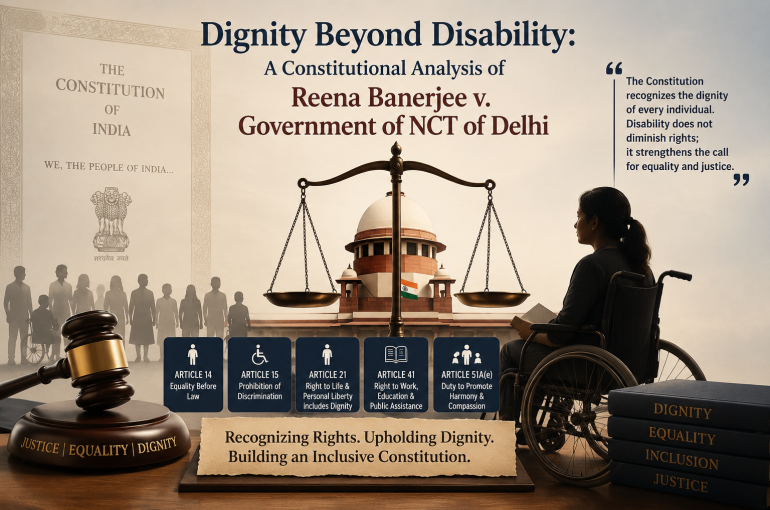
Dignity Beyond Disability: A Constitutional Analysis of Reena Banerjee v. Government of NCT of Delhi

- Introduction
In Reena Banerjee and Another v. Government of NCT of Delhi and Others, reported as 2025 INSC 1101 and decided on 12 September 2025, the Supreme Court of India delivered a landmark Judgment on disability rights and institutional reform. The Judgment was delivered by Justice Vikram Nath and Justice Sandeep Mehta.
The Supreme Court dealt with two long-pending proceedings concerning implementation of disability laws and the condition of persons with cognitive disabilities living in institutional care facilities. The Judgment significantly strengthened the rights guaranteed under the Rights of Persons with Disabilities Act, 2016 (“RPwD Act”) and adopted a rights-based approach centered on dignity, accessibility, autonomy and substantive equality. The Supreme Court further introduced “Project Ability Empowerment,” a nationwide monitoring mechanism involving National Law Universities to assess institutions housing persons with cognitive disabilities.
- Brief Facts of the Case
The litigation arose from two separate proceedings. The first was a Public Interest Litigation filed in 1998 by the Justice Sunanda Bhandare Foundation seeking effective implementation of the Persons with Disabilities (Equal Opportunities, Protection of Rights and Full Participation) Act, 1995. The Petition highlighted the failure of authorities to provide statutory reservations and safeguards to persons with disabilities.
The second proceeding originated from a Special Leave Petition filed in 2012, later converted into Civil Appeal No. 11938 of 2016. The matter concerned the disturbing conditions at Asha Kiran Home, a state-run institution in Delhi for persons with cognitive disabilities. Media reports revealed overcrowding, abuse, poor sanitation, inadequate healthcare and custodial deaths within the institution. Dissatisfied with the limited remedial measures directed by the Delhi High Court, the Appellants approached the Supreme Court seeking systemic reforms and independent oversight.
Over time, despite repeated judicial directions, several States and Union Territories failed to properly implement disability rights legislation. Consequently, the Supreme Court constituted an Advisory Group Expert Panel to examine institutional conditions and recommend reforms relating to accessibility, rehabilitation, healthcare and community-based care systems.
- Issues of Law
- Whether the Union and State Governments had effectively implemented the provisions of the RPwD Act, 2016 and earlier disability legislation.
- Whether conditions prevailing in State-run institutions for persons with cognitive disabilities violated Articles 14(Equality before law), 19(Protection of certain rights regarding freedom of speech, etc.), and 21(Protection of life and personal liberty) of the Constitution of India.
- Whether prolonged confinement in institutions and lack of accessibility amounted to systemic discrimination against persons with disabilities.
- Whether the State had failed to ensure dignity, autonomy, healthcare, education and community integration for persons with disabilities.
- Whether reservation policies under Section 34(Reservation) of the RPwD Act required reinterpretation to ensure substantive equality and “upward movement” for meritorious candidates with disabilities.
- Analysis of the Judgment
The Judgment marks a significant shift in Indian disability jurisprudence from a welfare oriented approach to a rights based framework. The Supreme Court rejected the traditional medical model of disability and recognized disability as a form of human diversity deserving equal participation in society. The Supreme Court observed that inaccessible public spaces and institutions effectively convert constitutional rights into “hollow promises.”
The Supreme Court strongly reaffirmed that disability rights are an integral part of constitutional rights. It interpreted Article 14 as guaranteeing substantive equality and held that Article 21 includes the right to live with dignity, autonomy and inclusion in society. Accessibility was treated as a constitutional obligation rather than an administrative convenience.
Another important aspect of the Judgment was its criticism of institutional care systems. The Supreme Court acknowledged that large institutions often become spaces of neglect, exclusion and abuse. Relying on the Advisory Group Expert Panel Report, the Court advocated a gradual shift towards community-based support systems and rehabilitation measures. It also directed the preparation of personalised care plans and rehabilitation pathways for residents.
The establishment of “Project Ability Empowerment” emerged as a major institutional reform. Eight National Law Universities were entrusted with monitoring state-run and private institutions housing persons with cognitive disabilities. The monitoring exercise was directed to assess accessibility, healthcare, education, vocational rehabilitation, grievance redressal mechanisms, staffing, welfare access and statutory compliance.
The Supreme Court also examined reservation under Section 34 of the RPwD Act. It criticized the practice of denying “upward movement” to meritorious candidates with disabilities who score above the general category cut-off. Referring to Indra Sawhney v. Union of India and M. Nagaraj v. Union of India, the Court held that such candidates should be shifted to the unreserved category to ensure that reservation benefits reach more deserving candidates with disabilities.
- Conclusion
The decision in Reena Banerjee and Another V. Government of NCT of Delhi and Others is a landmark Judgment in the field of disability rights and constitutional law. The Supreme Court transformed disability discourse in India by moving from a welfare-based perspective to one founded on dignity, accessibility, autonomy and substantive equality.
The Judgment is particularly significant for recognizing accessibility as a constitutional imperative, addressing the systemic neglect of persons with disabilities in institutional care, strengthening reservation jurisprudence and establishing a nationwide monitoring framework to ensure accountability. By emphasizing community integration, personalized care and structural reform, the Supreme Court reinforced the principle that persons with disabilities are equal constitutional citizens entitled to full participation in society.
TRISHMA KASHYAP
Legal Associate
The Indian Lawyer & Allied Services
Please log onto our YouTube channel, The Indian Lawyer Legal Tips, to learn about
various aspects of the law. Our latest Video, titled “Defamation on Social Media: Can a Meme Become a Crime?“, can be viewed at the link below:

Leave a Reply