



















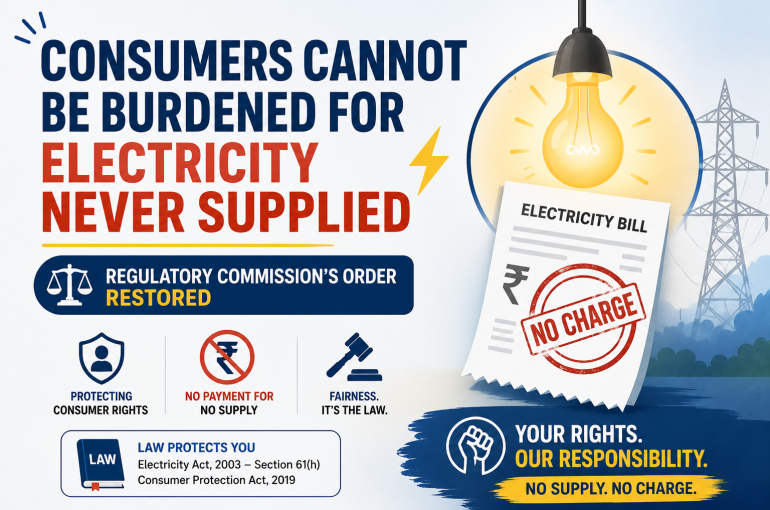
CONSUMERS CANNOT BE BURDENED FOR ELECTRICITY NEVER SUPPLIED: SUPREME COURT RESTORES REGULATORY COMMISSION’S ORDER

INTRODUCTION
In Delhi Electricity Regulatory Commission v. Tata Power Delhi Distribution Limited, 2026 INSC 461, decided on 7 May 2026, the Supreme Court of India, comprising Justice Pamidighantam Sri Narasimha and Justice Alok Aradhe, examined the interplay between depreciation recovery, tariff regulations and consumer protection under the Electricity Act, 2003.
The Court held that a generating utility cannot continue recovering depreciation costs from consumers after the plant has ceased supplying electricity, merely because the technical useful life of the plant continues. Reaffirming that consumer interest remains central to tariff determination, the Court restored the Order of the Delhi Electricity Regulatory Commission (DERC) and set aside the contrary view taken by the Appellate Tribunal for Electricity (APTEL).
BRIEF FACTS
The dispute concerned the Rithala Combined Cycle Power Plant established by Tata Power Delhi Distribution Limited (TPDDL) in Delhi as a temporary measure to address electricity demand during the Commonwealth Games period. The Project was conceived with an operational tenure of only five to six years, after which the land was to revert to the Delhi Development Authority.
The Plant commenced commercial operations in 2011. By an Order dated 31 August 2017, the DERC approved the project framework and permitted operation of the Plant only up to March 2018. At the same time, the Commission accepted that the Plant had a technical useful life of fifteen years and determined the admissible capital cost accordingly.
Subsequently, TPDDL sought recovery of the remaining depreciable capital cost even after the Plant had stopped supplying electricity to Delhi consumers. The Commission rejected this claim and permitted depreciation recovery only for the six-year operational period. However, APTEL reversed this finding and directed that the entire capital cost be recoverable through depreciation over fifteen years. This Order was challenged before the Supreme Court.
ISSUES OF LAW
The Supreme Court considered whether depreciation under the applicable tariff regulations must necessarily be allowed over the entire technical useful life of an asset irrespective of actual supply of electricity, whether Regulation 6.32 conferred an unconditional right to recover depreciation for fifteen years, and whether APTEL erred in ignoring the regulatory framework limiting the plant’s approved operational period.
ANALYSIS OF THE JUDGMENT
The Supreme Court emphasised that tariff determination under the Electricity Act is not a purely accounting exercise but a process involving careful balancing of commercial viability and consumer protection. Referring to Section 61(d) of the Electricity Act, 2003, the Court reiterated that safeguarding consumer interest is a core statutory objective and cannot be subordinated to unrestricted cost recovery by utilities.
The Court noted that although the technical useful life of the Plant was assessed at fifteen years, the regulatory approval itself restricted operation and supply to six years. This distinction between “technical useful life” and “regulatory recovery period” formed the heart of the dispute. According to the Court, merely because a plant is technically capable of operating for a longer duration does not automatically entitle the generating company to continue recovering tariff-related depreciation from consumers after supply has ceased.
A central aspect of the Judgment is the Court’s interpretation of Regulation 6.32 of the DERC Tariff Regulations, 2011. The Court clarified that the provision prescribing depreciation over the useful life of an asset cannot be read in isolation. Instead, it must be harmoniously construed with Regulation 4.1, which limits tariff entitlement to the duration approved under the Power Purchase Agreement and regulatory approval framework.
The Court found that APTEL had committed a serious error by treating depreciation recovery as an absolute right detached from actual supply of electricity. It observed that after March 2018, consumers in Delhi received no electricity from the Plant and therefore could not be compelled to continue bearing tariff burdens relating to that asset. The Court remarked that consumers cannot be asked to pay for a service which they no longer receive.
The Court also took note of the fact that TPDDL was not left remediless after March 2018. The Commission had already clarified that the plant could function as a merchant generator and sell electricity elsewhere. Therefore, TPDDL remained free to commercially exploit the plant or recover value through alternate means. What was impermissible, however, was fastening the burden of unrecovered depreciation upon Delhi consumers indefinitely.
Another important aspect of the Judgment is the Court’s reaffirmation that true-up proceedings are intended only to operationalise an already approved tariff framework and cannot be used to fundamentally alter or reopen settled regulatory conditions. Since TPDDL had accepted the 2017 order restricting the operational period to six years and never challenged it, APTEL could not subsequently enlarge the recovery framework through true-up proceedings.
CONCLUSION
The Supreme Court allowed the Appeal, set aside the Judgment of APTEL, and restored the Order of the Delhi Electricity Regulatory Commission restricting depreciation recovery to the approved six-year operational period.
The Judgment firmly reiterates that electricity tariff regulation must remain consumer-centric and that generating utilities cannot claim perpetual tariff recovery disconnected from actual electricity supply. By distinguishing between technical lifespan and regulatory entitlement, the Court has reinforced the principle that consumer interest forms the cornerstone of tariff jurisprudence under the Electricity Act, 2003.
SUSHILA RAM VARMA
ADVOCATE & CHIEF CONSULTANT
The Indian Lawyer & Allied Services
Please log onto our YouTube channel, The Indian Lawyer Legal Tips, to learn about
various aspects of the law. Our latest Video, titled “The Raghav Chadha Defection: What does Indian law say? Raghav Chadha, 6 other AAP MPs join BJP”, can be viewed at the link below:

Leave a Reply