



















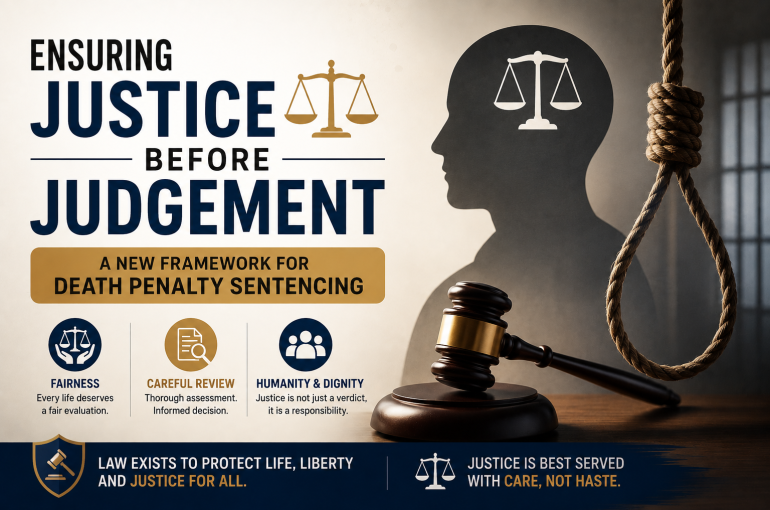
ENSURING JUSTICE BEFORE JUDGEMENT: A NEW FRAMEWORK FOR DEATH PENALTY SENTENCING

INTRODUCTION
In Aman Singh & Anr. v. State of Bihar 2026 INSC 424, (decided on 27 April 2026), the Supreme Court of India, speaking through Justices Vikram Nath, Sandeep Mehta and Vijay Bishnoi, passed a decision that marks a crucial development in the jurisprudence of death penalty sentencing. This case not only addresses procedural aspects in a capital punishment appeal but also highlightsA systemic deficiencies in the collection and evaluation of mitigating circumstances. The Court used the opportunity to lay down important guidelines to ensure a more informed and constitutionally compliant sentencing process.
BRIEF FACTS
The case arose from the Order dated 22.01.2026 passed by the Patna High Court in Death Reference No. 2 of 2024 and Criminal Appeal (DB) No. 691 of 2024, confirming the death sentence awarded to the Appellants. The matter thereafter reached the Supreme Court by way of a Criminal Appeal.
At the interim stage, the Supreme Court stayed the execution of the death sentence and called for various reports, including probation reports, prison conduct reports and psychological evaluations of the Accused. Additionally, the Court permitted mitigation experts to conduct detailed interviews with the Appellants to prepare a comprehensive mitigation investigation report.
While dealing with these procedural directions, the Court also examined broader issues relating to sentencing in death penalty cases.
ISSUES OF LAW
- Whether Courts are adequately considering mitigating and aggravating circumstances in death penalty cases?
- Whether the absence of structured procedures for collecting such material affects sentencing fairness?
- Whether delays in gathering relevant information undermine the reformative goal of punishment?
- Whether deficiencies in legal representation impact the quality of sentencing decisions?
ANALYSIS OF THE JUDGEMENT
Emphasis on Reformative Justice
The Supreme Court reiterated that reformation is a foundational goal of criminal punishment, particularly in death penalty cases. However, it noted that the lack of a structured framework for assessing mitigating circumstances has impeded the meaningful application of reformative principles.
Concern over Delayed Collection of Mitigating Factors
A major concern highlighted by the Supreme Court was that crucial information regarding mitigating and aggravating circumstances is often collected only at the appellate stage. This delay creates gaps in the sentencing process and undermines the possibility of a balanced and timely determination.
Inadequate Legal Representation
The Supreme Court took note of the poor quality of legal representation in many capital cases, observing that ineffective defense and lack of proper investigation often result in incomplete presentation of relevant facts. This, in turn, increases the risk of unjust or disproportionate sentencing.
Mandatory Guidelines for Courts
To address these systemic issues, the Supreme Court issued comprehensive directions:
- Trial Courts must call for reports on mitigating and aggravating circumstances immediately after conviction.
- High Courts must ensure such reports are available at the stage of death reference.
- Reports must be detailed, verified and submitted within a fixed timeframe.
- Courts must provide parties an opportunity to respond to these reports.
These directions aim to institutionalize a structured and evidence based sentencing process.
Strengthening Legal Aid in Death Penalty Cases
The Supreme Court mandated the constitution of dedicated legal teams, including experienced advocates, to represent accused persons in death penalty matters. It also directed the establishment of specialized panels and involvement of professionals to gather socio-economic, psychological and background information of the accused.
Role of NALSA and Systemic Reform
The Supreme Court directed the National Legal Services Authority (NALSA) to frame guidelines for collecting mitigating circumstances and to involve trained interdisciplinary teams. This step reflects a move toward holistic and data driven sentencing.
CONCLUSION
The decision constitutes a significant advancement in ensuring fairness, transparency and constitutional compliance in the administration of death penalty sentencing. By addressing procedural deficiencies, emphasizing the timely collection and evaluation of relevant material and strengthening the framework of legal representation, the Hon’ble Supreme Court has sought to bring sentencing practices in closer alignment with the foundational principles of justice and reformation.
Ultimately, the ruling underscores that in matters involving the gravest punishment, the process must be as rigorous and humane as the outcome is serious, ensuring that sentencing is informed, balanced and just.
TRISHMA KASHYAP
Legal Associate
The Indian Lawyer & Allied Services
Please log onto our YouTube channel, The Indian Lawyer Legal Tips, to learn about
various aspects of the law. Our latest Video, titled “The Raghav Chadha Defection: What does Indian law say? Raghav Chadha, 6 other AAP MPs join BJP”, can be viewed at the link below:

Leave a Reply