



















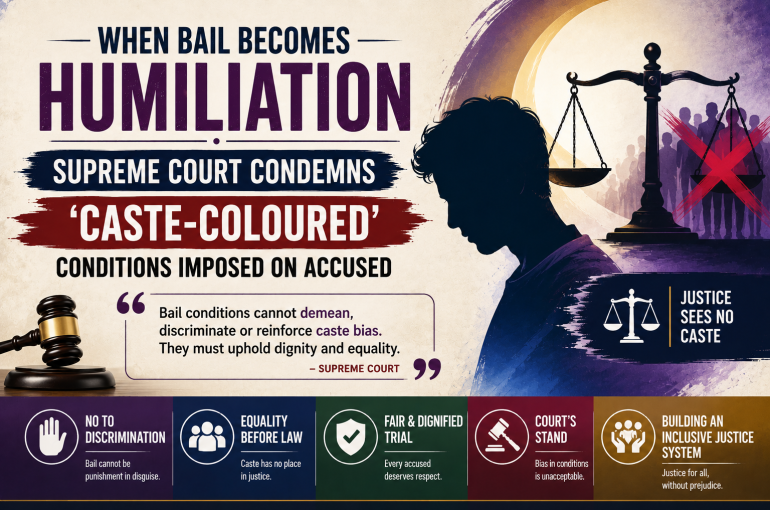
WHEN BAIL BECOMES HUMILIATION: SUPREME COURT CONDEMNS ‘CASTE-COLOURED’ CONDITIONS IMPOSED ON ACCUSED

INTRODUCTION
In In Re: Condition Being Imposed While Granting Bail by High Court of Orissa and District Courts in the State of Odisha and Ancillary Issues, 2026 SCC OnLine SC 809, decided on 4 May 2026, the Supreme Court of India, comprising Chief Justice Surya Kant and Justice Joymalya Bagchi, took suo motu cognisance of deeply troubling bail conditions imposed by courts in Odisha requiring accused persons to clean police station premises as a condition for release on bail.
Describing such directions as “abhorrent, degrading and unknown to law,” the Court held that bail conditions cannot become instruments of humiliation, forced labour, or pre-trial punishment. The Judgment stands as a strong reaffirmation of constitutional dignity, equality and the presumption of innocence.
BACKGROUND OF THE CASE
The controversy arose from criminal cases registered against protestors opposing a proposed bauxite mining project in the Rayagada and Kalahandi districts of Odisha. Many of the Accused belonged to Adivasi and Dalit communities. While granting bail to several accused persons, the Odisha High Court and subordinate courts imposed unusual conditions directing them to clean police station premises for specified periods.
One such Order required an Accused to clean the premises of Kasipur Police Station every morning for two months, with the police directed to provide cleaning materials such as broomsticks and phenyl. Similar conditions were imposed in several other bail orders passed by trial courts in Odisha.
The matter attracted widespread criticism and ultimately led the Supreme Court to initiate suo motu proceedings.
ISSUES BEFORE THE COURT
The Supreme Court examined whether courts can impose degrading or humiliating conditions while granting bail and whether such directions violate constitutional guarantees of dignity, equality and non-discrimination.
ANALYSIS OF THE JUDGMENT
The Supreme Court came down heavily on the practice of imposing such conditions. The Court observed that bail jurisprudence is founded upon the presumption of innocence and therefore conditions attached to bail cannot proceed on an assumption of guilt or become a form of punishment before trial.
A significant aspect of the Judgment is the Court’s recognition of the deeper social implications underlying such conditions. The Court noted that the Accused persons largely belonged to marginalised Adivasi and Dalit communities and observed that such orders carried the appearance of “caste-coloured” judicial behaviour. The Court remarked that even if imposed without deliberate prejudice, such conditions reinforce social hierarchies and create a perception of discrimination inconsistent with constitutional values.
The Court strongly criticised what it described as a “colonial mindset” reflected in these orders. It held that directing accused persons to clean police stations was not merely legally unsustainable but also fundamentally violative of human dignity. According to the Court, such conditions are alien to criminal jurisprudence and amount to degrading treatment prohibited by the Constitution.
Referring to Articles 14, 15, 16 and 17 of the Constitution, the Court reiterated that the constitutional vision of India is founded upon substantive equality and the eradication of caste-based discrimination. It emphasised that the judiciary, as the guardian of constitutional rights, carries a heightened obligation to protect vulnerable communities rather than subject them to indignity.
The Court also relied upon the broader constitutional philosophy evolved through landmark decisions such as E.P. Royappa v. State of Tamil Nadu and Maneka Gandhi v. Union of India, reiterating that arbitrariness is antithetical to equality and that every legal procedure must remain fair, just and reasonable.
Importantly, the Court declared all such bail conditions imposed by courts in Odisha to be null and void and directed that accused persons would continue to remain on bail without being subjected to those requirements. The Court further directed that no court anywhere in the country should impose similar conditions while granting bail.
In an unusually wide-reaching direction, the Supreme Court ordered circulation of the Judgment to all High Courts across India through their Registrar Generals, with instructions that every judicial officer be informed that such conditions are impermissible under any circumstances.
CONCLUSION
The Supreme Court declared the impugned bail conditions unconstitutional and void, directing all courts across the country to refrain from imposing similar humiliating or discriminatory conditions in future bail orders.
The Judgment is a powerful reminder that liberty under criminal law cannot be conditioned upon humiliation. In reaffirming dignity as the cornerstone of constitutional justice, the Court has underscored that judicial discretion, however broad, must always remain anchored to equality, humanity and the presumption of innocence.
SARTHAK KALRA
Senior Legal Associate
The Indian Lawyer & Allied Services
Please log onto our YouTube channel, The Indian Lawyer Legal Tips, to learn about
various aspects of the law. Our latest Video, titled “Defamation on Social Media: Can a Meme Become a Crime?”, can be viewed at the link below:

Leave a Reply