



















Supreme Court holds Students Transferred to Private Colleges After Original Institution Lost Recognition Cannot Claim Government Fees

- Introduction
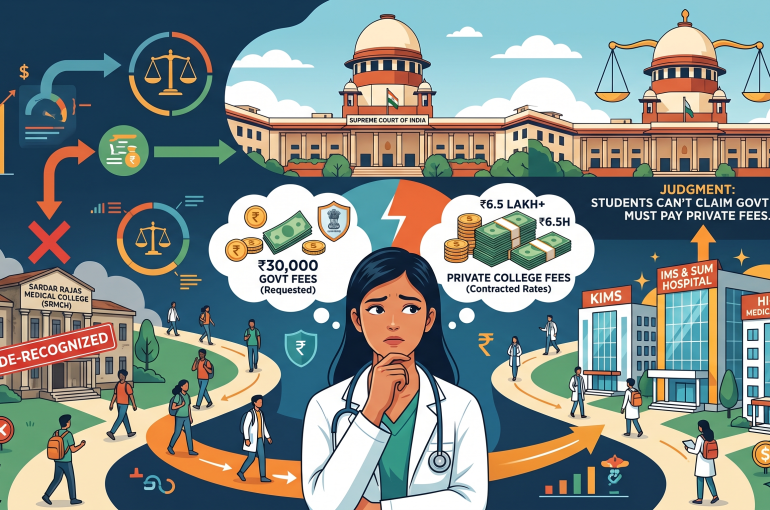
In Soumya Ranjan Panda & Ors. v. Subhalaxmi Dash & Ors., 2026 INSC 488, decided on 14 May 2026, the Hon’ble Supreme Court of India, comprising Justice Vikram Nath and Justice Sandeep Mehta, clarified a crucial aspect of financial liability and equitable distribution regarding the relocation of medical students from a de-recognized private institution. The Apex Court held that the transfer of these students to recognized private medical colleges does not entitle them to subsidized government fee rates. The private institution cannot be made to pay for the fault of another organization. The students were therefore called to pay a certain amount by way of fees which was not covered by the de-faulting institute.
- Brief Facts
The controversy stems from admissions to the MBBS course at Sardar Rajas Medical College, Hospital and Research Centre (SRMCH) for the academic sessions 2013-2014 and 2014-2015. Following inspections by the Medical Council of India (MCI/NMC), which revealed severe infrastructure and faculty deficiencies, SRMCH was denied renewal of its recognition.
To protect the students’ academic futures, the Supreme Court, via interim orders, facilitated the relocation of 122 students to three recognized private medical colleges in Odisha: Kalinga Institute of Medical Sciences (KIMS), Institute of Medical Sciences & SUM Hospital and Hi-Tech Medical College & Hospital. During this interim arrangement, the students were permitted to pay fees at the substantially lower government rate (approximately ₹30,000 per annum). Upon completion of their courses, the transferee colleges approached the Supreme Court seeking reimbursement for the significant shortfall in academic fees.
- Issue of Law
The Supreme Court framed the surviving controversy around the resolution of fee liability, specifically examining:
- Whether students transferred to private medical colleges are liable to pay fees at government rates or the higher rates applicable to private medical colleges.
- How the differential financial liability should be apportioned between the transferred students and the Selvam Educational and Charitable Trust (the entity managing the defaulting SRMCH).
- Analysis of Judgment
The Court observed that the transferred students had originally secured admission in SRMCH, a private institution and had consciously contracted to pay the higher fee standards applicable to private medical colleges. The Court noted that allowing these students to complete their education at private transferee colleges while paying mere government-rate fees would amount to “unjust enrichment” and a windfall.
The Court applied the legal maxim Commodum ex injuria sua nemo habere debet (no one should derive a benefit from their own wrong), holding that the defaulting SRMCH and the Selvam Educational and Charitable Trust could not benefit from their failure to maintain required standards. Consequently, the Court directed that the primary financial burden must fall upon the trust. A bank guarantee of approximately ₹10 crores held by the MCI/NMC, along with an additional ₹2 crore deposit (plus accrued interest) held in the Supreme Court registry, were ordered to be disbursed equally among the three transferee colleges.
Recognizing that the released trust funds (approximately ₹14 crores) would still leave a shortfall against the aggregate dues (approximately ₹16.2 crores), the Court permitted the transferee colleges to recover the deficit directly from the passed-out students. The recovery is to be calculated applying the original SRMCH fee structure, which the students had initially agreed to, rather than the slightly higher fee structures of the transferee colleges, while also adjusting for the amounts the students initially paid at the time of admission.
- Conclusion
The Supreme Court’s judgment firmly establishes that judicial interventions meant to protect students’ academic continuity cannot be exploited to evade legitimate financial obligations. By ensuring that the defaulting educational trust bears the primary financial penalty, while requiring students to fulfill their original fee commitments, the Court provided an equitable resolution for the transferee institutions that stepped in to accommodate the students during an extraordinary crisis. Students will be entitled to receive their academic and course-completion certificates forthwith only upon complying with this determined fee liability.
ANIKET KUMAR PARCHA
Legal Associate
The Indian Lawyer & Allied Services
Please log onto our YouTube channel, The Indian Lawyer Legal Tips, to learn about
various aspects of the law. Our latest Video, titled “Defamation on Social Media: Can a Meme Become a Crime?”, can be viewed at the link below:

Leave a Reply