



















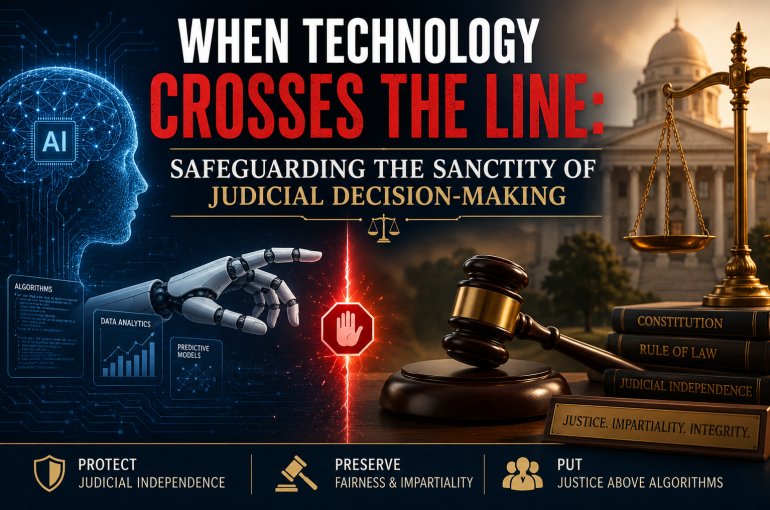
WHEN TECHNOLOGY CROSSES THE LINE: SAFEGUARDING THE SANCTITY OF JUDICIAL DECISION-MAKING

INTRODUCTION
On 2 July 2026, the Supreme Court of India delivered a significant Judgment in Pooja Ramesh Singh v. Jammu & Kashmir Bank Ltd. & Anr., 2026 INSC 668, addressing the growing influence of Artificial Intelligence (AI) in judicial proceedings. The Judgment was delivered by Justice P.S. Narasimha and Justice Alok Aradhe.
Although the Appeal originated from insolvency proceedings under the Insolvency and Bankruptcy Code, 2016, it assumed far greater significance when the Supreme Court found that the National Company Law Tribunal (NCLT) had relied upon several fictitious judicial precedents and fabricated extracts, apparently generated through AI. The National Company Law Appellate Tribunal (NCLAT) also failed to detect these errors while affirming the decision. This prompted the Court to examine the limits of AI in legal research and judicial decision-making, making the Judgment one of the first comprehensive pronouncements on the ethical use of AI in Indian courts.
BRIEF FACTS
The Appellant, a suspended director of Essel Infraprojects Limited, challenged the admission of insolvency proceedings initiated by Jammu & Kashmir Bank under Section 7 of the Insolvency and Bankruptcy Code. It was argued that the corporate guarantee had ceased to operate following a scheme of demerger and amalgamation and that a subsequent sanction letter no longer recognised the guarantee.
The NCLT rejected these submissions and admitted the Insolvency Petition. The NCLAT upheld the decision by relying upon several judicial precedents. Before the Supreme Court, however, the Appellant demonstrated that many of these cited authorities either did not exist, contained fabricated paragraphs or were wrongly attributed to genuine judgments. On independent verification, the Supreme Court found these allegations to be correct. It was further revealed that these authorities had not been cited by the Respondent’s Counsel but had originated from the Tribunal’s own research.
ISSUES BEFORE THE COURT
The Supreme Court considered three important questions:
-
Whether a judicial order based on fake or AI-generated precedents can be sustained in law.
-
Whether safeguards are required while using AI for legal research.
-
What responsibilities rest upon advocates and judges when relying upon AI-assisted material.
ANALYSIS OF THE JUDGMENT
The Supreme Court adopted a practical and balanced approach while dealing with the use of Artificial Intelligence in the legal system. It acknowledged that AI is a useful tool that can make legal research faster and help lawyers and judges work more efficiently. However, the Court made it clear that AI cannot replace human thinking, sound judgment or judicial discretion. It observed that deciding cases requires experience, careful reasoning and an understanding of justice; qualities that only a human mind can possess.
The Court expressed serious concern over “AI hallucinations” that generate non-existent judgments and fabricated legal propositions. It observed that the introduction of such material into judicial proceedings is capable of undermining the very foundation of the justice delivery system. Describing this danger as silent yet catastrophic, the Court stressed that every legal authority relied upon before a court must be independently verified.
Accordingly, the Supreme Court declared a zero-tolerance policy towards the use of fake or hallucinated AI-generated precedents. It held that advocates who cite unverified AI-generated judgments commit professional misconduct, while judges and tribunals relying upon such material commit a serious lapse affecting the integrity of adjudication. The Court categorically ruled that a judgment founded upon fabricated authorities is no judgment in the eyes of law and must be set aside irrespective of whether the fake material substantially influenced the final outcome.
Recognising the need for institutional safeguards, the Court directed the Bar Council of India to constitute a committee for framing guidelines governing the use of AI by advocates and to recommend appropriate disciplinary measures for violations. The Judgment thus encourages responsible technological adoption while emphasising that accountability must always accompany innovation.
Applying these principles, the Supreme Court set aside the Judgments of both the NCLT and the NCLAT, restored the Section 7 application to the NCLT and directed it to decide the matter afresh in accordance with law without being influenced by the earlier findings. The Court deliberately refrained from expressing any opinion on the merits of the insolvency dispute, confining its intervention to preserving the integrity of the judicial process.
CONCLUSION
The decision in Pooja Ramesh Singh v. Jammu & Kashmir Bank Ltd. & Anr. represents a defining moment in the relationship between law and Artificial Intelligence. Rather than discouraging technological advancement, the Supreme Court has drawn a clear distinction between using AI as an aid and permitting it to influence judicial reasoning without verification.
The Judgment reinforces that technology can enhance legal practice but cannot substitute professional diligence, independent research or judicial application of mind. By insisting upon strict verification of AI-generated material and calling for regulatory safeguards, the Court has laid the foundation for the responsible integration of AI into the legal profession. As AI continues to reshape legal research, this decision will undoubtedly remain a guiding precedent for ensuring that efficiency never comes at the cost of justice.
SUSHILA RAM VARMA
Advocate & Chief Consultant
The Indian Lawyer & Allied Services
Please log onto our YouTube channel, The Indian Lawyer Legal Tips, to learn about various aspects of the law. Our latest Video link is in below:

Leave a Reply