



















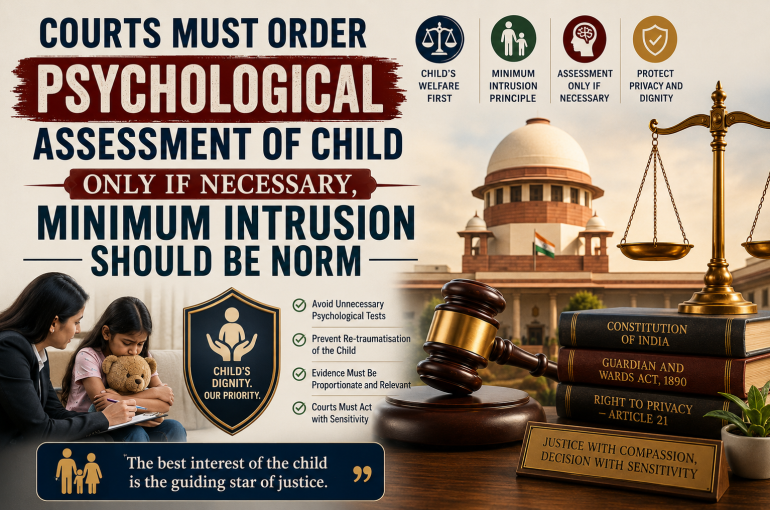
COURTS MUST ORDER PSYCHOLOGICAL ASSESSMENT OF CHILD ONLY IF NECESSARY; MINIMUM INTRUSION SHOULD BE NORM

Introduction
In the case of Sheetal Vasant Thakur v. Chirag Arora (2026 INSC 638), decided by Justice Sanjay Karol and Justice Nongmeikapam Kotiswar Singh on 11 June 2026, at the intersection of child custody, the POCSO Act 2012 and child psychology, the Supreme Court has laid down 19 comprehensive guidelines governing court-directed psychological evaluations of minor children in custody and visitation proceedings. Holding that the welfare, dignity and psychological well-being of the child constitute the paramount consideration, the Court set aside the Bombay High Court’s directions; constituting a four-member panel of experts to evaluate a minor girl who here is an alleged victim of sexual assault by her own father. The matter was remitted to the Family Court with detailed directions. The Court unequivocally held that the principle of minimum intrusion must be the norm and that repeated or multi layered psychological evaluations can risk the child to secondary victimisation and re-traumatisation.
Brief facts of the case
The Appellant-Mother Sheetal Vasant Thakur and Respondent-Father Chirag Arora were married in 2015 and relocated to the United States, where their daughter was born in 2016. It was alleged that between 2018-2019 while in USA, the Respondent subjected the mother to physical abuse and the minor child who was then about two years old, to sexual abuse. Following a domestic assault incident in December 2019, the mother returned to India with the child. FIRs were subsequently registered against the father under sections 376, 322, 504 and 506 IPC and Sections 4, 5(l), 5(n) and 6 of the POCSO Act. The father denied all allegations, contending they were motivated by matrimonial discord.
A prolonged chain of proceedings followed before the Family Court, Pune, the Bombay High Court and the Supreme Court concerning custody, visitation, video access and the appointment of psychological experts. The Family Court in a detailed order dated 28.04.2022, rejected the father’s application for appointment of an independent psychiatric expert citing the pendency of POCSO proceedings and the risk of harm to the child, who was already receiving therapeutic treatment from a child psychologist.
The High Court, however, reversed this position. By its Order dated 07.01.2023, it directed appointment of an independent expert in child psychology. Subsequently, on 28.04.2023, it modified this direction by substituting the word “expert” with “panel of experts.” Finally, by Order dated 07.12.2023, the High Court itself constituted a four-member panel which included one expert from USA based on the father’s suggestion. Aggrieved, the mother approached the Supreme Court.
POCSO Act’s Child-Centric Architecture
The Court undertook a detailed analysis of the POCSO Act’s underlying philosophy emphasising that its significance lies not merely in creating substantive offences but equally in mandating child-sensitive procedures throughout the justice delivery process.
Section 24 requires that statements of a child be recorded in a child-friendly manner without exposing the child to fear, intimidation or distress. Section 33(5) obliges the Special Court to ensure the child is not called repeatedly to testify, embodying what the Court described as the principle of minimum exposure and minimum re-traumatisation. Section 36 ensures the child is not exposed to the accused during recording of evidence. Section 39 provides for support persons and expert assistance to safeguard the child’s dignity and well-being.
The Court held that this framework, when viewed holistically, reveals a consistent legislative intent that legal procedures involving child victims must not themselves become instruments of psychological distress. While these provisions arise in the criminal context, the Court found that their underlying doctrine provides essential guidance even in custody and visitation proceedings.
Relying on Gaurav Nagpal v. Sumedha Nagpal [(2009) 1 SCC 42], the Court reaffirmed that the welfare of the child is the overriding and determining factor in all matters concerning custody and visitation, to which all other considerations, including competing parental rights, remain subservient. Welfare must be understood in its wildest sense, encompassing the child’s physical, emotional, moral, intellectual and psychological well-being. Drawing from Thrity Hoshie Dolikuka v. Hoshiam Shavaksha Dolikuka [(1982) 2 SCC 544], the Court cautioned that repeated interviews of a minor can cast a gloom on the sensitive mind of a child and cause strain and depression.
The Court also drew a crucial distinction that therapeutic engagement intended to support healing is fundamentally different from repeated evaluation conducted as part of adversarial litigation to vindicate the claim of one party. The former aids recovery; the latter risks converting the child into an object of continuous forensic scrutiny.
Analysis
The Court found the High Court’s Order flawed on several counts. Replacing a single “expert” with a “panel of experts” was not a minor procedural change, it increases the child’s psychological exposure and the number of professionals she’d have to face. The High Court gave no reasons for why one expert was insufficient, why multiple evaluators were needed or how this satisfied the minimum-intrusion standard nor did it address re-traumatisation risk.
The four-member panel, largely constituted from names proposed by the father, who faced pending POCSO charges, undermined institution neutrality. Any evaluation process must remain strictly welfare-oriented and independent of adversarial interests. Including a US-based expert and another outside the local jurisdiction, requiring hybrid evaluation, added logistical and emotional burden on the child without any recorded consideration of its impact.
Addressing the father’s claims of “parental alienation syndrome” (PAS) and “false memory creation,” the Court relying on Col. Ramneesh Pal Singh v. Sugandhi Aggarwal [(2024) SCC OnLine 847] held that PAS is not a diagnosable syndrome but a manipulative process and courts must not label a parent as its propagator without identifying specific alienating conduct. It nonetheless directed the Family Court to ensure the child isn’t exposed to influences fostering such alienation against the father.
The Family Court must first appoint a psychologist to assess both parents. That psychologist will consult the child’s treating psychologist and report back. Only then will the Family Court decide whether direct psychological assessment of the child is even necessary, by one independent child psychologist with minimal interaction, in consultation with the treating therapist. The Family Court must also be kept apprised of the POCSO proceedings’ status, given its bearing on access/visitation orders.
The Nineteen Guidelines
In a significant contribution to child-centric jurisprudence, the Court laid down nineteen guidelines, of which the key ones are:
-
“Welfare, emotional security, dignity and psychological well-being of the child shall be the paramount consideration in all proceedings involving a child victim.
-
Psychological evaluation shall not be directed as a matter of routine merely because custody or visitation issues arise.
-
Before directing evaluation, courts must record specific reasons as to necessity, purpose, relevance, and why less intrusive alternatives are inadequate.
-
Courts shall adopt the principle of minimum intrusion and minimum exposure.
-
Repeated, overlapping or multi-layered evaluations shall ordinarily be avoided unless compelling circumstances exist and reasons are recorded in writing.
-
Where evaluation is necessary, it should ordinarily be conducted by one independent, court-appointed child psychologist.
-
A panel of experts shall be an exceptional course, adopted only where indispensable.
-
The appointed expert must be demonstrably independent and neutral, without prior engagement with either party.
-
The evaluative process must not assume an adversarial character or become an evidence-gathering exercise for either party.
-
Evaluative reports shall not contain findings on criminal culpability.
-
Courts shall retain continuing supervisory jurisdiction over the process and may modify or discontinue it if the child’s welfare is at risk.
-
Psychological assessment of both parents is desirable before subjecting the child to any evaluation, as the child’s psychological growth is intertwined with the parents’ psychological condition.”
Adv. Shomdeepta Chanda
The Indian Lawyer & Allied Services
Editor’s Comments
Sheetal Vasant Thakur v. Chirag Arora is a path-breaking judgement that firmly situates child welfare at the heart of judicial processes, not merely as a factor in deciding custody outcomes but as a standard governing the very procedures through which courts engage with child victims. Courts exercising jurisdiction in custody and visitation matters, particularly where POCSO proceedings are pending are now armed with a comprehensive framework that balances parental claims against the constitutional obligation to preserve the dignity, emotional security and psychological integrity of the child. The judgement is a reminder that the judicial system while adjudicating disputes between adults, must never lose sight off the most vulnerable participant, the child.
Sushila Ram Varma
Advocate & Chief Consultant
The Indian Lawyer & Allied Services
Please log onto our YouTube channel, The Indian Lawyer Legal Tips, to learn about various aspects of the law. Our latest Video link is in below:

Leave a Reply