



















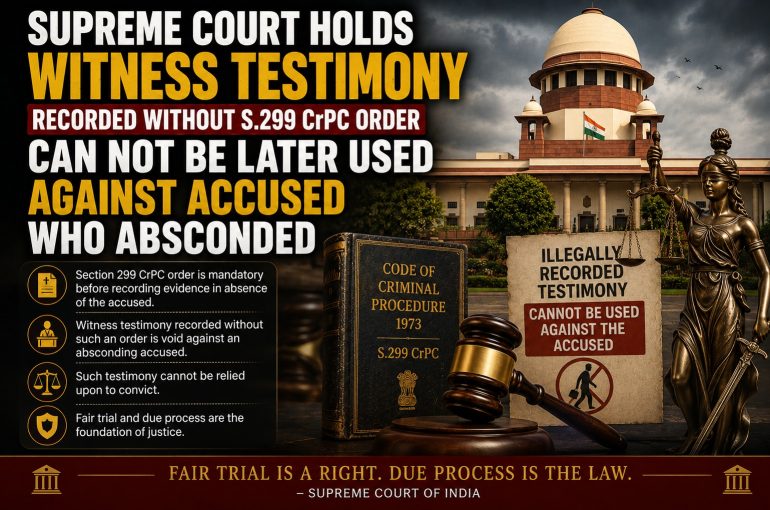
SUPREME COURT HOLDS WITNESS TESTIMONY RECORDED WITHOUT S.299 CrPC ORDER CAN NOT BE LATER USED AGAINST ACCUSED WHO ABSCONDED

INTRODUCTION
The Hon’ble Supreme Court of India recently tackled a crucial question regarding the procedural strictness of admitting past evidence against an accused person who evaded the law for years. In Mahendra Singh v. The State of Chhattisgarh, 2026 INSC 775, decided on July 31, 2026, a two-judge Bench comprising Hon’ble Justices J.B. Pardiwala and K. Vinod Chandran delivered a definitive verdict. The Hon’ble Court made it clear that merely because a key witness deposed against a co-accused in a previous trial, that testimony does not automatically become admissible against an absconding accused in a subsequent trial. If the Prosecution wants to use a deceased or unavailable witness’s earlier statements, they must ensure the trial court explicitly records an order under Section 299 of the Code of Criminal Procedure (Cr.PC) proving the accused’s flight at that initial stage.
BRIEF FACTS
At the heart of the dispute was a murder that took place on April 1, 1999.
The Prosecution alleged that the Appellant, Mahendra Singh, alongside a co-accused, assaulted the victim, with the appellant sitting on the victim’s chest and strangulating him.
Following the incident, the Appellant absconded, prompting the trial court to split the case. The co-accused faced trial and was ultimately acquitted.
The Appellant managed to evade the law for over 18 years and was finally arrested on September 11, 2017.
By the time of his delayed trial, the Prosecution’s star eyewitness (PW1) had passed away. Other eyewitnesses turned hostile and PW2 failed to positively identify the accused, noting there were two individuals named Mahendra Singh in the village.
Desperate to secure a conviction, the trial court and the High Court relied on the testimony given by the deceased PW1 during the initial 1999 trial of the co-accused, finding the Appellant guilty. This prompted the Appellant to approach the Supreme Court.
ISSUES OF LAW
The Apex Court primarily locked its focus onto two pivotal questions:
1.Whether the evidence recorded in a trial against one accused can be legally used against an absconding co-accused when they are finally arrested and subjected to a fresh trial.
2.Whether the absence of a specific court order under Section 299 Cr.PC during the first trial, recording the jurisdictional facts of the accused’s abscondence, renders that past testimony legally inadmissible.
ANALYSIS OF THE JUDGMENT
Taking a sharp, critical stance against the lower courts’ casual approach to the rules of evidence, the Supreme Court laid down several hard-hitting observations:
1.The Indefeasible Right to Cross-Examine: The Court stressed that under Section 33 of the Indian Evidence Act, the right to cross-examine a witness is a non-negotiable, valuable right. Section 299 of the Cr.PC serves as a strict exception to this rule, founded on the principle that an accused who deliberately goes undercover cannot claim the benefit of their own wrong to frustrate the justice system.
2.The Two-Part Jurisdictional Test: To invoke Section 299, the Court reiterated that two jurisdictional facts must be established conjunctively: first, that the accused is actively absconding and second, that there is no immediate prospect of arresting them.
3.The Requirement of a Formal Order: The Court held that an order must conclusively find proof of both these jurisdictional facts at the very first stage, either at the committal or when the initial trial commences. It is not something that can be retroactively established when the accused is finally apprehended.
4.The Fatal Procedural Flaw: Applying these principles, the Supreme Court found that no such order under Section 299 was passed back in 1999 during the trial of the second accused. The flight of the Appellant and the impossibility of his immediate arrest were never formally urged before or recorded by that court.
5.Inadmissibility of PW1’s Testimony: Because the foundational requirements of Section 299 were not met concurrently during the initial trial, the deceased eyewitness’s prior testimony could not legally be imported into the new trial. Without this crucial piece of evidence and with all other witnesses turning hostile, the Prosecution’s case completely collapsed.
CONCLUSION
Finding immense merit in the Appeal, the Hon’ble Supreme Court firmly stepped in to correct the lower courts’ Order. Consequently, the Apex Court allowed the Appeal, acquitting the Appellant of all charges due to the failure of the Prosecution’s evidence. The Court ordered that Mahendra Singh be released if in custody or his bail bonds cancelled if already released.
ANIKET KUMAR PARCHA
Legal Associate
The Indian Lawyer & Allied Services
Editor’s Comments
The criminal law in India considers a person guilty only if it is proved beyond reasonable doubt. With such exacting standards the criminal justice administration ought to be very careful. This verdict sends a powerful message to prosecuting agencies and trial courts: procedural safeguards regarding absconding accused persons must be strictly documented in real-time. Failing to formally record a Section 299 order during a split trial will permanently strip the Prosecution of the ability to use that recorded evidence in the future.
Sushila Ram Varma
Advocate and Chief Consultant
The Indian Lawyer & Allied Services
Watch our Latest Video. Click on the link below

Leave a Reply