



















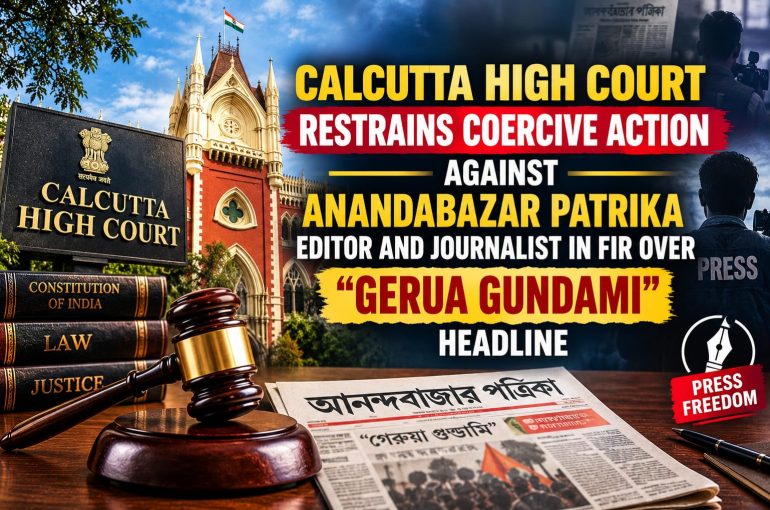
CALCUTTA HIGH COURT RESTRAINS COERCIVE ACTION AGAINST ANANDABAZAR PATRIKA EDITOR AND JOURNALIST IN FIR OVER “GERUA GUNDAMI” HEADLINE

Ishani Datta Ray & Anr. v. The State of West Bengal & Ors., WPA 24272 of 2026
The Calcutta High Court, in an order passed by Justice Saugata Bhattacharyya on 24.09.2026, has restrained the Police from taking coercive steps against two journalists, one of whom is the editor of Anandabazar Patrika, in connection with an FIR registered over a news headline that used the expression “Gerua Gundami” (“Saffron Hooliganism”).
Background
The FIR, registered as Bowbazar Police Station Case No. 180 of 2026 dated 28.08.2026, arose from a complaint dated 27.08.2026. The Complainant alleged that the headline “Gerua Gundami,” used in a news item published in the 21.08.2026 edition of Anandabazar Patrika, hurt Hindu religious sentiment on account of the use of the term “Gerua” (“Saffron”).
The two journalists approached the High Court under its Writ Jurisdiction, questioning the propriety of the FIR and seeking protection from coercive action during the pendency of the investigation.
Proceedings Before the Court
The Court noted that notices under Section 35(3) of the Bharatiya Nagarik Suraksha Sanhita, 2023 (BNSS) had already been issued to the Petitioners and duly complied with. It further noted that the offences invoked in the FIR carry a maximum punishment of less than seven years’ imprisonment. On this basis, the Court held that the Petitioners were entitled to the protection contemplated under Section 35(3) BNSS, which restricts arrest in cases involving offences below this threshold, subject to compliance with the notice procedure.
Senior Advocate Mr. S.N. Mookherjee, appearing for the Petitioners, additionally placed before the Court the text of Section 196 of the Bharatiya Nyaya Sanhita, 2023, seeking to demonstrate that the provision, which deals with promoting enmity between groups, was not attracted on the facts disclosed in the Complaint.
The Court declined to enter into this question at the present stage. It observed that whether Section 196 BNS was attracted or not was a matter falling within the domain of the Investigating Agency, to be examined in the course of completing the investigation.
Interim Protection Granted
Notwithstanding this, the Court directed that the concerned police authorities shall not take coercive steps against the Petitioners till 15.12.2026 or until further orders, whichever is earlier. The Petitioners were directed to cooperate with the investigation and to comply with any further notices issued in connection with the Prosecution.
The Order records a corresponding liberty in favour of the State Respondents: if the Petitioners fail to cooperate with the Investigating Agency, the State may approach the Court by way of an appropriate application seeking variation or vacation of the Protective Order.
Procedural Directions
The Court also noted that the Original Complainant had not been made a party to the Writ Petition. Leave was granted to the Petitioners to amend the Cause Title and implead the Complainant as an additional respondent by the next day, 25.09.2026. Notice, along with a copy of the amended Writ Petition and the Order passed, was directed to be served on the newly added Respondent within seven days, with an affidavit of service to be filed on the next date of hearing.
The Court expressly recorded that, as of the date of the Order, the Complainant had not yet been made a party and had not been served notice. It clarified that the Order was nonetheless being passed taking note of the submission made on behalf of the State respondents that custodial interrogation of the Petitioners was not required.
The matter has been listed for further consideration on 01.12.2026.
Significance
The Order is a further instance of constitutional courts extending interim protection under Section 35(3) BNSS to journalists facing criminal complaints arising out of published content, without entering into an adjudication of whether the underlying penal provision is made out.
Shomdeepta Chanda
Associate
The Indian Lawyer & Allied Services
EDITOR’S COMMENTS
The Court’s approach reflects the settled principle that at the interim stage, particularly where custodial interrogation is not shown to be necessary, coercive action can be held in abeyance while leaving the merits of the complaint, including the applicability of provisions such as Section 196 BNS, to be examined by the investigating agency and, in due course, by the Court itself. This Order also protects journalists who inadvertently use titles that are catchy to attract readers without realising that they might be over reaching their limits as journalists. While the freedom of expression is a fundamental right, it comes with some restrictions that is necessary to protect society.
Sushila Ram Varma
Advocate & Chief Consultant
The Indian Lawyer & Allied Services
Watch our latest video

Leave a Reply