



















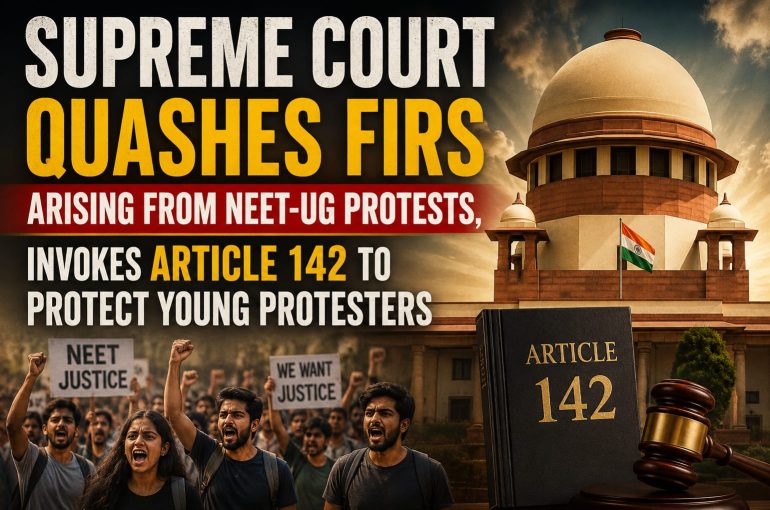
SUPREME COURT QUASHES FIRS ARISING FROM NEET-UG PROTESTS, INVOKES ARTICLE 142 TO PROTECT YOUNG PROTESTERS

INTRODUCTION
In Shailendra Mani Tripathi v. Union of India & Ors., Writ Petition (Criminal) No. 280 of 2026, the Supreme Court of India, by its Order dated 1 September 2026, comprising of the Hon’ble Chief Justice of India Mr. Surya Kant, Hon’ble Mr. Justice Joymallya Bagchi and Hon’ble Mrs. Justice V. Mohana, exercised its extraordinary powers under Article 142 of the Constitution of India and ordered the quashing of FIRs registered in connection with student protests held between 20 July 2026 and 25 July 2026. The Court also directed that similar FIRs relating to the same incidents in other States and Union Territories should not be pursued.
BACKGROUND OF THE CASE
The proceedings arose against the backdrop of protests held by thousands of young students following alleged irregularities in the NEET-UG examination, 2026. The protests took place between 20 July and 25 July 2026 in Delhi and several other parts of the country.
Following these protests, a number of FIRs were registered. The Order records 13 FIRs registered by the Delhi Police, along with several FIRs registered in Bihar, West Bengal, Assam and Maharashtra. The Court noted that thousands of young students had participated in these protests.
The concerned authorities subsequently approached the Supreme Court seeking appropriate directions, including the exercise of the Court’s powers under Article 142 for quashing the FIRs.
WHY DID THE GOVERNMENT AGREE TO DROP THE FIRS?
The Central Government and the Applicant States took a conscious decision not to pursue the FIRs relating to the protests.
The reason was not merely technical. The Court recorded that the decision was taken as a gesture of goodwill, with the objective of ensuring that the FIRs did not prejudice the future of young students who had participated in the peaceful protests. The Court also noted the important principle that mere participation in a protest is not, by itself, an offence under the penal laws.
This aspect is important because an FIR, even when it does not ultimately result in conviction, can have serious consequences for a young person’s education, employment and future prospects.
NO FRESH FIRS FOR THE SAME INCIDENTS
An important assurance placed before the Supreme Court was that no fresh FIR would be registered in Delhi or elsewhere in the country concerning the incidents of protest between 20 July and 25 July 2026.
The Government also agreed that if any other FIR concerning the same incidents was subsequently found, the concerned persons would not be prevented from seeking similar relief from the Supreme Court.
The Court ultimately went a step further. It directed that any other FIR concerning the same incidents, even in States or Union Territories which were not before the Court, would not be pursued or investigated and would be treated as closed.
EXCEPTION FOR PERSONS WITH SERIOUS CRIMINAL ANTECEDENTS
The Order, however, does not provide an unconditional protection to everyone who was present at the protests.
The Delhi Police had sought permission to register a fresh FIR against 2,873 individuals who were alleged to have serious criminal antecedents according to the National Crime Records Bureau database and who were prima facie present at the protest site.
The Court permitted the Central Government/Delhi Police to register a fresh FIR against these individuals, particularly in relation to allegations involving bodily harm or destruction of public property. This was also subject to the earlier clarification of the Court that protection would not extend to persons having criminal antecedents involving grave and heinous offences.
SUPREME COURT INVOKES ARTICLE 142
The central legal aspect of the Order is the invocation of Article 142 of the Constitution.
The Court observed that the Central Government, State Governments and other stakeholders had made commitments before it. Taking into account the future prospects of the young protesters who had participated in the protests in good faith, the Court considered it a fit case to exercise its extraordinary power to do “complete justice” between the parties.
Accordingly, the Court quashed the FIRs specifically listed in the Order and all proceedings arising from them.
COMPENSATION FOR FAMILIES OF STUDENTS
The Order also deals with a separate but important issue concerning students who died by suicide in connection with the NEET-UG Examination, 2026.
The Solicitor General informed the Court that the affected families were situated across different parts of the country and that a uniform, PAN-India approach would therefore be required.
The Court directed the Central Government, in consultation with the State Governments and Union Territories, to formulate a policy or arrangement for payment of compensation to such families within 90 days and to arrange payment thereafter. The Court further observed that such a mechanism could subsequently be adopted by the States and Union Territories as a regular compensatory measure.
A SIGNIFICANT QUALIFICATION: NO BINDING PRECEDENT
There is, however, an important qualification attached to the Order.
The Supreme Court expressly stated that its directions were being issued in the peculiar facts and circumstances of the case and therefore should not be treated as a binding precedent. The exercise of Article 142 was also made conditional upon both sides honouring the statements and commitments made before the Court.
CONCLUSION
The Order represents a balanced approach. On one hand, the Supreme Court protected students who had participated in peaceful protests from the continuing consequences of criminal proceedings. On the other, it permitted investigation against a specifically identified category of persons where there were allegations of bodily harm, destruction of public property and serious criminal antecedents.
More importantly, the Order shows the manner in which Article 142 can be used to bring an end to criminal proceedings in exceptional circumstances where the Court considers it necessary to do complete justice.
At the same time, the Court’s express clarification that the Order is not to be treated as a binding precedent is significant. The decision therefore has considerable practical importance, but its application will have to be understood in the context of the peculiar facts and the settlement placed before the Court in the present proceedings.
SUSHILA RAM VARMA
Advocate & Chief Consultant
The Indian Lawyer & Allied Services
Watch our latest video

Leave a Reply