



















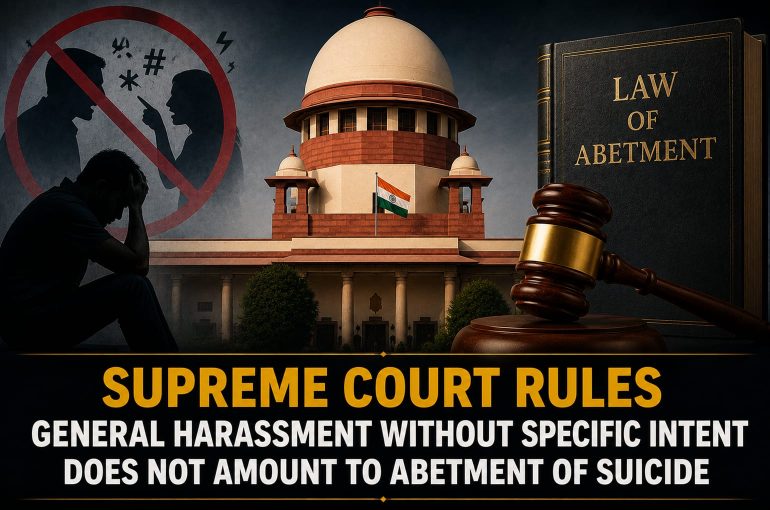
SUPREME COURT RULES GENERAL HARASSMENT WITHOUT SPECIFIC INTENT DOES NOT AMOUNT TO ABETMENT OF SUICIDE

Sanjay Kumar v. State of Himachal Pradesh, Criminal Appeal No. 1108 of 2016 (2026 INSC 948)
The Supreme Court, in Sanjay Kumar v. State of Himachal Pradesh, has set aside a conviction for abetment of suicide under Section 306 read with Section 107 of the Indian Penal Code, 1860, holding that generalised allegations of harassment, unaccompanied by evidence of a specific act of instigation or intent, cannot sustain a conviction under this provision. The judgment was delivered on September 3, 2026 by a Bench comprising Justice Atul S. Chandurkar and Justice Ujjal Bhuyan, with Justice Chandurkar authoring the opinion.
Background
The Appellant, Sanjay Kumar, married the Victim, Lata, in January 2008. The Prosecution alleged that the Appellant’s mother and sisters harassed the Victim after the marriage and that the Appellant himself subjected her to cruelty and torture, including denial of proper food. In November 2009, the Victim consumed a poisonous substance and died during treatment. A charge sheet was filed against the Appellant and three relatives under Sections 498-A and 306 IPC.
Trial Court and High Court Proceedings
The Sessions Court acquitted all four accused. It held that the evidence of dowry demand and cruelty was largely hearsay and stated in general terms, that no injuries were found on the Victim’s body and that no complaint of torture had ever been made to any authority prior to her death. The State appealed the acquittal before the Himachal Pradesh High Court. The High Court upheld the acquittal of the Appellant’s mother and sisters but reversed the acquittal of the Appellant, convicting him under Sections 498-A and 306 IPC. He was sentenced to four years’ rigorous imprisonment for the offence under Section 306 and two years’ rigorous imprisonment under Section 498-A, the sentences to run concurrently.
Findings of the Supreme Court
The Supreme Court held that the High Court erred in reversing the acquittal without recording a finding that the Sessions Court’s view was perverse or impossible on the evidence. This is the settled standard governing appellate interference with an acquittal and the High Court’s judgment, spanning only two paragraphs on the point, did not meet this threshold.
On examination of the Prosecution evidence, the Court found that all witnesses deposed in general terms, without reference to any specific incident of torture, harassment, or dowry demand. The victim’s mother admitted in cross-examination that she never reported the alleged torture to any authority and that the victim and appellant appeared happy whenever they visited her. The victim’s sisters similarly testified that they were treated well on their visits to the matrimonial home and gave no specific instance of mistreatment. A neighbour testified that the appellant enjoyed good social standing, that she had never heard of any marital dispute and that the appellant had tried his best to save the victim’s life. The Court also noted that omissions were established in cross-examination regarding claims of physical abuse allegedly made before the police, which the witnesses admitted they had not stated.
The medical and forensic evidence established that the Victim died from ingestion of a poisonous substance (endosulfan), with no injuries found on her body. A pharmacist who was called by the Appellant on the day of the incident testified that the Appellant sought immediate medical assistance and administered an injection before taking the Victim to hospital.
The Court held that the High Court’s finding that the Appellant had abused and dragged the victim in the presence of her mother and sisters was not supported by the record, since the very witnesses who allegedly made such statements admitted in cross-examination that they had made no such statements to the police.
Legal Position on Section 306 IPC
The Court held that ordinary domestic discord in a marriage, without more, does not attract Section 306 read with Section 107 IPC. Abetment requires evidence of a specific act on the part of the accused instigating or aiding the act of suicide. General allegations of harassment, without particulars and without evidence connecting such harassment to the act of suicide, do not meet this standard. The Court observed that the appellant’s conduct in immediately seeking medical aid and shifting the victim to hospital on realising she had ingested the substance was inconsistent with the case set up by the Prosecution.
Conclusion
The Supreme Court held that the Sessions Court had correctly concluded that the Prosecution failed to prove the charges beyond reasonable doubt and that the High Court committed an error in reversing that acquittal. The High Court’s Judgment dated 17.08.2016 in Criminal Appeal No. 566 of 2010 was quashed and set aside. The Appellant was acquitted of all charges and his bail bonds were cancelled. The Appeal was allowed.
Shomdeepta Chanda
Associate
The Indian Lawyer & Allied Services
Editor’s Comments
This case is a classic example of how a false criminal case can wreck a person’s future. The fact that the Appellant was a good husband could have been proved because of his good social standing. Implicating a person in a false criminal case is very easy in India. It is the Appellant’s good luck that the Supreme Court after examining the evidence noticed the discrepancies in the averments and let the Appellant go free.
Sushila Ram Varma
Advocate & Chief Consultant
The Indian Lawyer & Allied Services
Watch our latest video

Leave a Reply