



















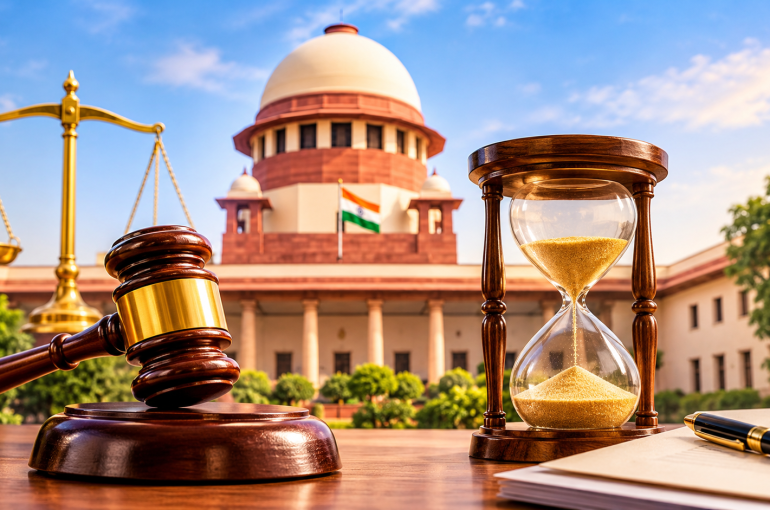
Supreme Court Clarifies Section 29A : Extension of Arbitral Mandate Remains Available Even After an Award

Introduction
Section 29A of the Arbitration and Conciliation Act, 1996 (the “Act”) prescribes timelines within which an arbitral tribunal must make its award and empowers the Court to extend those timelines. A persistent question has been whether the Court can still extend the mandate once the prescribed period has lapsed and more pointedly, once the tribunal has already passed an award during the lapsed period. In C. Velusamy v. K. Indhera (Civil Appeal No. 696 of 2026), decided on 3 February 2026, a Bench of Justice P.S. Narasimha and Justice A.S. Chandurkar have answered the question in favour of maintainability.
Factual Background
Disputes between the Parties were referred to arbitration. The Arbitrator delivered the Award about three months after the mandate had expired. The Respondent, K. Indhera, approached the Madras High Court under Section 34 of the Act to set aside the Award, contending that it was passed after the mandate had expired and the proceedings had terminated. The Appellant, C. Velusamy, in turn filed an Application under Section 29A seeking extension of the mandate.
By its Order dated 24 January 2025, the High Court held that an award rendered after expiry of the mandate was a nullity and dismissed the Extension Application as not maintainable. Relying on that Order, the High Court subsequently allowed the Section 34 Petition. The Appellant carried the matter to the Supreme Court.
Issue Before the Court
The Court was called upon to decide whether an application under Section 29A(5) for extension of the Arbitrator’s mandate can be entertained after the eighteen-month statutory period has run out and even after an award has been pronounced.
Analysis and Reasoning
The Court examined the legislative history of Section 29A, including the 176th Report of the Law Commission of India, the Statement of Objects and Reasons of the 2015 Amendment and relevant literature. It also drew on the observations of a coordinate Bench in Rohan Builders (India) (P) Ltd. v. Berger Paints (India) Ltd. (2025) 10 SCC 802.
The Court noted that the Arbitration Act, 1940 expressly allowed courts to enlarge time even after the prescribed period had expired or an award had been made. The 1996 Act, in its original form, set no timeline at all. The Law Commission proposed a structured timeline, but stressed that arbitral proceedings subsist until an award is made, so that time, costs and evidence already invested are not wasted. The 2015 amendment, according to its Statement of Objects and Reasons, was aimed at making arbitration user-friendly, cost-effective and expeditious.
From this, the Court inferred that Parliament intended proceedings to culminate in an award, with judicial intervention serving as a facilitative and corrective device against delay and not as a means of aborting the arbitral process. The scheme of Section 29A supports this reading: Section 29A(4) permits extension before or after expiry of the period; its proviso allows proceedings to continue while an extension application is pending and Sections 29A(6) and (7) ensure that proceedings carry on uninterrupted once an extension is granted.
The Court also followed Rohan Builders, where it was observed that if an award is pronounced while an extension application is pending, the court must still decide that application and, where needed, may invoke Sections 29A(6) to (8) or the first and third provisos to Section 29A(4). Accordingly, the Court held that Section 29A cannot be read to create a threshold bar against an application under Section 29A(5) merely because the award came after the mandate expired.
Decision
The Court held that the power under Section 29A(4) may be exercised either before or after the statutory period ends and that the tribunal’s failure to render the award within time does not impair that jurisdiction. An application for extension is therefore maintainable even after expiry of the period and even where an award has already been passed in the interim. No outer time limit is prescribed for exercising this power, save the court’s own discretion.
Where an extension is granted in such circumstances, the tribunal proceeds from the stage at which its mandate expired and concludes within the time fixed by the court. The Court allowed the appeal, set aside the High Court’s Judgment of 24 January 2025, restored the Appellant’s extension application and directed the High Court to decide it in accordance with the principles laid down.
Significance
The ruling removes the uncertainty created by the view that a late award is automatically a nullity incapable of being rescued. It signals that courts should look to the substance of the arbitral process and its legislative purpose, rather than treat the lapse of time as fatal.
At the same time, the Court has left the question of extension to judicial discretion. A party seeking extension after an award will still have to persuade the court that the circumstances justify it and the opposing party may still object. The decision does not dispense with scrutiny.
Shomdeepta Chanda
Associate
The Indian Lawyer & Allied Services
Editor’s Comments
- Velusamy v. K. Indhera consolidates a purposive reading of Section 29A. By confirming that the court’s power to extend the mandate survives both expiry of time and the passing of an award, the Supreme Court has aligned the provision with the Act’s objective of ensuring that arbitral proceedings reach a conclusion, while keeping judicial oversight over delay firmly in place. Arbitration is a widely used dispute resolution mechanism and as such a delay in the passing of the award should not prejudice the rights of the parties. Courts should understand and appreciate that a lot of time and money has gone into the process before declaring an award to be null and void.
Sushila Ram Varma
Advocate and Chief Consultant
The Indian Lawyer & Allied Services
Please log onto our YouTube channel, The Indian Lawyer Legal Tips, to learn about various aspects of the law. Our latest Video, titled “18+ Rule For All Religions, No One Above POCSO & PCMA” can be viewed at the link below:

Leave a Reply