



















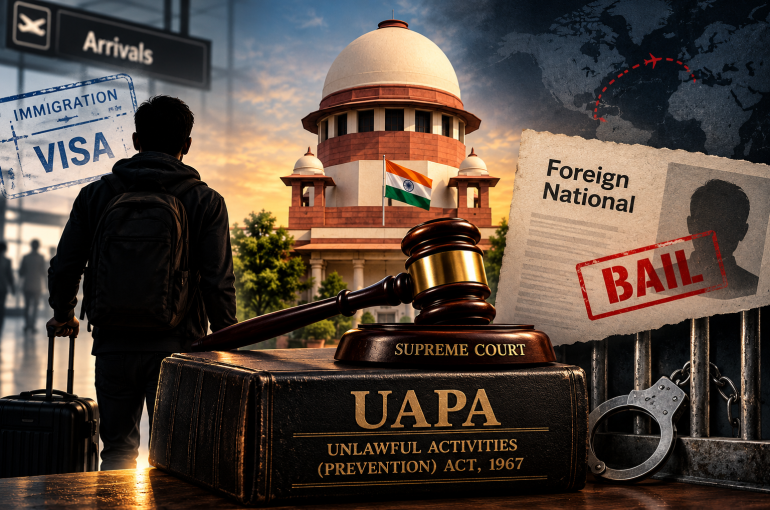
SUPREME COURT CLARIFIES FOREIGN NATIONALS ACCUSED UNDER UNLAWFUL ACTIVITIES (PREVENTION) ACT, 1967 CAN STILL CLAIM DEFAULT BAIL: SCOPE OF SECTION 43D(7) DISCUSSED

INTRODUCTION
The Supreme Court of India, in Union of India v. Mohamed Rifas @ Mohamed Rigbas, 2026 INSC 1160, delivered an important Judgment on 27 October 2026 concerning the restrictions on grant of bail to foreign nationals accused under the Unlawful Activities (Prevention) Act, 1967 (UAPA)(hereinafter referred to as ‘the Act’). The Court examined the scope of Section 43D(7) of the Act and clarified the circumstances in which the statutory restriction on bail can be invoked against a foreign national.
The Judgment is significant because it distinguishes between entering India illegally and subsequently overstaying after entering the country lawfully. The Court also clarified that the restriction under Section 43D(7) does not take away the right to Default Bail under Section 167(2) of the Code of Criminal Procedure, 1973, as applicable to UAPA cases through Section 43D(2).
BRIEF FACTS
The Respondent, Mohamed Rifas, was arrayed as an Accused in an FIR registered in Tamil Nadu in April 2018 under various provisions of the Indian Penal Code, 1860, the UAPA and the Arms Act, 1959. The allegations related to an alleged conspiracy to disturb communal harmony and wage an armed struggle against the Government of India.
On 5 July 2018, the Sessions Court granted him Default Bail under Section 167(2) CrPC because the Investigating Agency had failed to file the Charge Sheet within the prescribed statutory period.
Subsequently, the National Investigation Agency took over the investigation and filed a Charge Sheet in January 2021. Meanwhile, another FIR was registered in November 2019 alleging that the Respondent was a Sri Lankan national who had entered India in 2009, overstayed his visa and obtained Indian identity documents.
Relying on these allegations, the Union of India sought cancellation of the bail granted to the Respondent. It contended that, being a foreign national who had entered India illegally, he was covered by the prohibition contained in Section 43D(7) of the UAPA.
The Special Court cancelled his bail in July 2022. However, the Madras High Court set aside that Order in December 2023. The Union of India thereafter approached the Supreme Court.
ISSUES OF LAW
The principal questions before the Supreme Court were:
- Whether Section 43D(7) of the UAPA prohibits the grant of bail to every Foreign National accused under the Act or only to those who have entered India unauthorizedly or illegally.
- Whether subsequent expiry or revocation of a visa can be treated as illegal or unauthorised entry into India for the purpose of Section 43D(7).
- Whether the restriction under Section 43D(7) overrides the statutory right to Default Bail under Section 167(2) CrPC.
- Whether the bail granted to the Respondent could be cancelled on the grounds raised by the Union of India.
ANALYSIS OF THE JUDGMENT
The Supreme Court examined Section 43D(7) of the UAPA, which provides that a person accused of an offence under the Act, who is not an Indian citizen and has entered India unauthorizedly or illegally, shall not be granted bail except in very exceptional circumstances and for reasons recorded in writing.
The Court identified three essential conditions for invoking this provision: the person must be accused of an offence under the UAPA, must not be an Indian citizen and must have entered India unauthorizedly or illegally. Importantly, these conditions must exist together. Merely establishing that an accused is a foreign national is not sufficient.
The Court further clarified that the legality of entry must be examined at the time the person initially entered India. If a foreign national entered India through a valid visa or other lawful authorisation, the subsequent expiry or revocation of that authorisation does not retrospectively make the original entry illegal. Consequently, subsequent overstaying cannot, by itself, attract the restriction under Section 43D(7).
The Court also explained that even where all three conditions are prima facie established, the provision recognises a narrow exception for granting bail in very exceptional circumstances, provided reasons are recorded in writing. The burden of establishing such exceptional circumstances rests upon the Accused.
Another significant aspect of the Judgment concerns Default Bail. The Court observed that Section 43D(2) of the UAPA modifies Section 167 CrPC by extending the period available for completion of investigation, but does not eliminate the right to Default Bail. The overriding effect of Section 43D(7) is confined to sub-sections (5) and (6) of Section 43D and does not extend to sub-section (2). Therefore, the statutory right to Default Bail remains available even in cases involving foreign nationals.
On the question of the alleged confession made by the Respondent to a Village Administrative Officer, the Court held that such a confession is not automatically inadmissible under Section 25 of the Evidence Act, since a Village Administrative Officer is not a police officer for the purposes of that provision. Its voluntariness, truthfulness and credibility would, however, have to be examined by the Trial Court.
Finally, the Court reiterated the distinction between setting aside an erroneous bail order and cancelling bail on account of subsequent circumstances or misconduct. It found that the Prosecution had failed to establish that the Respondent had initially entered India illegally. It also noted that no sufficient ground had been shown to justify cancellation of the Default Bail and that the delay in seeking cancellation had not been satisfactorily explained.
CONCLUSION
The Judgment reinforces the principle that restrictions on personal liberty must be applied strictly in accordance with the statutory conditions prescribed by law. Section 43D(7) of the UAPA cannot be invoked merely because an accused is a foreign national or has subsequently overstayed a visa. The Prosecution must prima facie establish that the person’s initial entry into India was unauthorised or illegal.
The decision also confirms that the right to Default Bail under Section 167(2) CrPC continues to operate in UAPA cases, subject to the extended investigation period prescribed under Section 43D(2).
By dismissing the Union of India’s Appeal and affirming the Madras High Court’s Order, the Supreme Court has clarified the limits of the statutory restriction on bail while reaffirming the importance of protecting personal liberty within the framework of the law.
SARTHAK KALRA
Senior Legal Associate
The Indian Lawyer & Allied Services
Please log onto our YouTube channel, The Indian Lawyer Legal Tips, to learn about various aspects of the law. Our latest Video, titled “18+ Rule For All Religions, No One Above POCSO & PCMA” can be viewed at the link below:

Leave a Reply