



















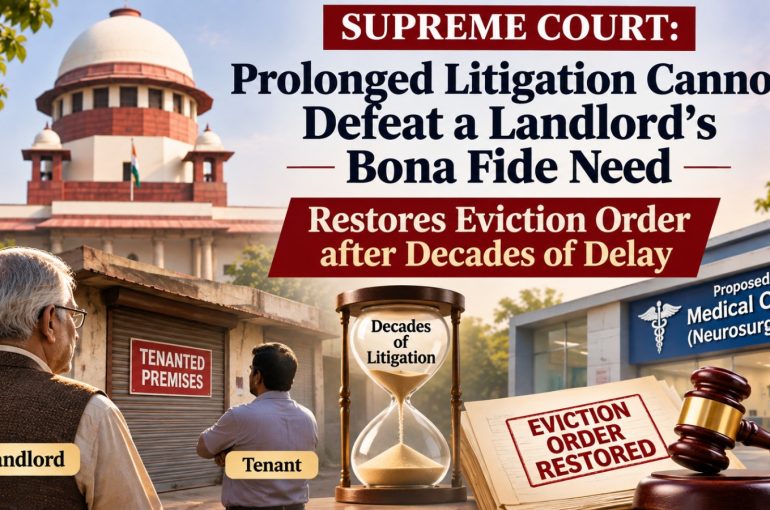
PROLONGED LITIGATION CANNOT DEFEAT A LANDLORD’S BONA FIDE NEED: SUPREME COURT RESTORES EVICTION ORDER AFTER DECADES OF DELAY

INTRODUCTION
In a significant Order concerning Landlord–Tenant disputes, the Supreme Court of India has held that the passage of several decades during litigation cannot be allowed to defeat a Landlord’s legitimate and bona fide requirement of the tenanted premises. The Court emphasised that where proceedings have remained pending for an extraordinarily long period, an initial technical impediment relating to the institution of the proceedings may cease to be decisive.
In Devendra Nath Mishra & Ors. v. Ravi Bajpai; SLP (Civil) No. 25567 of 2025), the Supreme Court applied the principles laid down in Ravi Khandelwal v. Taluka Stores and restored the Eviction Order passed by the Prescribed Authority and affirmed by the Appellate Authority. The decision underscores the importance of balancing procedural restrictions with the interests of justice, particularly where a Landlord has been prevented from using the property for the purpose for which it was genuinely required.
BRIEF FACTS OF THE CASE
The Appellants were the Landlords of the premises in dispute, ownership of which they had acquired on 10 July 1984. Following the acquisition, a Statutory Notice was issued under Section 21(1)(a) of the Uttar Pradesh Urban Buildings (Regulation of Letting, Rent and Eviction) Act, 1972, requiring the Tenant to vacate the premises upon the expiry of three years.
Despite the Statutory Notice and assurances reportedly given before the Prescribed Authority as far back as 1988, the Respondent-Tenant did not vacate the premises. The Landlords sought eviction on the ground of bona fide requirement, stating that the premises were required to establish a medical clinic for their son, who is a neurosurgeon.
The Prescribed Authority considered the pleadings and evidence and accepted the Landlords’ claim of bona fide requirement. Accordingly, an Eviction Order was passed on 12 December 2012. The Tenant challenged the Order before the Appellate Authority, but the Appeal was dismissed and the Eviction Order was affirmed.
The Tenant thereafter approached the Allahabad High Court under Article 227 of the Constitution of India. The High Court allowed the Petition in favour of the Tenant, setting aside the Orders passed by the Authorities below. Aggrieved by the High Court’s decision, the Landlords approached the Supreme Court.
ISSUES OF LAW
The principal issue before the Supreme Court was whether an Eviction Order founded upon the Landlord’s bona fide requirement could be sustained when the proceedings had continued for several decades and the tenant had remained in occupation throughout that period.
The Court was also required to consider whether an initial technical impediment concerning the timing of institution of the proceedings should continue to defeat the Landlord’s claim despite the extraordinary passage of time during litigation.
ANALYSIS OF THE JUDGMENT
The Supreme Court examined the statutory framework under Section 21 of the Uttar Pradesh Urban Buildings (Regulation of Letting, Rent and Eviction) Act, 1972 and relied upon its earlier decision in Ravi Khandelwal v. Taluka Stores (2023) 7 SCC 720.
In Ravi Khandelwal, the Court had considered a situation where the proceedings had been instituted within the initial five-year period of the tenancy. However, by the time the matter reached the Supreme Court, more than 38 years had elapsed. The Court had observed that such an extraordinary passage of time could not be ignored and that the initial impediment against institution of the proceedings would, in the circumstances of that case, stand washed away.
The Supreme Court had specifically cautioned against an interpretation that would require the Landlord to commence fresh proceedings after decades of litigation. Such an approach would effectively reward prolonged litigation and defeat the very purpose of the statutory restriction.
Applying this reasoning in the present case, the Supreme Court took note of the fact that the Landlords had acquired the premises in 1984 and that the Tenant had continued to occupy the property for approximately four decades. The Court also highlighted that the Landlords’ Son, a neurosurgeon, had been unable to establish his medical clinic in the premises because the property had not been vacated.
The Court considered that the Landlord’s bona fide requirement had already been accepted by the Prescribed Authority and that the Appellate Authority had affirmed that finding. In these circumstances, allowing the High Court’s Order to stand would have resulted in further frustration of the Landlords’ legitimate requirement.
The Supreme Court accordingly held that the interests of justice would be served by setting aside the High Court’s Order and restoring the concurrent findings and Eviction Orders passed by the authorities below.
The Court directed the Tenant to hand over vacant and peaceful possession of the premises within thirty days. The Tenant was also directed to clear all outstanding arrears of rent, together with any current rent due, within the same period.
SARTHAK KALRA
Senior legal Associate
The Indian lawyer & Allied Services
EDITOR’S COMMENTS
The Landlord had to wait for almost 36 years to get back his tenanted premises despite making out a case for bona fide use. The fact that more than three decades had passed before he got his property reflects very poorly on the system and erodes the confidence of the common man on the legal system.
The decision in Devendra Nath Mishra & Ors. v. Ravi Bajpai reinforces the principle that procedural and technical objections must be considered in the context of the overall circumstances of a case. While statutory restrictions governing eviction proceedings remain important, they cannot be interpreted in a manner that allows decades of litigation to permanently frustrate a Landlord’s bona fide requirement.
The Judgment also highlights the need to prevent prolonged proceedings from becoming an advantage for a tenant who continues to retain possession despite an eviction order being upheld by the competent authorities.
By restoring the Eviction Order and directing delivery of possession within thirty days, the Supreme Court has reaffirmed that the administration of justice must take account of the realities of prolonged litigation and must not permit procedural technicalities to defeat substantive rights.
SUSHILA RAM VARMA
Advocate & Chief Consultant
The Indian Lawyer & Allied Services
Please log onto our YouTube channel, The Indian Lawyer Legal Tips, to learn about various aspects of the law. Our latest Video, titled “Can a Finance Company Forcefully Recover Your Vehicle? Know Your Rights” can be viewed at the link below:
https://www.youtube.com/watch?v=w4RkuvlhyYU

Leave a Reply