


















BEYOND INSURANCE COVERAGE THE PURSUIT OF COMPLETE JUSTICE UNDER ARTICLE 142

INTRODUCTION
In Sukumarbai & Ors. v. United India Insurance Company Ltd. & Anr., 2026 INSC 1272, decided on 25 November 2026, a three-Judge Bench of the Supreme Court of India comprising Justices Vikram Nath, Sandeep Mehta and Aparesh Kumar Singh considered two important questions under the Motor Vehicles Act, 1988. The Court examined whether an occupant of a private vehicle is automatically covered under an “Act Only Policy” (An “Act Only Policy” also called third party only covers legal liability towards third party for bodily injury, death and property damage caused by the insured vehicle but it does not pay anything for the damage, if any, to the insured’s vehicle). It also considered whether an insurer, despite having no statutory or contractual liability, can be directed to pay compensation first and subsequently recover the amount from the vehicle owner under Article 142 (Enforcement of decrees and orders of Supreme Court and orders as to discovery, etc) of the Constitution. The Judgment draws an important distinction between the scope of insurance coverage and the Court’s constitutional power to prevent substantial injustice.
BRIEF FACTS
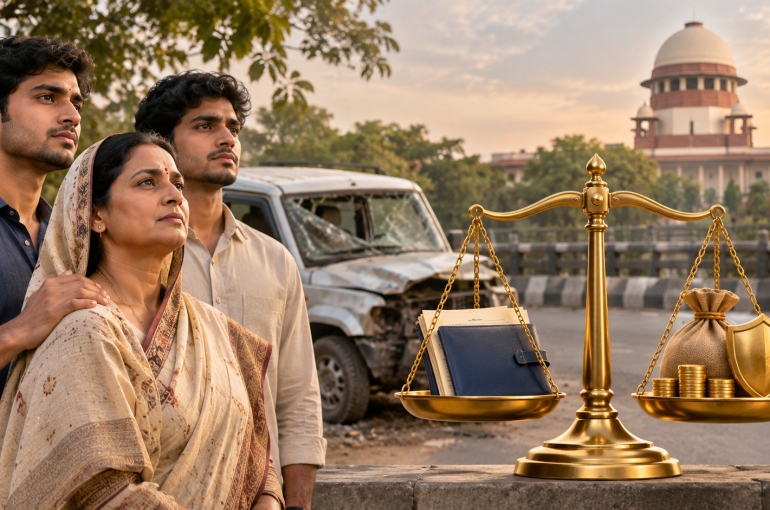
On 15 April 2012, the Deceased was travelling in a Car after attending a marriage ceremony. During the return journey, the Car, driven by its owner, allegedly at a high speed and in a rash and negligent manner, lost control, struck the railing of a bridge and overturned. Deceased sustained serious injuries and eventually succumbed to them during treatment.
His Wife and two Sons instituted a Claim Petition under Section 166 (Application for compensation) of the Motor Vehicles Act before the Motor Accident Claims Tribunal, Latur. The Tribunal held that the accident had occurred due to the owner’s rash and negligent driving. It awarded compensation of Rs.7,79,800/-, together with interest at 7.5% per annum and directed the Insurance Company to satisfy the award first and thereafter recover the amount from the Car owner. However, the Tribunal also found that the Car had been hired for attending the marriage ceremony and that no additional premium had been paid for passenger coverage.
Aggrieved by the Tribunal Order to pay and recover, the Insurance Company approached the Bombay High Court. The High Court maintained the compensation awarded but held that the Deceased, being a passenger in a private vehicle insured under an “Act Only Policy”, was not covered by the insurance policy. It consequently set aside the Order to pay and recover, leaving the Car owner solely responsible for satisfying the award. The Deceased’s Wife and his Sons thereafter approached the Supreme Court.
ISSUES OF LAW
- Whether an occupant of a private vehicle or a pillion rider is automatically covered as a third party under Section 147 (Requirements of policies and limits of liability) of the Motor Vehicles Act when the vehicle is insured under an “Act Only Policy” and no additional premium has been paid?
- Whether the Supreme Court can, in exercise of its powers under Article 142 of the Constitution, direct an insurer having no statutory or contractual liability to satisfy a compensation award first and subsequently recover the amount from the person legally responsible?
ANALYSIS OF THE JUDGMENT
On the first issue, the Court examined Sections 145 (Definitions), 146 (Necessity for insurance against third party risk) and 147 of the Motor Vehicles Act and distinguished between compulsory statutory coverage and additional contractual coverage. It observed that the expression ‘third party’ cannot be interpreted in isolation to mean that every person other than the insured and the insurer is automatically entitled to insurance coverage. The nature of the risk must also fall within the coverage mandated by the statute or undertaken under the insurance policy.
Relying upon decisions including New India Assurance Co. Ltd. v. Asha Rani, National Insurance Co. Ltd. v. Baljit Kaur and United India Insurance Co. Ltd. v. Tilak Singh, the Court reaffirmed that an “Act Only Policy” does not automatically cover a gratuitous occupant of a private vehicle or a pillion rider. A comprehensive or package policy may, however, provide wider coverage depending upon its terms. Since no additional premium had been paid for passenger coverage in the present case, the Insurance Company was held to have no statutory or contractual liability.
The second issue required the Court to examine the scope of Article 142. It clarified that the power to do complete justice is wide but not unlimited. It cannot be routinely exercised to disregard the statutory framework or impose a general insurance obligation upon an insurer for risks that it was neither required nor contractually bound to cover. Nevertheless, the absence of statutory or contractual liability does not create an absolute bar against exceptional intervention by the Supreme Court.
Importantly, the Court laid down four requirements for granting pay and recover relief under Article 142. First, the liability of the person responsible must already be established and enforceable. Second, exceptional circumstances must demonstrate that ordinary recovery would result in substantial injustice. Third, the direction must be necessary and proportionate, keeping the interests of the insurer in consideration. Fourth, procedural fairness and effective safeguards for recovery must be ensured. The Court clarified that these requirements must be considered collectively and do not create an automatic entitlement to relief.
Applying these principles, the Court took note of the prolonged litigation, the fact that the compensation award had remained unrealised and the financial difficulties stated by the Deceased’s Wife and age related medical infirmities. Considering the circumstances collectively, it found that exceptional intervention was warranted, without shifting the ultimate legal responsibility away from the Car owner.
CONCLUSION
The Supreme Court affirmed the High Court’s finding that the Insurance Company had no statutory or contractual liability, but modified the impugned Judgment in exercise of its powers under Article 142. It directed the Insurance Company to satisfy the outstanding compensation, together with interest at 7.5% per annum, after adjusting any amount already received by the Claimants. The Tribunal was directed to determine the outstanding amount within four weeks, following which the Insurance Company was required to deposit it within eight weeks. The Insurance Company was also granted liberty to recover the amount from the Car owner through execution proceedings before the Tribunal, without instituting a separate suit.
The Judgment is significant because it draws a clear distinction between the scope of insurance coverage and the constitutional power to secure complete justice. While protecting insurers from being made automatically liable for uninsured risks, the Court recognised that a compensation award must provide more than a remedy existing merely on paper. The Judgment lays down clear guidelines for granting pay and recovers relief under Article 142. It ensures that such relief is granted only in exceptional circumstances, where it is genuinely necessary to secure justice and provide meaningful compensation to accident victims and their families.
TRISHMA KASHYAP
Legal Associate
The Indian Lawyer & Allied Services
Editor’s Comment
Though the insurance company is not liable to pay compensation to the victim’s family in the present case the Apex Court in order to do complete justice directed the insurance company to pay compensation as it felt it was genuinely required to meet the ends of justice in a case where the widow was left with no means to support herself. The law of liability makes the insurance company primarily liable, with the right to recover the amount paid by the insurance company from the policy holder.
SUSHILA RAM VARMA
Advocate & Chief Consultant
The Indian Lawyer & Allied Services
Please log onto our YouTube channel, The Indian Lawyer Legal Tips, to learn about various aspects of the law. Our latest Video, titled “Can Dadi-Dada/Nani-Nana Become Legal Guardians!” can be viewed at the link below:
https://www.youtube.com/watch?v=Sa5zUOBPKoM