



















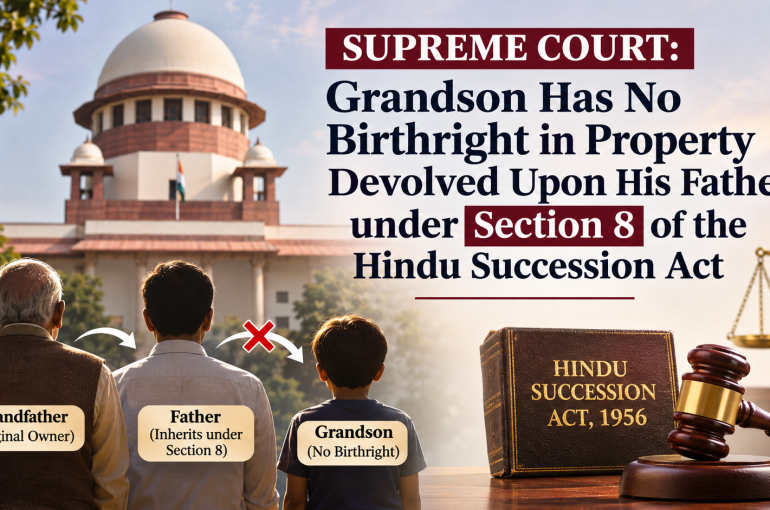
GRANDSON HAS NO BIRTHRIGHT IN PROPERTY DEVOLVED UPON HIS FATHER UNDER SECTION 8 OF THE HINDU SUCCESSION ACT: SUPREME COURT

INTRODUCTION
The Supreme Court of India, in J. Rajesh (Minor) v. M. Kumaran (Dead) through LRs & Ors., 2026 INSC 1208, decided on 6 November 2026, examined an important question concerning the rights of a grandson in property inherited by his father from his grandfather. The Court clarified that where the property of a Hindu male dying intestate devolves upon his Class I heirs under Section 8 of the Hindu Succession Act, 1956, the son who inherits such property becomes its absolute owner in his individual capacity. His own son does not acquire an independent right by birth in that property merely because it was ancestral in the hands of the grandfather.
The Judgment reiterates the settled legal position that the rules of succession under Section 8 of the Hindu Succession Act override the traditional concept of a son’s birthright in his father’s property. It also clarifies the effect of a subsequent partition among the legal heirs and the applicability of the Tamil Nadu Amendment relating to coparcenary rights.
BRIEF FACTS
The dispute concerned a property measuring 1,811 square feet, which originally belonged to the Grandfather, N. Ramakrishnan. Upon his death, the property devolved upon his legal heirs. A Partition Suit was instituted in 1993 by the Grandfather’s Daughter and the dispute was ultimately resolved through a compromise dated 3 February 1994. Under the Compromise Decree, the Appellant’s Father received a specific share in the property.
The Appellant, J. Rajesh, was born on 6 January 1994, shortly before the Compromise Decree was passed. He subsequently filed a Suit for Partition and Possession, claiming that he had acquired coparcenary rights in the property by birth and was entitled to a half share. He contended that the property continued to retain its ancestral character even after it was allotted to his Father under the Partition.
The Father had executed two Sale Deeds dated 3 April 1997 and 17 April 1997 in favour of the Purchasers, who were impleaded as Defendants. The Purchasers contested the Suit, asserting that the Father had become the absolute owner of the property allotted to him and was competent to transfer it.
The Trial Court granted a Preliminary Decree for partition in favour of the Appellant. However, the First Appellate Court reversed that decision, holding that the Father had acquired absolute ownership under the Hindu Succession Act and that the Appellant had no birth right in the property. The High Court affirmed the appellate decision. Aggrieved, the Appellant approached the Supreme Court.
ISSUES OF LAW
The principal issues before the Supreme Court were:
- Whether a grandson acquires a right by birth in property inherited by his father from his grandfather under Section 8 of the Hindu Succession Act, 1956.
- Whether property that was originally ancestral retains its coparcenary character after devolving upon the Grandfather’s Class I heirs and being divided through partition.
- Whether Section 29-A of the Hindu Succession Act, as inserted by the Tamil Nadu Amendment Act, 1989, preserved the Appellant’s alleged coparcenary rights.
- Whether the Appellant could claim a share in the property allotted to his Father, who was still alive, on the basis of birthright under Mitakshara Hindu law.
ANALYSIS OF THE JUDGMENT
The Supreme Court examined the scheme of succession under Sections 6 and 8 of the Hindu Succession Act, 1956 and reiterated the distinction between property devolving through coparcenary succession and property inherited by an individual under the statutory rules of intestate succession.
The Court relied upon its earlier decision in C.W.T. v. Chander Sen, wherein it was held that when a Hindu male dies intestate and his property devolves upon his son under Section 8, the son inherits it in his individual capacity and not as the Karta of his own Hindu Undivided Family. This is because the Schedule to Section 8 includes a son as a Class I heir but does not include the son of a living son. The statutory scheme, therefore, does not permit a grandson to claim an independent right by birth in property inherited by his father under that provision.
The Court also referred to Bhanwar Singh v. Puran and Radha Bai v. Ram Narayan, reiterating that once property devolves upon the Class I heirs under Section 8 and is subsequently partitioned, the respective heirs become absolute owners of their allotted shares. They hold the property as tenants-in-common and not as members of a continuing coparcenary. Consequently, the property allotted to the father does not automatically become joint family property vis-à-vis his own son.
Applying these principles, the Court observed that upon the death of N. Ramakrishnan, his property devolved upon his Class I heirs under Section 8. The surviving sons and daughters succeeded simultaneously and became entitled to their respective shares. Under the Compromise Decree dated 3 February 1994, the Father of the Appellant became the exclusive owner of the property allotted to him. The joint coparcenary of the Grandfather’s Family did not continue after the statutory succession and subsequent partition.
The Appellant also relied upon Section 29-A of the Hindu Succession Act, inserted through the Tamil Nadu Amendment Act, 1989, to contend that his coparcenary rights remained protected. The Court rejected this argument. It held that Section 29-A could not assist the Appellant in the facts of the case because the succession had already opened upon the death of the Grandfather before the Appellant’s birth. The provisions of Section 6 of the Hindu Succession Act and Section 29-A of the Tamil Nadu Amendment Act were, therefore, not applicable to create a coparcenary interest in the Appellant.
The Court further noted that the Appellant had not challenged the Compromise Decree or the Sale Deeds executed by his Father. The Suit was instituted on the premise that the Appellant had acquired coparcenary rights by birth, despite the property having already devolved upon the Class I heirs and been divided among them.
Accordingly, the Supreme Court found no infirmity in the High Court’s decision and held that the Appellant could not claim a share in the property merely on the basis of his birth.
SARTHAK KALRA
Senior Legal Associate
The Indian Lawyer & Allied Services
Editor’s Comments
The Supreme Court dismissed the Appeal, reaffirming that property inherited by a Hindu male under Section 8 of the Hindu Succession Act, 1956, is held by him in his individual capacity and does not automatically become coparcenary property in relation to his own son. Once the property devolves upon the Class I heirs and is subsequently partitioned, the share allotted to each heir becomes their exclusive property.
The Judgment is significant because it reiterates the distinction between ancestral property in the traditional sense and property that devolves through statutory succession under the Hindu Succession Act. It makes clear that the mere fact that property originally belonged to a grandfather does not confer an automatic birth right upon a grandson when the property has devolved upon the father under Section 8 of the Act.
The decision reinforces the supremacy of the codified law of succession over inconsistent principles of traditional Hindu law and provides clarity on the limits of a grandson’s claim to property held by his living father.
Sushila Ram Varma
Advocate and Chief Consultant
The Indian Lawyer & Allied Services
Please log onto our YouTube channel, The Indian Lawyer Legal Tips, to learn about various aspects of the law. Our latest Video, titled “Can a Finance Company Forcefully Recover Your Vehicle? Know Your Rights” can be viewed at the link below:
https://www.youtube.com/watch?v=w4RkuvlhyYU

Leave a Reply