



















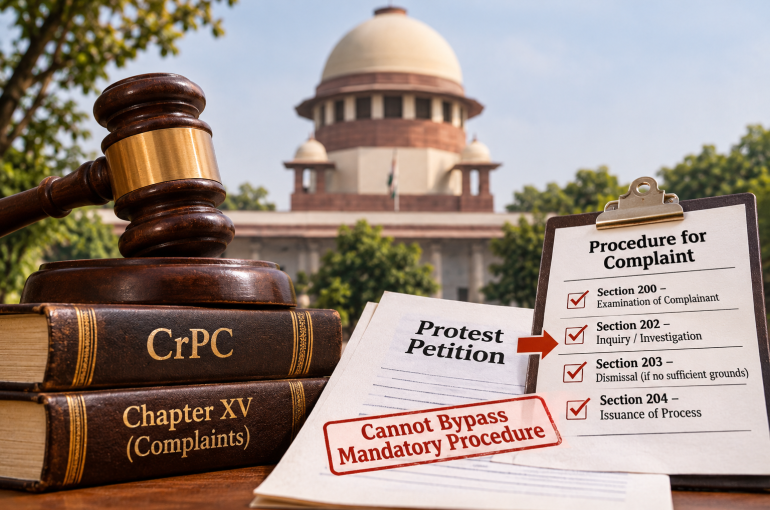
SUPREME COURT SETS ASIDE SUMMONING ORDER PASSED ON PROTEST PETITION: MAGISTRATE MUST FOLLOW COMPLAINT PROCEDURE

INTRODUCTION
In Deepti Singh v. State of U.P. & Anr., 2026 INSC 1264, decided on 25 November 2026, the Supreme Court of India, comprising Justice Prashant Kumar Mishra and Justice Shree Chandrashekhar, examined whether a Magistrate can summon a person not charge-sheeted by the police on the basis of a Protest Petition without following the procedure prescribed for complaints under the Code of Criminal Procedure, 1973 (CrPC).
The Court clarified that a Protest Petition may be treated as a complaint, but the Magistrate must follow the procedure prescribed under Chapter XV of the CrPC before issuing process against the proposed accused.
BRIEF FACTS OF THE CASE
The case arose from the death of Abhishek Singh following an altercation with his neighbour, Gaurav Singh, the husband of the Appellant, Deepti Singh. An FIR was registered under Sections 302, 352 and 504 IPC on the complaint of the deceased’s Sister, who alleged that Gaurav Singh, instigated by the Appellant, had assaulted her brother.
After investigation, the police filed a charge sheet against Gaurav Singh under Sections 323, 504 and 506 IPC. The Appellant was not charge-sheeted, as her involvement was not established.
Dissatisfied with the investigation, the Informant filed a Protest Petition alleging that the investigation was unfair and that material evidence and witness statements had not been properly considered.
On 25 March 2025, the Chief Judicial Magistrate, Banda, took cognizance of offences under Sections 302, 201, 218, 504 read with Sections 34 and 120B IPC and summoned the Appellant, her husband, medical practitioners and several police officials.
The Appellant challenged the Order before the Allahabad High Court under Section 528 of the Bharatiya Nagarik Suraksha Sanhita, 2023 (BNSS). The High Court dismissed her Application, prompting her Appeal before the Supreme Court.
ISSUES OF LAW
- Whether a Magistrate can summon a person not charge-sheeted by the police on the basis of a Protest Petition without following the procedure prescribed for complaints under Chapter XV CrPC.
- Whether a Protest Petition merely questioning the fairness of an investigation qualifies as a complaint under Section 2(d) CrPC.
- Whether the High Court should exercise its inherent jurisdiction under Section 528 BNSS to quash proceedings initiated in violation of the prescribed procedure.
ANALYSIS OF THE JUDGMENT
The Supreme Court emphasised the distinction between taking cognizance on a Police Report under Section 190(1)(b) CrPC and taking cognizance on a complaint under Chapter XV.
A Magistrate is not bound by the conclusions of the Investigating Agency and must independently apply his mind to the Police Report. Where the investigation is deficient, the Magistrate may, where appropriate, direct further investigation under Section 173(8) CrPC. However, the procedure applicable to a police report cannot be substituted for the procedure prescribed for a complaint.
The Court held that a Magistrate may treat a Protest Petition as a complaint, but it must satisfy the requirements of Section 2(d) CrPC. It must contain specific allegations against the proposed Accused and a list of witnesses. Merely raising objections to the manner in which the police conducted the investigation does not automatically convert a Protest Petition into a valid complaint.
Once a Protest Petition is treated as a complaint, the Magistrate must follow Chapter XV, including examination of the complainant and witnesses under Section 200, consideration of an inquiry or investigation under Section 202, and, where appropriate, dismissal under Section 203. The issuance of summons must comply with Section 204.
Applying these principles, the Supreme Court found that the Chief Judicial Magistrate had failed to follow the prescribed procedure. Instead, the Magistrate undertook an extensive examination of the investigation, medical opinions and witness statements before summoning the Appellant and others. The Court also criticised the seventy-page Cognizance Order, observing that an Order taking cognizance need not contain elaborate reasons.
Relying upon R.R. Chari v. State of Uttar Pradesh, AIR 1951 SC 207, and Kanti Bhadra Shah v. State of West Bengal, (2000) 1 SCC 722, the Court reiterated that cognizance essentially involves the application of judicial mind to the suspected commission of an offence.
The Court further clarified that defects in an investigation, by themselves, cannot justify taking cognizance on a Complaint that does not disclose sufficient material against the proposed accused.
On the High Court’s jurisdiction, the Supreme Court held that Section 528 BNSS, corresponding to Section 482 CrPC, preserves the inherent power of the High Court to prevent abuse of process and secure the ends of justice. The High Court ought to have examined the legality of the Magistrate’s procedure rather than declining interference merely because disputed questions of fact were involved.
Allowing the Appeal, the Supreme Court set aside the Allahabad High Court’s Order dated 18 February 2026 and quashed the Cognizance Order dated 25 March 2025 and the consequential criminal proceedings insofar as they concerned the Appellant.
SARTHAK KALRA
Senior Legal Associate
The Indian Lawyer & Allied Services
EDITOR’S COMMENTS
In Deepti Singh v. State of U.P. & Anr., the Supreme Court reaffirmed that a Protest Petition cannot be used to bypass the statutory safeguards governing complaint proceedings. A Magistrate must follow the procedure prescribed under Chapter XV CrPC before issuing process when treating a Protest Petition as a Complaint.
The Judgment reinforces that the power to summon an individual to face criminal trial must be exercised strictly in accordance with law and procedural safeguards cannot be disregarded merely because the Complainant disputes the outcome of the police investigation.
SUSHILA RAM VARMA
Advocate & Chief Consultant
The Indian Lawyer & Allied Services
Please log onto our YouTube channel, The Indian Lawyer Legal Tips, to learn about various aspects of the law. Our latest Video, titled “Can Dadi-Dada/Nani-Nana Become Legal Guardians!” can be viewed at the link below:
https://www.youtube.com/watch?v=Sa5zUOBPKoM