



















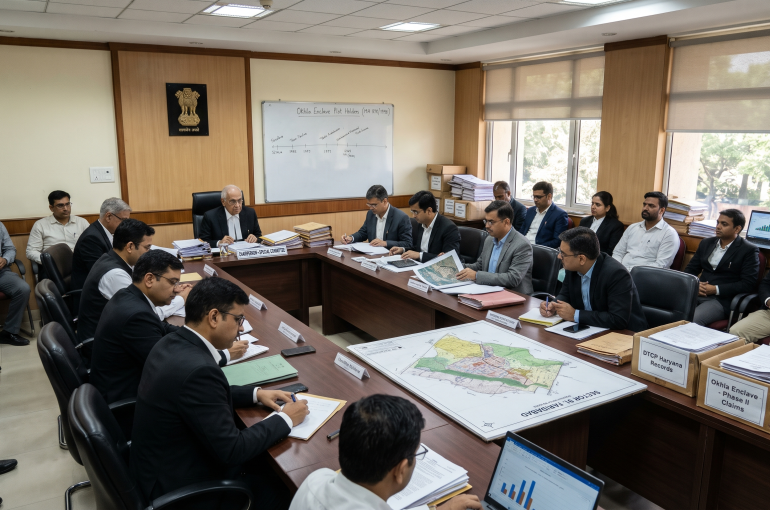
SUPREME COURT RECONSTITUTES SPECIAL COMMITTEE TO RESOLVE DECADES-LONG OKHLA ENCLAVE HOUSING DISPUTE: OKHLA ENCLAVE PLOT HOLDERS WELFARE ASSOCIATION V. UNION OF INDIA

INTRODUCTION
The Hon’ble Supreme Court of India recently delivered a landmark Judgment to resolve the complex, four-decade-long urban housing dispute surrounding the ‘Okhla Enclave’ project in Sector 91, Faridabad, Haryana. In Okhla Enclave Plot Holders Welfare Association v. Union of India and Others (Miscellaneous Application No. 876 of 1996 Batch, 2026 INSC 1259), a Division Bench comprising Hon’ble Mr. Justice Vikram Nath and Hon’ble Mr. Justice Sandeep Mehta, on November 20, 2026, intervened to restore administrative integrity and expedite long-pending plot allotments. Following procedural lapses and the resignation of former Chairperson Justice (Retd.) Vikramajit Sen, the Apex Court reconstituted the Special Committee under Hon’ble Mr. Justice (Retd.) Sanjay Karol. The Court framed clear Terms of Reference, fixed a four-month deadline and established an equitable framework to reconcile severe ground-level land shortfalls with verified claims.
BRIEF FACTS
In 1985, M/s Durga Builders Private Limited (“Developer”) acquired roughly 235 acres in Faridabad to establish the ‘Okhla Enclave’ colony (later ‘Edenburg City’). Under a 1991 Bilateral Agreement with the Department of Town and Country Planning, Haryana (“DTCP”), plots were divided into three statutory categories: Economically Weaker Section (EWS – 20%), No Profit No Loss (NPNL – 25%) and General Category (55%).
However, the Developer defaulted on completing internal and external infrastructure, issued unauthorized duplicate allotments and failed to pay External Development Charges (EDC) and license renewal fees exceeding ₹21.86 crores, causing all seven colonization licenses to lapse in 1999. Aggrieved buyers moved the Supreme Court in 1996 and the High Court of Punjab and Haryana in 2001.
Key milestones during the multi-decade litigation include:
- 2008: A Court Commissioner identified 2,196 valid claims.
- 2015-2016: A Special Committee under Justice (Retd.) Vikramajit Sen was constituted.
- 2019: The Supreme Court affirmed binding cut-off criteria: full land cost paid on/before April 7, 1997; development charges paid on/before December 31, 1999; and a strict “one plot per family” rule.
- 2023: Phase I scrutiny finalized 1,011 verified allottees (866 NPNL, 96 EWS, 49 General).
On April 25, 2025, the Court ordered Phase II scrutiny for 2,036 remaining claims and exempted open-market General Category buyers from single-plot limits. However, local DTCP officials prematurely sanctioned building plans up to March 25, 2025, for 480 unverified claimants. This unauthorized queue-jumping prompted Justice Sen’s resignation, leaving the Special Committee functus officio.
ISSUES OF LAW
The Apex Court addressed several key legal questions:
- Reconstitution of Oversight Body: Whether a new Chairperson must be appointed to lead Phase II title audits following the previous Chairperson’s resignation?
- Physical Inventory Deficit: How to equitably resolve the supply deficit where 866 verified Phase I NPNL buyers compete for only 150 vacant plots, against a layout reduced by 46.85 acres of illegal encroachments?
- Land-Use Modification: Whether DTCP can legally re-layout or convert unutilized EWS land banks into NPNL plots or multi-storey group housing to maximize plot yield?
- Universal Verification Scope: Whether litigating groups holding registered deeds or prior High Court decrees (e.g., 567 members of the Okhla Enclave Plot Holders Forum) can claim exemption from Special Committee scrutiny?
- Status of Premature Approvals: What legal consequences attach to building plans unauthorizedly sanctioned by DTCP officials prior to committee verification?
ANALYSIS OF THE JUDGMENT
The Supreme Court laid down comprehensive directives to enforce finality:
(a) Reconstitution under Justice (Retd.) Sanjay Karol: The Bench appointed Justice (Retd.) Sanjay Karol, former Judge of the Supreme Court, as Chairperson of the reconstituted Special Committee, conferring full administrative and adjudicatory powers to finish Phase II verification.
(b) Strict Eligibility and Universal Scrutiny: The 1997/1999 cut-off dates remain non-negotiable. The Court unequivocally rejected all claims of blanket exemption. All claimants, including original writ petitioners and forum members holding High Court orders, must undergo document audits. Defaulting claimants were given a final three-week window (until November 20, 2026) to submit dossiers.
(c) Deficit Allocation and Land-Use Re-zoning: To overcome the land shortfall on the remaining 187.825 unencumbered acres, the Committee is empowered to formulate an allocation plan, incorporating draws of lots, layout modifications or refunds. Crucially, the Committee will examine converting unutilized EWS land into NPNL plots or multi-storey housing.
(d) Inquiry into Irregularities and Financial Audit: The Special Committee must investigate premature DTCP building approvals granted up to March 25, 2025, recommend disciplinary action and reconcile past buyer deposits against the approved ₹128.70 crore infrastructure budget.
(e) Framework and Timelines: Un-scrutinized applicants must submit a ₹10,000/- Demand Draft to fund committee expenses. The Committee must submit its report in a sealed cover within four months, with monitoring scheduled for March 2, 2027.
CONCLUSION
The Order dated November 20, 2026, brings decisive structural clarity to a historic real estate dispute. By appointing Justice (Retd.) Sanjay Karol, enforcing universal document scrutiny and encouraging adaptive solutions like land-use re-zoning, the Supreme Court has established a firm, time-bound pathway toward securing justice and physical possession for genuine homebuyers.
ANIKET KUMAR PARCHA
Legal Associate
The Indian Lawyer & Allied Services
Editor’s Comment
The project is now going to be chaired by one of the finest judges in the country. His approach has always been proactive and favoring a resolution to the problem. He has always encouraged parties to settle the issue rather than prolong the dispute. Though the issue is complex the chairperson will in all likelihood resolve the matter successfully and in the interest of the buyers one can only wait and watch.
SUSHILA RAM VARMA
Advocate & Chief Consultant
The Indian Lawyer & Allied Services
Please log onto our YouTube channel, The Indian Lawyer Legal Tips, to learn about various aspects of the law. Our latest Video, titled “Can Dadi-Dada/Nani-Nana Become Legal Guardians!” can be viewed at the link below:
https://www.youtube.com/watch?v=Sa5zUOBPKoM