



















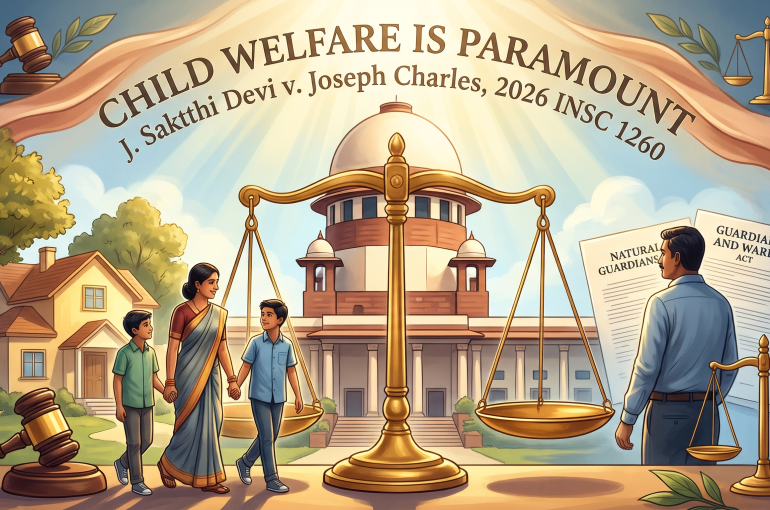
PARAMOUNTCY OF CHILD WELFARE OVER FATHER’S NATURAL GUARDIANSHIP: SUPREME COURT’S RULING IN J. SAKTHI DEVI @ CHRITI V. JOSEPH CHARLES

INTRODUCTION
The Hon’ble Supreme Court of India recently delivered a significant Judgment reinforcing the principle that child welfare holds absolute priority over parental statutory rights in custody disputes. In J. Sakthi Devi @ Chriti v. Joseph Charles (Civil Appeal No. [13768] of 2026, arising out of SLP (Civil) No. 30284 of 2024, 2026 INSC 1260), a Division Bench comprising Hon’ble Mr. Justice Vikram Nath and Hon’ble Mr. Justice Aparesh Kumar Singh, on November 23, 2026, set aside a High Court ruling that had transferred the custody of two minor sons to their Father. The Apex Court observed that while the Father is a natural guardian without any proven disqualification, removing adolescent children from their Mother’s long-standing care and established environment would be detrimental to their physical and emotional well-being. Emphasizing the preferences expressed by the mature minors under Section 17(3) of the Guardians and Wards Act, 1890, the Court preserved the Mother’s primary custody while establishing a structured visitation scheme to ensure the children maintain an emotional connection with their Father.
BRIEF FACTS
The Appellant (Mother) and the Respondent (Father) were married on August 23, 2009, according to Christian rites in Coimbatore and had two minor sons, born on July 10, 2010 and May 26, 2012. Following matrimonial disharmony, the parties separated on May 5, 2014, with the children remaining continuously in the custody of the Mother and her parents in Madurai.
The marital discord resulted in multiple legal proceedings before the Family Court, Madurai, which passed three separate Orders on November 19, 2018:
- Divorce Proceeding (I.D.O.P. No. 86/2014): The marriage was dissolved on the grounds of cruelty, which attained finality as the wife did not Appeal.
- Maintenance Proceeding (M.C. No. 100/2014): The Father was directed to pay ₹6,000/- per month for each child, an Order later upheld by the High Court.
- Custody Proceeding (G.W.O.P. No. 36 of 2015): The Family Court granted custody of the minor sons to the Father, directing the Mother to hand them over after the school examinations, while providing visitation rights to the Father at the Gandhi Museum, Madurai.
Criminal proceedings under Section 498-A IPC initiated by the Mother resulted in the acquittal of the Father and his family members on March 22, 2022.
The Mother challenged the Family Court’s custody Decree before the High Court of Judicature at Madras (C.M.A. (MD) No. 17 of 2019). On January 9, 2019, the High Court admitted the Appeal and granted an interim stay, preserving the Father’s visitation rights. However, in its final Judgment, the High Court affirmed the Family Court’s decision, holding that the Father, as a biological parent and natural guardian, could not be denied custody since no disqualification or unfitness was established against him. Aggrieved by the High Court’s dismissal, the Mother approached the Supreme Court.
ISSUES OF LAW
The Apex Court addressed several key legal questions:
- Natural Guardianship vs. Child Welfare: Whether the custody of minor children, who have lived continuously with their Mother for over a decade, should be forcibly transferred to the Father solely because he is a natural guardian with no established legal disqualification?
- Intelligent Preference of Minors: What weight must the Court accord to the preferences expressed by adolescent children under Section 17(3) of the Guardians and Wards Act, 1890, when deciding conflicting parental custody claims?
- Disruption of Environment: Whether uprooting children from a stable, supportive academic and domestic environment maintained by the Mother serves the “paramount consideration” of their overall development?
- Equitable Parental Rights: How can the Court balance the welfare of the children with the Father’s right to parental love and affection when long-standing separation has weakened their bond?
ANALYSIS OF THE JUDGMENT
The Supreme Court allowed the Appeal and set aside the High Court’s ruling, laying down key judicial principles:
- Paramountcy of Child Welfare Over Absolute Parental Rights: Reaffirming settled jurisprudence, including Anjali Kapoor v. Rajiv Baijal, (2009) 7 SCC 322, the Court held that custody decisions cannot be made purely on legal rights or parental claims. Children are not mere chattels or playthings. The concept of “welfare” must be interpreted in its widest sense, encompassing emotional stability, moral environment, health and quality education, overriding statutory rights of guardianship under Section 19(b) of the Act.
- Ascertainment of Minors’ Preferences: Exercising powers under Section 17(3) of the Act, the Bench interacted directly with both minor sons (aged 16 and 14) in chambers without parental presence. The Court found the boys to be mature, confident and clear in their desire to continue residing with their Mother and maternal grandparents. The Bench observed that uprooting them from their natural environment at this crucial stage of growth would cause psychological distress and impede their well-being.
- Mother’s Sole Contribution and Parental Capacity: The Court highlighted that the Mother, a postgraduate pursuing her Ph.D. and working professionally, had single-handedly supported the children’s upbringing and provided quality education without taking financial aid from the Father. Even though the Father had sufficient financial capacity and no explicit disqualification was proven against him, financial capability alone cannot override the deep emotional bond and stability provided by the Mother.
- Structured Visitation Scheme: Recognizing that children of fractured marriages require the affection of both parents for balanced growth, the Apex Court issued specific directives to re-establish the Father’s relationship with his sons:
- Monthly Visitation: The Father is permitted to meet the children on the second Saturday and Sunday of every month at the Gandhi Museum, Madurai, between 10:00 AM and 02:00 PM, facilitated by the Mother.
- Vacation Access: The Father may meet the children during Pongal and half-yearly school vacations, either at the Mother’s residence or at the Gandhi Museum, Madurai, following prior intimation via telephone or WhatsApp.
- Educational Expenses: The Father remains obligated and willing to share future educational expenses whenever requested by the Mother.
CONCLUSION
The Judgment dated November 23, 2026, re-emphasizes that in judicial determinations of child custody, human elements and emotional stability far outweigh rigid statutory claims of guardianship. By upholding the primacy of the children’s welfare, respecting the preferences of mature minors and maintaining their long-standing custodial environment, the Supreme Court successfully struck a delicate balance, protecting the minors’ immediate stability while securing a structured pathway for paternal affection.
ANIKET KUMAR PARCHA
Legal Associate
The Indian Lawyer & Allied Services
Editor’s Comment
In many such similar matters the Apex Court has now started interacting with children and asking them their preference when it comes to custody. This is probably because children are more mature and independent now as compared to the passed few decades. Over exposure in the digital world matures them well before their years. The Apex Court while appreciating that the child has a bonding with the Father still preferred to give the custody to the Mother because of the way she had nurtured them as also the children’s own preference of living with their Mother. Estranged parents should always keep in mind that while the matter is pending in Court, they should continue in fulfilling their roles as parents and develop a bonding with the child.
SUSHILA RAM VARMA
Advocate & Chief Consultant
The Indian Lawyer & Allied Services
Please log onto our YouTube channel, The Indian Lawyer Legal Tips, to learn about various aspects of the law. Our latest Video, titled “Can Dadi-Dada/Nani-Nana Become Legal Guardians!” can be viewed at the link below:
https://www.youtube.com/watch?v=Sa5zUOBPKoM