



















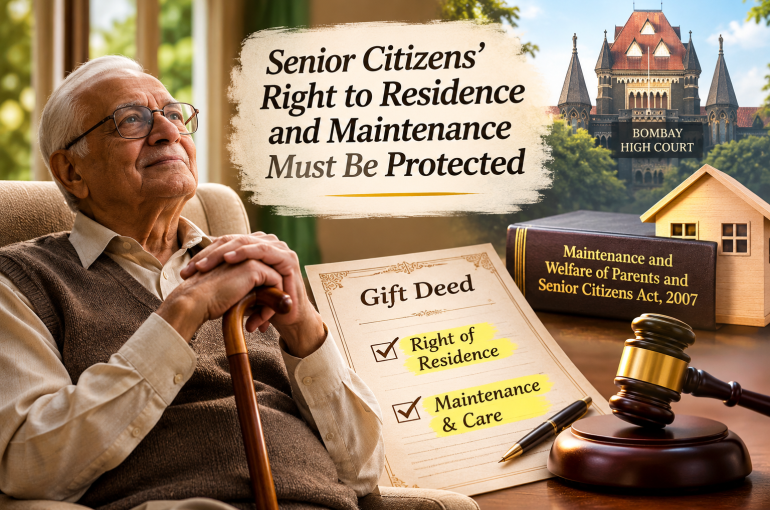
BOMBAY HIGH COURT REVOKES GIFT DEED TO PROTECT SENIOR CITIZEN RIGHTS

INTRODUCTION
In Devchand Korshi Dedhia v. Shiban Devchand Dedhia & Anr., Writ Petition Nos. 16296 of 2024 and 17404 of 2024, the Bombay High Court, presided over by Justice Aarti Sathe, delivered its Judgment on 26 November 2026. The Court decided two Writ Petitions filed by a Senior Citizen and his Son and Daughter-in-law. Court examined the scope of Section 23 of the Maintenance and Welfare of Parents and Senior Citizens Act, 2007, (hereinafter referred to as ‘the Act’) particularly whether a gift deed executed by a senior citizen which mentioned the donor’s right of residence, which was not honoured by the donee could be revoked. The second Writ dealt with whether the Son had to provide maintenance when the Gift Deed does not contain a separate clause expressly requiring the Donee to provide maintenance.
The Judgment underscores that the statutory protection afforded to Senior Citizens cannot be defeated and cancelled the Gift Deed by which the Son had been given the Residential Flat.
BRIEF FACTS OF THE CASE
The Petitioner, Mr. Devchand Korshi Dedhia, an elderly father aged 86 years when the proceedings were instituted, had acquired a Residential Flat in Mumbai in the name of himself and his deceased wife. On 4 June 2018, he executed a registered Gift Deed in favour of his elder son, Shiban Devchand Dedhia.
The Gift Deed was conditional and contained an express recital that the Son would permit the Father to reside with him during his lifetime.
According to the Father, following execution of the Gift Deed, the conduct of his Son and Daughter-in-law changed and he was subjected to neglect and ill-treatment. He alleged that he was eventually deprived access to the Flat and was compelled to reside in unsuitable accommodation and subsequently in an old-age home.
The Father approached the Parents and Senior Citizens Welfare Tribunal seeking, among other reliefs, revocation of the Gift Deed, restoration of possession and maintenance. By an Order dated 14 March 2024, the Tribunal partly allowed his Application and directed payment of monthly maintenance of Rs. 10,000 and certain other reliefs, but declined to revoke the Gift Deed.
The Appellate Tribunal upheld the decision on 10 July 2024. Both the Father and the Son approached the Bombay High Court under Article 227 of the Constitution, challenging the common Appellate Order.
ISSUES OF LAW
The principal issues before the High Court were:
- Whether a gift deed containing an express assurance of lifetime residence in favour of the donor could be treated as a conditional transfer under Section 23 of the Senior Citizens Act, 2007.
- Whether the absence of a separate clause expressly providing for maintenance or basic amenities would prevent revocation of the gift deed.
- Whether the High Court, exercising supervisory jurisdiction under Article 227 of the Constitution, could interfere with the findings of the Maintenance Tribunal and the Appellate Tribunal.
ANALYSIS OF THE JUDGMENT
The High Court began by examining the recitals and conditions contained in the Gift Deed. It observed that the Father had transferred the Property out of natural love and affection, on the express assurance that he would be permitted to reside in the Flat during his lifetime. The Deed further recorded that only symbolic possession had been handed over to the Son.
The Court held that the right of residence expressly secured in the Gift Deed was required to be honoured. The circumstances that subsequently made it impossible for the Father to reside with the Respondents were relevant to determining whether the conditions underlying the transfer had been fulfilled.
A significant aspect of the Judgment was the interpretation of Section 23 of the Act. Under this provision, where a senior citizen transfers property by way of gift or otherwise, subject to the condition that the transferee will provide basic amenities and physical needs and the transferee refuses or fails to do so, the transfer is deemed to have been made by fraud, coercion or undue influence and may be declared void at the option of the transferor.
The Respondents contended that the Gift Deed did not expressly impose an obligation upon the son to maintain his father or provide basic amenities. The Court rejected this narrow interpretation.
Referring to Sections 2(b), 4 and 5 of the Act, the Court emphasised that maintenance includes food, clothing, residence, medical attendance and treatment. The obligation of children to maintain their parents extends to meeting their needs so that they may lead a normal life.
The Court reasoned that where a gift deed expressly secures a senior citizen’s right to reside in the transferred property during his lifetime, the right to residence cannot be divorced from the corresponding obligation to ensure the senior citizen’s maintenance. Accordingly, the absence of a separate maintenance clause could not, by itself, defeat the protection contemplated under Section 23.
The Court also noted that the Authorities below had themselves recognised the Father’s financial difficulties and directed payment of monthly maintenance and rent from the godown. Having acknowledged the need for maintenance, they had nevertheless declined to revoke the Gift Deed solely because it did not contain an express maintenance clause. The High Court found this approach contradictory and perverse.
In interpreting the legislation, the Court emphasised its beneficial character and held that the provisions of the Senior Citizens Act must receive a liberal and purposive construction consistent with the object of protecting elderly persons from neglect, harassment and deprivation of basic necessities.
The Court also considered the decisions in Urmila Dixit v. Sunil Sharan Dixit, (2025) 2 SCC 787, and Ravi Kant Gupta v. State of Uttar Pradesh & Ors., in the context of the protective purpose of the Act and the powers available to the Authorities to safeguard senior citizens. It distinguished Sudesh Chhikara v. Ramti Devi & Anr., (2024) 14 SCC 225, on the facts, noting that the transfer involved in that case did not contain a comparable assurance of lifetime residence.
The Respondents also relied upon the right of residence of the daughter-in-law under the Protection of Women from Domestic Violence Act, 2005. The Court distinguished S. Vanitha v. Deputy Commissioner, Bengaluru Urban District & Ors., (2021) 15 SCC 730, observing that the present dispute did not concern matrimonial discord between the Respondents but the statutory rights of the senior citizen father, whose lifetime residence had been expressly protected in the Gift Deed.
The Court further found that the Father’s financial and residential vulnerability, the material concerning his alleged ill-treatment and his continued stay in an old-age home distinguished the case from Jitendra Gorakh Megh, which had been relied upon by the Respondents.
Ultimately, exercising its supervisory jurisdiction under Article 227, the High Court set aside the Orders of the Tribunal and Appellate Tribunal insofar as they refused to revoke the Gift Deed. It declared the Gift Deed revoked and directed the Respondents to hand over possession of the Flat to the Father within fifteen days, failing which they would be evicted with police assistance. The other reliefs granted to the father by the Appellate Tribunal were left undisturbed. The Son’s Writ Petition was dismissed.
CONCLUSION
The Judgment reinforces the protective purpose of the Maintenance and Welfare of Parents and Senior Citizens Act, 2007. It clarifies that the rights of senior citizens cannot be reduced to the narrow wording of a gift deed where its terms and circumstances demonstrate that the transfer was made subject to the donor’s continued right of residence.
The decision is particularly relevant where elderly parents transfer property to their children on the assurance that they will continue to receive residence, care and support. A transferee cannot rely upon the absence of an express maintenance clause to disregard the substance of the arrangement and deprive the transferor of the protection contemplated under the Act.
The ruling also serves as an important reminder that property transfers within families, particularly those involving elderly parents, should clearly record the conditions relating to residence, maintenance and care. Where such conditions are breached, Section 23 may provide an effective statutory remedy to protect the senior citizen’s dignity, security and right to live a normal life.
SUSHILA RAM VARMA
Advocate & Chief Consultant
The Indian Lawyer & Allied Services
Please log onto our YouTube channel, The Indian Lawyer Legal Tips, to learn about various aspects of the law. Our latest Video, titled “Can Dadi-Dada/Nani-Nana Become Legal Guardians!” can be viewed at the link below:
https://www.youtube.com/watch?v=Sa5zUOBPKoM