



















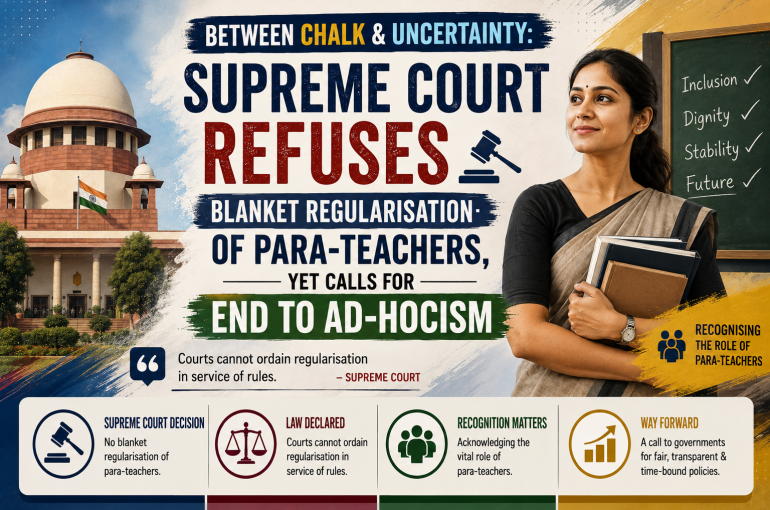
BETWEEN CHALK AND UNCERTAINTY: SUPREME COURT REFUSES BLANKET REGULARISATION OF PARA-TEACHERS, YET CALLS FOR END TO AD-HOCISM

INTRODUCTION
In Sunil Kumar Yadav & Ors. v. State of Jharkhand & Ors., 2026 INSC 462, decided on 7 May 2026, the Supreme Court of India, speaking through Justice S.V.N. Bhatti, examined the long-standing demand of Para-Teachers in Jharkhand for regularisation as Assistant Teachers and Sahayak Acharyas under the Sarva Shiksha Abhiyan (SSA).
While refusing to grant blanket regularisation contrary to statutory recruitment rules, the Court issued significant directions to the State of Jharkhand to periodically fill earmarked vacancies reserved for para-teachers and strongly criticised the continuing culture of “ad-hocism” in public employment. The Judgment carefully balances constitutional principles governing public recruitment with the realities faced by thousands of teachers who have spent years educating children under temporary arrangements.
BRIEF FACTS
The Appellants were Para-Teachers engaged on a contractual basis under the Sarva Shiksha Abhiyan, a Centrally Sponsored Scheme implemented to strengthen elementary education under Article 21A and the Right to Education Act, 2009. Many of the Para-Teachers had served for over a decade and possessed qualifications such as B.Ed., graduation degrees, and Teacher Eligibility Test (TET) certification.
Before the Jharkhand High Court, the Para-Teachers sought regularisation of their services as Assistant Teachers, parity in pay with regular teachers and a declaration that the Jharkhand Primary School Recruitment Rules, 2012 were unconstitutional insofar as they failed to provide an effective route for regularisation.
The High Court dismissed the Petitions, holding that Para-Teachers had voluntarily accepted contractual engagements and therefore could not claim regularisation as a matter of right. The matter thereafter reached the Supreme Court.
ISSUES OF LAW
The principal issues before the Supreme Court were whether Para-Teachers engaged under SSA were entitled to regularisation as Assistant Teachers or Sahayak Acharyas, whether courts could direct such regularisation contrary to statutory recruitment rules framed under Article 309 of the Constitution, and whether the State was obligated to ensure meaningful avenues for absorption of para-teachers into regular service.
ANALYSIS OF THE JUDGMENT
The Supreme Court undertook an extensive examination of the constitutional framework governing public employment, particularly Articles 14, 16 and 309, along with the principles laid down in State of Karnataka v. Umadevi, Jagjit Singh, Vinod Kumar, Jaggo, Shripal and several other precedents concerning regularisation and pay parity.
The Court observed that the central question was not whether the initial appointment of Para-Teachers was “illegal” or “irregular,” but whether constitutional courts could issue a mandamus directing regularisation in a manner contrary to statutory recruitment rules. It held that direct absorption of Para-Teachers into the State cadre of Assistant Teachers would fundamentally alter the source and character of appointment, bypassing the statutory framework framed under Article 309.
A significant aspect of the Judgment is the Court’s distinction between a “scheme post” and a “cadre post.” It held that Para-Teachers were engaged under the SSA scheme, jointly funded by the Union and State Governments, whereas Assistant Teacher and Sahayak Acharya posts constituted regular State cadre posts governed by statutory service rules. Therefore, automatic migration from one category to another through judicial directions would amount to creating an entirely new mode of recruitment not contemplated by law.
The Court reaffirmed the principle in Uma devi that regularisation cannot become a substitute for constitutionally compliant recruitment. At the same time, it acknowledged the harsh realities faced by Para-Teachers who had served the education system for years under insecure and poorly paid contractual arrangements.
Importantly, the Court noted that the State of Jharkhand itself had recognised Para-Teachers as a legitimate and distinct class by reserving 50% vacancies for them under the 2012 Rules and the 2022 Rules governing appointment of Assistant Teachers and Sahayak Acharyas. The Court therefore held that while Para-Teachers do not possess an enforceable right to regularisation, they certainly possess a right to fair participation and consideration under the statutory recruitment framework.
The Judgment contains strong observations against prolonged contractualism in public employment. The Court remarked that the “sense of security of employment is a sine qua non for enhancing efficiency in any service, and education is no different.” It further observed that expecting para-teachers to secure the future of children while their own employment remained uncertain was inherently flawed.
Another important aspect of the ruling is the Court’s criticism of administrative delay in conducting recruitment. The Court observed that the State could not simultaneously resist regularisation and yet indefinitely fail to operationalise its own statutory mechanism for appointment of para-teachers into regular posts.
Accordingly, while declining blanket regularisation, the Court moulded relief by directing the State of Jharkhand to periodically undertake recruitment exercises exclusively for para-teachers against the 50% earmarked vacancies under the statutory rules. The Court emphasised that the State must eliminate “ad-hocism” and ensure timely recruitment every academic year.
The Court also rejected the claim for automatic pay parity with regular Assistant Teachers, observing that equal pay for equal work is not an automatic entitlement and depends upon qualitative identity in duties, responsibilities, accountability and service conditions. However, the Court did not disregard the broader issue of financial insecurity faced by Para-Teachers And repeatedly stressed the need for policy-driven solutions.
CONCLUSION
The Supreme Court refused to direct blanket regularisation of Para-Teachers as Assistant Teachers or Sahayak Acharyas, holding that such a direction would violate the constitutional framework governing public employment and recruitment. At the same time, it directed the State of Jharkhand to meaningfully implement its statutory framework by periodically filling earmarked vacancies reserved for Para-Teachers.
The Judgment stands as a nuanced attempt to reconcile constitutional discipline with social reality. While reaffirming that courts cannot bypass statutory recruitment procedures in the name of equity, the Court simultaneously reminded the State that public employment cannot be perpetually sustained through insecurity, temporary arrangements and endless contractual dependence.
SARTHAK KALRA
Senior Legal Associate
The Indian Lawyer & Allied Services
Please log onto our YouTube channel, The Indian Lawyer Legal Tips, to learn about
various aspects of the law. Our latest Video, titled “Defamation on Social Media: Can a Meme Become a Crime?“, can be viewed at the link below:

Leave a Reply