



















CAN A FINANCE COMPANY TAKE YOUR VEHICLE WITHOUT NOTICE? SUPREME COURT EXPLAINS THE LAW ON REPOSSESSION

INTRODUCTION
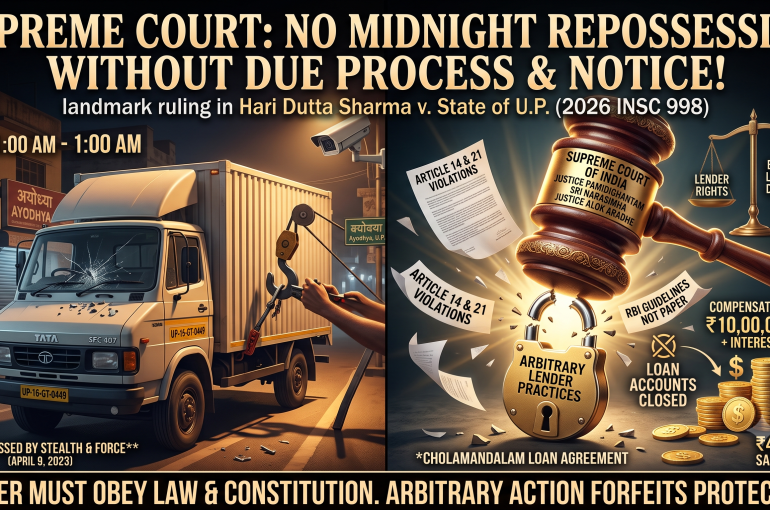
The Hon’ble Supreme Court of India recently reiterated the crucial distinction between the legitimate recovery of secured debts and the arbitrary, forceful seizure of assets by financial institutions. In Hari Dutta Sharma v. State of U.P. & Ors. (2026 INSC 998), decided on September 16, 2026, a two-judge Bench comprising Hon’ble Justices Pamidighantam Sri Narasimha and Alok Aradhe delivered a significant verdict. The Court firmly clarified that a finance company cannot unilaterally bypass statutory safeguards to repossess a vehicle, explicitly declaring that Reserve Bank of India (RBI) guidelines on fair recovery practices hold statutory force and must be strictly obeyed.
BRIEF FACTS
The dispute originated from a commercial vehicle loan obtained by the Appellant to finance a Tata SFC 407 Truck through Cholamandalam Investment and Finance Company Limited. Following defaults on repayment installments, the financier initiated recovery actions.
On April 9, 2023, at approximately 1:00 a.m., recovery agents repossessed the Truck by breaking the steering lock while the vehicle was parked under CCTV surveillance in Ayodhya. The repossession was executed without issuing any prior notice to the Appellant. The Finance Company subsequently sold the vehicle on August 31, 2023, for Rs. 4,50,000.
Aggrieved by this stealthy seizure, the Appellant approached the Allahabad High Court, which dismissed the writ petition solely on the ground of delay. Challenging this dismissal, the Appellant elevated the matter to the Supreme Court.
ISSUES OF LAW
The Apex Court focused its evaluation on fundamental legal questions regarding the procedural mechanisms of asset repossession under loan agreements:
- Whether a financier’s right to self-help repossession can be exercised arbitrarily, without issuing mandatory prior notice as stipulated by RBI guidelines?
- Whether contractual clauses permitting “ipso facto” termination of borrower rights and authorizing recovery agents to enter any premises for seizure are legally valid under the Indian Contract Act, 1872?
- Whether depriving a citizen of a commercial vehicle used for their livelihood through stealth and force constitutes a violation of fundamental rights under the Constitution?
ANALYSIS OF THE JUDGMENT
The Supreme Court took a sharp, principled stance against conflating a financier’s contractual right to recovery with an unbridled license for ‘goonda-ism’, laying down the following key observations:
- Statutory Force of RBI Guidelines:The Supreme Court established that the ‘Fair Practices Code for Lenders’ issued by the RBI under Section 35-A of the Banking Regulation Act, 1949, holds statutory force. Financial institutions are legally bound to follow these directives, which mandate a fair procedure for taking possession, including proper notice and an opportunity to cure the default.
- Invalidity of Arbitrary Contract Clauses:The Bench heavily criticized Article 11 of the loan agreement, which allowed the company to terminate the borrower’s rights “ipso facto without any notice” and permitted agents to enter any premises. The Court struck down this clause, holding that permitting one party to unilaterally dispense with procedural safeguards is unconscionable and offends the Indian Contract Act, 1872.
- Prohibition of Forceful Seizures: The Court highlighted that seizing property by stealth, force or in the dead of night, without a signed memorandum or prior notice, is entirely unauthorized. Since the mandatory seven-day notice was absent, the right to repossession never legally accrued to the Finance Company.
- Violation of Fundamental Rights:The Court clarified that depriving an individual of modest means of their sole livelihood-generating asset in an arbitrary and unfair manner goes beyond a mere contractual breach, directly violating Articles 14 and 21 of the Constitution.
CONCLUSION
Recognizing the severe deprivation of livelihood, the Court awarded Rs. 10,00,000 as compensation for mental agony, alongside Rs. 50,000 for litigation costs. Crucially, the Court directed the RBI to take immediate, effective steps to ensure NBFCs and banks genuinely comply with its circulars, preventing future incidents of citizens being dispossessed of their livelihoods without due process. To rectify the unlawful seizure, the Financier was directed to immediately close the Appellant’s loan accounts and refund the Rs. 4,50,000 sale proceeds along with 6% annual interest calculated from the date of the sale.
ANIKET KUMAR PARCHA
Legal Associate
The Indian Lawyer & Allied Services
EDITOR’S COMMENT
This case is of significant interest to all those people who have taken car/ vehicle loan and have not been able to pay the loan due to some reason or the other. While this Judgment does not mean that the defaulter of a loan can go scot free it addresses the issue of how seizure of vehicle can be done. Finding that the midnight seizure lacked the necessary procedural foundation and flagrantly violated statutory guidelines, the Hon’ble Supreme Court allowed the Appeal. The Court quashed the High Court’s dismissal order. To rectify the unlawful seizure, the Financier was directed to immediately close the Appellant’s loan accounts and refund the Rs. 4,50,000 sale proceeds along with 6% annual interest calculated from the date of the sale. The Apex Court decided the matter in favour of the borrower because the abrupt seizure of the vehicle took away his life to livelihood. While the Court granted the sale proceeds with interest it does not lay down a precedent that a borrower can escape the liability of repayment.
SUSHILA RAM VARMA
Advocate & Chief Consultant
The Indian Lawyer & Allied Services
Watch our latest video

Leave a Reply