



















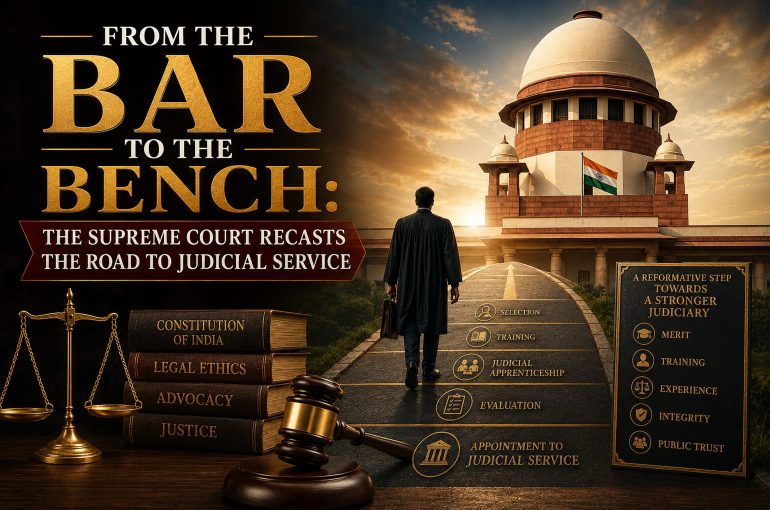
FROM THE BAR TO THE BENCH: THE SUPREME COURT RECASTS THE ROAD TO JUDICIAL SERVICE

INTRODUCTION
The Supreme Court of India, in Bhumika Trust v. Union of India & Ors., 2026 INSC 904, has significantly altered the framework governing eligibility for appointment as Civil Judge (Junior Division). The Judgment was delivered on 21 August 2026 by a Three-Judge Bench comprising Chief Justice of India Surya Kant, Justice Augustine George Masih and Justice K. Vinod Chandran. While CJI Surya Kant authored the majority Judgment on behalf of himself and Justice Augustine George Masih, Justice K. Vinod Chandran delivered a separate dissenting opinion. The Judgment is therefore a 2:1 majority decision.
The Judgment modifies the earlier decision dated 20 May 2025, which had restored three years of practice at the Bar as a mandatory eligibility requirement for appearing in the Civil Judge examination.
BRIEF FACTS
The controversy originates from the long-running All India Judges Association litigation. In the Second AIJA Case, decided in 1993, the Supreme Court prescribed three years’ practice at the Bar as a qualification for entry-level judicial service. The underlying rationale was that courtroom experience would help develop competent and independent judicial officers.
However, in the Third AIJA Case in 2002, the requirement was reversed. Fresh law graduates were once again permitted to enter judicial service without prior practice, with emphasis instead being placed upon adequate post-selection training.
This position continued for more than two decades until the Supreme Court, in its Judgment of 20 May 2025, restored the three-year practice requirement. The Court had then noted concerns regarding the lack of courtroom familiarity, procedural understanding and court etiquette among some fresh graduates entering the judiciary directly from law school.
The 2025 Judgment was subsequently challenged through Review Petitions. Bhumika Trust also approached the Court, particularly raising concerns regarding the impact of the requirement upon persons with disabilities.
ISSUE OF LAW
The principal issue was whether three years of practice at the Bar was indispensable before a candidate could even appear for the Civil Judge (Junior Division) Examination or whether the objective of practical exposure could be achieved through a combination of limited practice, judicial training and supervised experience.
The Court also considered the impact of the restored requirement upon candidates who had pursued their legal education under the earlier regime and upon groups who may face greater difficulty in establishing themselves at the Bar.
ANALYSIS OF THE JUDGMENT
The majority did not dispute the importance of practical experience. It recognised that judicial officers deal with matters affecting life, liberty, property and personal rights and therefore require familiarity with court proceedings, judicial temperament and courtroom discipline.
However, the Court questioned whether three years of conventional practice should necessarily be treated as the only route to acquiring such experience. The quality of practice can differ considerably depending upon the court, chamber, opportunities for appearances, mentorship and the candidate’s circumstances. Mere completion of a specified period, therefore, does not necessarily guarantee meaningful courtroom experience.
The Court was also mindful of the disruption caused by the 2025 Judgment. Candidates who had entered law school or planned their careers under the earlier system suddenly faced a three-year delay before becoming eligible even to compete for judicial service.
The majority consequently adopted a structured alternative.
For recruitment notifications issued after the 2025 Judgment and up to 31 March 2027, all law graduates will remain eligible to apply. Selected candidates will be designated as Trainee Judicial Officers and will undergo one year of intensive training at the State Judicial Academy. This will be followed by one year of structured Law Clerkship.
The Law Clerkship will consist of six months under a Principal District/District and Sessions Judge or a member of the Higher Judicial Service, followed by six months under a sitting Judge of the concerned High Court. The clerkship will be treated as equivalent to one year of Bar practice for satisfying the eligibility requirement.
From 1 April 2027, candidates will be required to possess at least one year of actual practice in the District Courts, supported by the prescribed certification and verification mechanism. Even after selection, they will undergo the same one-year judicial academy training and one-year Law Clerkship.
The Court has also provided for a reasoned evaluation of the trainee’s conduct, diligence, analytical ability, understanding of procedure, capacity to deal with cases and overall suitability before regular appointment.
THE DISSENT OF JUSTICE K. VINOD CHANDRAN
Justice K. Vinod Chandran adopted a different approach. He was not persuaded that the earlier three-year practice requirement required review. In his view, the earlier decision was a carefully considered Judgment and there was insufficient justification for reopening it.
Justice Chandran placed particular emphasis on the courtroom as a training ground for future Judges. He observed that forensic and analytical skills are developed through observing actual proceedings and understanding the functioning of the Bar and Bench. In his view, practical professional experience remains essential before a person assumes judicial office.
His dissent consequently provides an important counterpoint to the majority’s emphasis on structured post-selection training.
CONCLUSION
The Judgment in Bhumika Trust v. Union of India & Ors. represents a significant shift in the recruitment framework for India’s entry-level Judiciary.
The Supreme Court has not abandoned the value of practical experience. Instead, it has moved away from treating three years of conventional Bar practice as the sole measure of preparedness. The new framework combines limited practical exposure with institutional training and supervised judicial experience.
At the same time, Justice K. Vinod Chandran’s dissent highlights the enduring argument that the courtroom itself remains an indispensable teacher and that judicial competence cannot be developed entirely through institutional training.
The majority has also deliberately kept the new framework open to review after experience is gathered regarding recruitment quality, trainee performance and the effectiveness of training and clerkship.
Ultimately, the Judgment seeks to strike a balance between experience and opportunity, academic learning and practical exposure, and accessibility and judicial competence. The journey from the law classroom to the Bench has changed; but the Court’s message remains that becoming a Judge requires far more than merely passing an examination.
SARTHAK KALRA
Senior Legal Associate
The Indian Lawyer & Allied Services
Watch our latest video

Leave a Reply