



















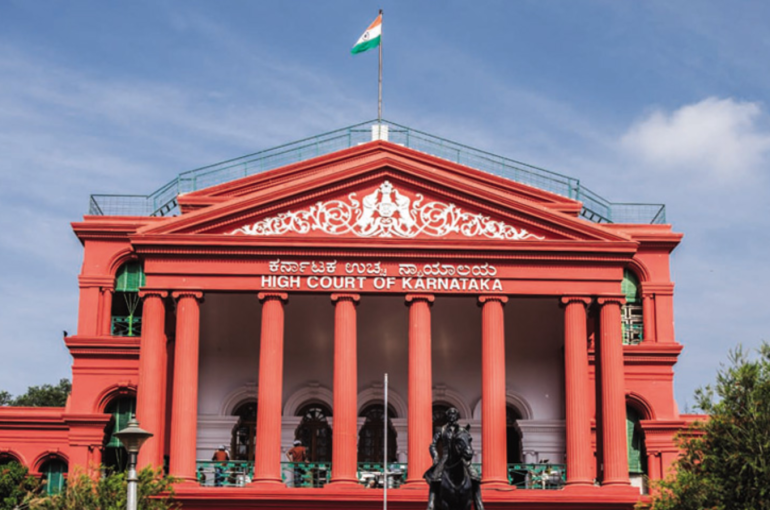
KARNATAKA HIGH COURT: MOTHER DOES NOT HAVE LEGAL RIGHT TO SHARE IF THE SON DIES INTESTATE LEAVING BEHIND WIFE AND CHILDREN

The High Court of Karnataka, in a Judgment delivered on February 2, 2026, addressed a significant error in the application of the Indian Succession Act, 1925, regarding the inheritance rights of Christian legal heirs. The case, titled Mrs. Estrida Lucy Janet Vaz & Ors. v. Nil (MFA No. 3127 of 2024 (ISA)), was heard by the Hon’ble Ms. Justice Jyoti M.
The Appeal challenged an earlier Order passed by the XX Additional City Civil and Sessions Judge, Bengaluru, who had erroneously denied a succession certificate to the widow and children of a deceased Christian male. This Judgment serves as a vital reminder of the specific statutory hierarchy prevalent in Christian succession law, distinguishing it from other personal laws in India. By setting aside the Lower Court’s dismissal, the High Court reaffirmed the rights of the widow and lineal descendants to the exclusion of other relatives, such as the mother of the deceased, in specific circumstances defined by the Act.
Factual Background
The case arose from the death of Mr. Herold Vaz, a Christian by religion, who passed away intestate (without leaving a will). Mr. Vaz was survived by his wife, Mrs. Estrida Lucy Janet Vaz (Appellant No. 1) and his two sons, Mr. Elgar Julius Vaz and Mr. Aaron Darius Vaz (Appellants No. 2 and 3).
During his lifetime, Mr. Vaz had invested funds in shares of the Reliance Group of Companies. However, he had not nominated a beneficiary for these shares. Upon his death, his widow and sons, acting as his Class I legal heirs and lineal descendants, approached the company to transmit the shares into their names. They submitted the necessary documentation, including the death certificate and share certificates. The Company, adhering to corporate compliance procedures, informed the family that the transmission of shares could not be processed without a succession certificate issued by a competent court of law.
Consequently, the Appellants filed a petition under Section 372 of the Indian Succession Act, 1925, before the XX Additional City Civil and Sessions Judge, Bengaluru (P & S.C. No. 532/2018), seeking the grant of a succession certificate. Surprisingly, on November 8, 2019, the Trial Court dismissed their Petition. The rejection was based on the premise that the Mother of the Deceased was also a legal heir and her non-inclusion or the nature of her claim prevented the grant of the certificate to the wife and children alone. Aggrieved by this dismissal, the Family approached the High Court of Karnataka in 2024.
Contentions of the Parties
The Appellants contended that the Trial Court had committed a grave error in law. Their primary argument was rooted in the specific provisions of the Indian Succession Act, 1925, which governs Christian succession. They argued that under this personal law, the mother of a deceased male is not considered a legal heir if the deceased is survived by lineal descendants (children). The Appellants maintained that since Mr. Herold Vaz left behind a widow and two sons, they constituted the entirety of the legal heirs entitled to the estate. They argued that the Trial Court’s reasoning, that the mother’s status as a legal heir precluded their claim, was legally unsustainable and displayed a misunderstanding of Sections 32 and 33 of the Act. They had provided all prima facie evidence required for the grant of the certificate, yet were denied relief due to this misinterpretation.
The Respondent argued that the case was filed against “Nil” (no specific respondent), as it was a Petition for a succession certificate where the Appellants claimed to be the only rightful heirs. Consequently, there were no opposing contentions filed by any third party or family member contesting their status.
Court’s Decision
The High Court meticulously examined the Trial Court’s order and the relevant statutory provisions. The Court found that the core issue was whether the Trial Court was justified in refusing the succession certificate on the grounds of the Mother’s potential claim.
The High Court observed that the Trial Court had failed to apply Sections 32 and 33 of the Indian Succession Act, 1925 correctly. Justice Jyoti M. clarified the law regarding Christian intestate succession. The Court held that Section 33 explicitly states that if an intestate dies leaving a widow and lineal descendants, one-third of the property belongs to the widow and the remaining two-thirds goes to the lineal descendants.
The Court highlighted that under these specific sections, the Mother of the intestate has no legal right to a share if the Deceased is survived by children (lineal descendants). The Mother only succeeds to the estate in the absence of lineal descendants.
The High Court held that the Trial Court’s Judgment was “unsustainable in law” and “erroneous.” The Judge noted that since Mr. Herold Vaz was survived by his wife and children, his Mother was excluded from inheritance by operation of law. Therefore, the Appellants were the sole legal heirs entitled to the shares.
The Court set aside the Order dated November 8, 2019, passed by the XX Additional City Civil and Sessions Judge. Furthermore, to prevent further delay in a matter that had already been pending for years, the High Court issued a mandatory direction to the Trial Court to grant the Succession Certificate to the Appellants “forthwith within a week’s time” from the receipt of the order.
Conclusion
The Judgment serves as an essential precedent for the correct interpretation of Christian succession laws in India. It corrects a common judicial oversight where principles from other personal laws (where a mother is often a Class I heir alongside the wife and children) are incorrectly projected onto Christian cases.
The High Court of Karnataka decisively affirmed that for Christians, the presence of lineal descendants extinguishes the succession rights of ascendants like the mother. By allowing the Appeal and ordering the immediate issuance of the certificate, the Court delivered justice to the family of the late Mr. Herold Vaz, allowing them to finally access the assets that were rightfully theirs. This Judgment underscores the judiciary’s role in ensuring that statutory distinctions in personal law are strictly adhered to, ensuring fair and expeditious legal remedies for citizens.
YASH HARI DIXIT
LEGAL ASSOCIATE
THE INDIAN LAWYER AND ALIED SERVICES
Please log onto our YouTube channel, The Indian Lawyer Legal Tips, to learn about various aspects of the law. Our latest Video, titled “Hindu sentiments hurt by use of impure Cow Milk at Tirumala Temple” can be viewed at the link below:

Leave a Reply