



















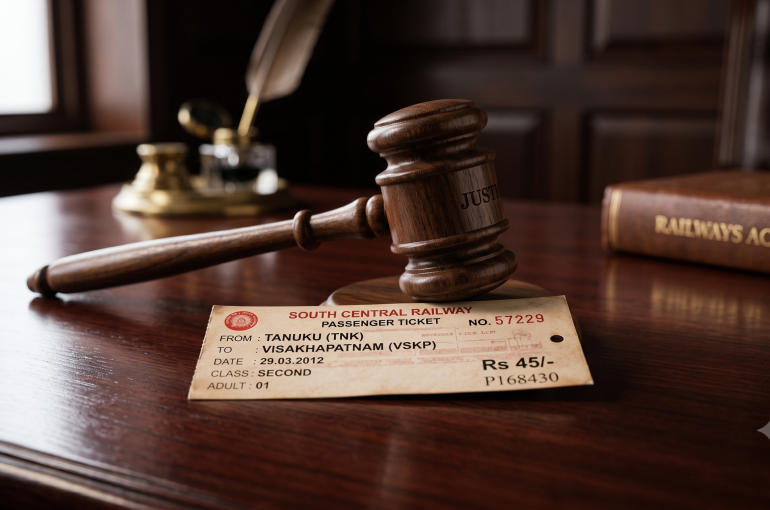
NO RAILWAY TICKET FOUND AFTER AN ACCIDENT? CAN THE FAMILY STILL CLAIM COMPENSATION? HIGH COURT EXPLAINS

INTRODUCTION
The Hon’ble High Court of Andhra Pradesh recently clarified the legal standards for granting compensation in railway accidents, specifically addressing the rights of passengers who lose their journey tickets in the aftermath of a tragedy. In N. Sri Rama Prasad and another v. Union of India (C.M.A.NO. 159 OF 2021), decided on September 11, 2026, Hon’ble Sri Justice Balaji Medamalli delivered a significant verdict. The Court firmly established that the mere absence of a physical ticket does not negate a Victim’s status as a bona fide passenger and ruled that falling from a moving train due to negligence cannot be dismissed by the Railways as a self-inflicted injury.
BRIEF FACTS
The dispute originated when a young engineering graduate traveled to Tanuku Railway Station with his father on the intervening night of March 28-29, 2012. The father purchased a journey ticket to Visakhapatnam and the deceased boarded Train No. 57229. Due to a heavy rush of passengers and sudden jerks from the running train, the deceased accidentally slipped and fell between the platform and the train at Tuni Railway Station. He sustained severe crush injuries and was declared dead shortly after being shifted to the hospital.
The Railway Claims Tribunal initially dismissed the parents’ compensation claim. The Tribunal held that since no journey ticket was recovered from the body, the deceased was not a bona fide passenger. Furthermore, relying on a railway report suggesting he fell while trying to board from the off-side, the Tribunal concluded the incident was a self-inflicted injury rather than an “untoward incident”. Aggrieved by this dismissal, the parents approached the High Court.
ISSUES OF LAW
The High Court focused its evaluation on fundamental legal questions regarding passenger rights and the strict liability of the Railway Administration:
- Whether the mere absence of a physical journey ticket on the deceased’s person automatically strips them of their status as a bona fide passenger?
- Whether accidental death or injury caused by falling during the boarding or de-boarding of a train constitutes a “self-inflicted injury” or a compensable “untoward incident”?
- Whether the Railway Administration can rely on an investigation report submitted long after the statutory 60-day deadline mandated by the Railway Passengers Rules, 2007?
ANALYSIS OF THE JUDGMENT
The High Court took a strong stance against denying rightful compensation on the basis of technical presumptions and procedural delays, laying down the following key observations:
- Initial Burden of Proof:Relying on Supreme Court precedents like Union of India v. Rina Devi (2019) 3 SCC 572 and Doli Rani Saha v. Union of India, (2024) 9 SCC 656, the Court established that the absence of a ticket does not defeat a claim. The initial burden rests on the claimant, which was successfully discharged here by filing an affidavit stating the father purchased the ticket. The burden then shifted to the Railways, which failed to rebut it with adequate evidence.
- Untoward Incident vs. Self-Inflicted Injury:The Court rejected the Railways’ argument that the victim’s fall was a self-inflicted injury. The legal concept of a “self-inflicted injury” requires an actual intention to inflict harm upon oneself, not mere negligence. Consequently, death or injury occurring during boarding or de-boarding falls squarely under the definition of an “untoward incident”.
- No-Fault Liability:Invoking the “no-fault theory,” the Court emphasized that compensation for untoward incidents is payable regardless of any wrongful act, neglect or contributory negligence by the Victim.
- Procedural Lapses by Railways:The Court noted that the mandatory investigation report by the railway force was submitted more than a year after the claim was filed before the Tribunal. This blatantly violated Rule 7 of the 2007 Rules, which requires the investigation to be completed within sixty days, casting doubt on the reliability of the Railway’s defense.
CONCLUSION
Finding that the deceased was indeed a bona fide passenger who died in an untoward incident, the High Court allowed the Appeal and set aside the Tribunal’s dismissal Order. To rectify the denial of the Claim, the Court directed the Union of India to pay a compensation of Rs. 8,00,000 to the bereaved parents. The compensation amount is to be apportioned equally between them and paid within a period of two months from the date of the order.
ANIKET KUMAR PARCHA
Legal Associate
The Indian Lawyer & Allied Services
EDITOR’S COMMENT
The Hon’ble High Court tried to do justice by allowing a compensation of Rs. 8,00,000 to the parents. The loss of the parents cannot be measure by the value of the compensation. The loss of the parents cannot be quantified as loss of a child is probably the worst loss that any parent can undergo. The Railway Authority trying to evade compensation demonstrates the casualness with which the Indian Railway perceives such horrific accidents. It also establishes the fact that this sector needs change and better infrastructure
SUSHILA RAM VARMA
Advocate & Chief Consultant
The Indian Lawyer & Allied Services
Watch our latest video

Leave a Reply