



















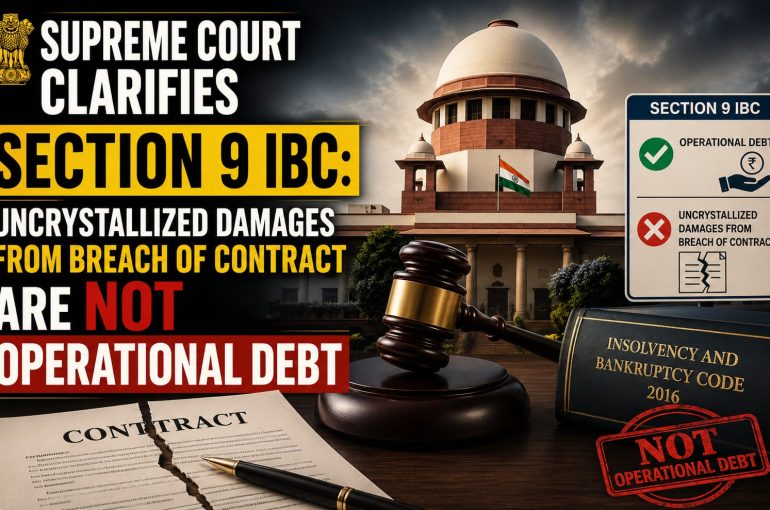
SUPREME COURT CLARIFIES SECTION 9 IBC: UNCRYSTALLIZED DAMAGES FROM BREACH OF CONTRACT ARE NOT OPERATIONAL DEBT

INTRODUCTION
The Hon’ble Supreme Court of India recently addressed the crucial distinction between valid operational debts and unadjudicated damage claims under the Insolvency and Bankruptcy Code, 2016 (IBC). In Srinivasa Reddy Velagala v. Sravanthi Infratech Pvt. Ltd. (Civil Appeal No. 876 of 2021), decided on August 12, 2026, a two-judge Bench comprising Hon’ble Justices J. B. Pardiwala and Manoj Misra delivered a landmark verdict. The Court made it strictly clear that claims for damages arising from a breach of contract cannot be treated as operational debt to trigger insolvency proceedings until they are crystallized by a competent court.
BRIEF FACTS
The dispute originated from an Engineering Procurement and Construction (EPC) contract awarded to the Respondent in December 2010 for setting up a 225 MW gas-based power station in Andhra Pradesh. The total contract value was Rs. 827 crore, with payments tied to specific milestones. While the Respondent achieved the first three milestones, the Appellant paid only Rs. 50.15 crore out of the Rs. 165.4 crore that had become due. Due to this non-payment, the Respondent issued a notice of suspension of works on July 30, 2011 and eventually demobilized.
Despite sending multiple legal notices between 2014 and 2015, which the Appellant completely ignored, the Respondent did not terminate the contract. Finally, on July 2, 2018, the Respondent issued a statutory demand notice under Section 8 of the IBC, claiming a massive Rs. 1292+ crore, which included unpaid milestone payments as well as hefty suspension and demobilization charges. The National Company Law Tribunal (NCLT) admitted the Section 9 application in December 2019 and the National Company Law Appellate Tribunal (NCLAT) affirmed this decision in February 2021. Aggrieved, the Appellant preferred a Civil Appeal before the Supreme Court.
ISSUES OF LAW
The Apex Court focused its evaluation on fundamental legal questions regarding the IBC and contract law:
Whether the construction contract automatically expired or became invalid just because a lot of time had passed?
Whether the extra penalty costs claimed by the contractor like the charges for pausing work and packing up equipment, legally count as a standard business debt under the bankruptcy law?
Whether there existed a prior dispute in respect of the claims?
Whether the application filed under Section 9 of the IBC was barred by limitation?
ANALYSIS OF THE JUDGMENT
The Supreme Court took a sharp, principled stance against the misuse of the IBC for debt recovery and unadjudicated claims, laying down the following key observations:
No Frustration by Efflux of Time: The Court held that the EPC contract was not frustrated. Under Section 56 of the Indian Contract Act, frustration requires a supervening impossibility, which does not apply to a “self-induced frustration” where a party elects to suspend works due to non-payment. Since neither party formally terminated the agreement, the contract continued to subsist.
Damages are Not Operational Debt: The Bench highlighted a critical difference in the claims. While the unpaid milestone payments validly qualified as operational debt, the claims for suspension, idling and demobilization charges were in the nature of damages. The Court definitively ruled that damages, whether liquidated or unliquidated, do not become an operational debt until they are assessed and crystallized through adjudication by a civil court or arbitral tribunal. The NCLT is not a forum for resolving contractual disputes.
Absence of Pre-existing Dispute: The Court observed that the Appellant maintained a total and consistent silence across multiple legal notices over seven years. This silence served as strong evidence that there was no genuine, pre-existing dispute prior to the filing of the Section 9 application.
Application Hopelessly Time-Barred: The Supreme Court criticized the NCLAT’s view on limitation. The Court emphasized that a default occurs on the specific date of non-payment (crystallized here in early 2012). The mere subsistence of the EPC contract does not grant a “continuing cause of action”. Because the Section 9 application was filed well beyond the three-year limitation period governed by Article 137 of the Limitation Act and without any valid acknowledgment of debt to reset the clock, the claim was time-barred.
CONCLUSION
Finding that the IBC is a mechanism for corporate resolution and not a mere money recovery tool for time-barred or uncrystallized claims, the Hon’ble Supreme Court allowed the Appeal. The Court set aside the Judgments of the NCLAT and the NCLT, thereby dismissing the Section 9 insolvency application against the Appellant, while granting the Respondent liberty to pursue appropriate alternative dispute resolution forums
ANIKET KUMAR PARCHA
Legal Associate
The Indian Lawyer & Allied Services
Please log onto our YouTube channel, The Indian Lawyer Legal Tips, to learn about various aspects of the law. Our latest Video, titled “What to do when false FIR/case filed against you? How to deal with false cases” can be viewed at the link below:
Watch our latest video on Maintenance

Leave a Reply