



















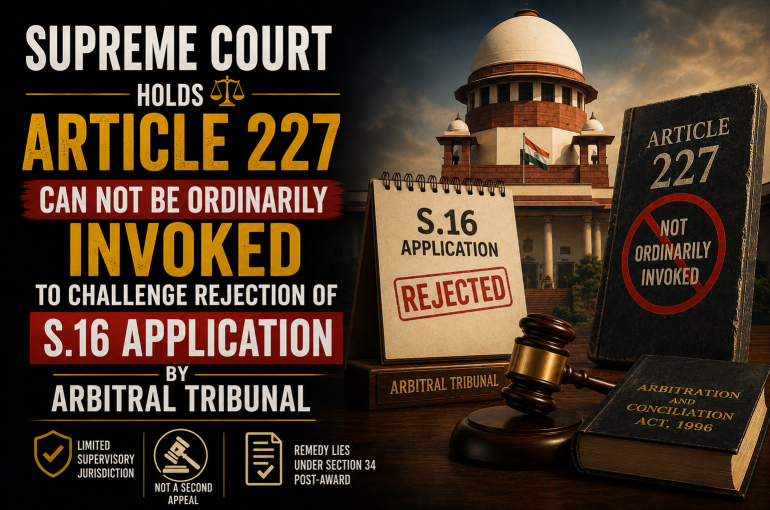
SUPREME COURT HOLDS ARTICLE 227 CAN NOT BE ORDINARILY INVOKED TO CHALLENGE REJECTION OF S.16 APPLICATION BY ARBITRAL TRIBUNAL

INTRODUCTION
The Hon’ble Supreme Court of India examined a case concerning the extent of a High Court’s supervisory jurisdiction under Article 227 of the Constitution when dealing with an Arbitral Tribunal’s rejection of a jurisdictional challenge, namely Manash Kamal Bezboruah v. M/s Bokahola Tea Company Pvt. Ltd. & Ors., 2026 INSC 701. This decision was made on July 14, 2026. The Court, consisting of Hon’ble Justices K.V. Viswanathan and Vijay Bishnoi, stated that the Arbitration and Conciliation Act, 1996 (the Act) is a self-contained code. The Court was concerned with ensuring minimal judicial interference during ongoing arbitral proceedings, emphasizing that High Courts cannot routinely interfere with an arbitrator’s ruling on their own jurisdiction unless there is a glaring, inherent defect.
BRIEF FACTS
-
This case involves a partnership firm, initially constituted in 1948, where the Appellant became a sleeping partner in 1974.
-
The partnership deed executed in 1976 contained a specific clause for resolving disputes through arbitration.
-
In 2012, the Appellant filed a Civil Suit claiming financial mismanagement and seeking a rendition of accounts.
-
A subsequent Application to refer the dispute to arbitration under Section 8 of the Act was initially rejected by the Trial Court and the High Court because some defendants were not signatories to the partnership deed.
-
However, the Hon’ble Supreme Court passed a consent order on November 21, 2024, sending the parties to arbitration and appointing a Sole Arbitrator.
-
During the arbitration, the non-signatory Respondents filed Applications, treated as Section 16 Applications, asking to be removed from the proceedings.
-
When the Arbitral Tribunal rejected this request, the Respondents challenged the decision before the High Court, which stayed the arbitral notices against them using its powers under Article 227.
ISSUES OF LAW
The Hon’ble Supreme Court addressed three key legal questions:
-
Whether a High Court can invoke Article 227 of the Constitution to entertain a Revision Petition against an Arbitral Tribunal’s interim Order rejecting a Section 16 Application.
-
Whether entertaining such constitutional petitions violates the principle of minimal judicial intervention mandated by Section 5 of the Act.
-
Whether the Arbitral Tribunal holds the competence to decide if a non-signatory is bound by an arbitration agreement under the “Group of Companies” doctrine.
ANALYSIS OF THE JUDGMENT
The Hon’ble Supreme Court criticized the High Court’s interference in the ongoing arbitral process. The Apex Court made the following important observations:
-
Minimal judicial intervention: The Apex Court acknowledged that Section 5 of the Act contains a strict non-obstante clause designed to limit court involvement. It noted that allowing High Courts to correct Tribunal Orders during pending arbitration defeats the legislative objective of speedy dispute resolution.
-
Threshold for constitutional interference: The Court emphasized that while Article 227 is part of the Constitution’s basic structure, it must be used with extreme caution in arbitral matters. It established that interference is only justified if the Tribunal’s Order suffers from a “patent lack of inherent jurisdiction” that requires no extensive argument to prove.
-
Tribunal’s absolute competence: The Supreme Court pointed out that Section 16 of the Act empowers the Arbitral Tribunal to rule on its own jurisdiction. It suggested that complex questions about whether non-signatories are veritable parties to an agreement must be left to the Tribunal to decide.
-
Proper statutory remedy: The Court rejected the premature use of writ petitions. The Apex Court noted that the correct legal avenue to challenge a Section 16 rejection is through Section 34 of the Act, which can only be utilized after the final arbitral award is pronounced.
-
Discouraging dilatory tactics: The Court observed that the Respondents failed to object to the initial Supreme Court consent order referring them to arbitration. Furthermore, it noted that raising these disputes later creates unnecessary delays that destroy the core purpose of the Arbitration Act.
CONCLUSION
The Hon’ble Supreme Court allowed the Appeals filed by the Appellant, setting aside the earlier interim Orders of the High Court.
Therefore, the Hon’ble Supreme Court upheld the Arbitral Tribunal’s authority to independently determine the status of the non-signatory Respondents.
ANIKET KUMAR PARCHA
Legal Associate
The Indian Lawyer & Allied Services
Editor’s Comments
Courts have always held that the powers of the arbitral tribunal should not be interfered with unless there is an illegality. As arbitration is an alternate method of settling disputes courts do not want to defeat the alternate way of settling disputes by interfering in the working of the arbitrators. This ruling reinforces the principle that statutory mechanisms for arbitration override routine judicial interventions, ensuring the uninterrupted progress of alternative dispute resolution. The Court ultimately directed the Tribunal to finish the proceedings swiftly and without being influenced by external observations
Sushila Ram Varma
Advocate and Chief Consultant
The Indian Lawyer & Allied Services
Please log onto our YouTube channel, The Indian Lawyer Legal Tips, to learn about various aspects of the law. Our latest Video link is in below:

Leave a Reply