



















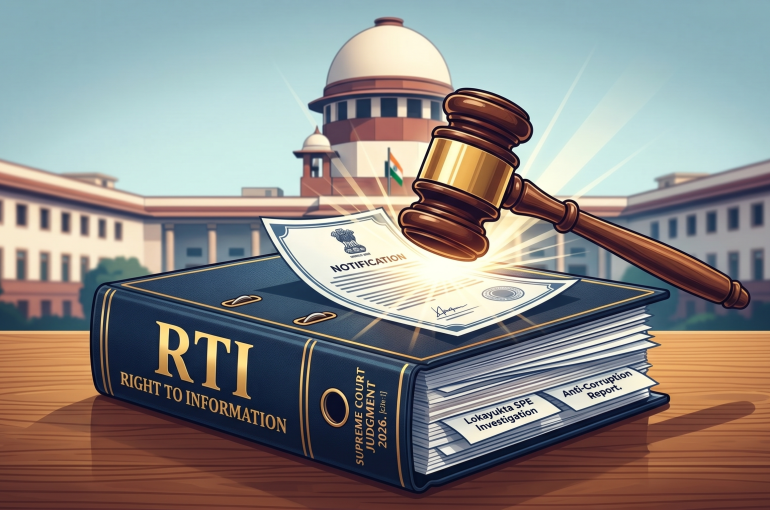
SUPREME COURT HOLDS LOKAYUKTA SPECIAL POLICE NOT ‘INTELLIGENCE & SECURITY ORGANISATION’ EXEMPT FROM RTI ACT

INTRODUCTION
On June 15, 2026, the Supreme Court of India made a significant ruling in the case of Special Police Establishment v. Kamta Prasad Mishra and others 2026 INSC 644. Justices J.K. Maheshwari and Atul S. Chandurkar laid down clear limits on who qualifies for an exemption under the Right to Information (RTI) Act, 2005.
They made it clear that an anti-corruption body like the Special Police Establishment (SPE) cannot simply label itself an “intelligence and security organisation” to dodge transparency. This decision did not just stop there, it overturned a decade-old Madhya Pradesh Notification that had been giving the SPE a free pass from RTI rules. The Apex Court also stood firm on its own powers, stating that constitutional courts do not have to sit back when a piece of subordinate legislation goes beyond its parent law; they can strike it down on their own.
Brief Facts
- The Charges: Kamta Prasad Mishra worked as a Town Inspector in Katni. The SPE in Bhopal trapped him in a corruption case and authorities registered a FIR against him under the Prevention of Corruption Act, 1988 on April 11, 2017.
- The RTI Request: After wrapping up the investigation, the State’s Home Department approved his prosecution on May 20, 2020. Town Inspector wanted to know how they reached that decision. On July 1, 2020, he used the RTI Act to ask for details, the internal communications, responses from the Lokayukta and the complete decision-making trail.
- The Refusal: Both the Authorities and the State Information Commission shut him down, citing Section 8(1)(h) of the RTI Act. They argued that sharing this information could hurt the prosecution.
- The Legal Battle: The Madhya Pradesh High Court disagreed, pointing out that since the investigation was over, there was no reason to withhold the information and ordered the SPE to release it. The SPE appealed before the Supreme Court, leaning heavily on a State Notification from 2011 that claimed the SPE was fully exempt from the RTI Act.
ISSUES OF LAW
The Supreme Court had to address three primary questions:
- Defining the agency: Does the SPE genuinely count as an “intelligence and security organization” under Section 24(4) of the RTI Act and does that mean it gets a blanket exemption from releasing information?
- Validity of the Notification: Did the 2011 State Notification fit within the law or had the government overstepped by shielding a regular anti-corruption unit in ways the parent law never intended?
- Judicial Review: Could the Judges review and strike down this Notification on their own (Suo Motu), even though Town Inspector did not directly challenge it in his petition?
ANALYSIS OF THE JUDGMENT
The Supreme Court rejected the SPE’s argument that the 2011 Notification shielded them.
- Power to Strike Down Subordinate Legislation: Right from the start, the Judges affirmed that Constitutional Courts have the power to throw out subordinate legislation that clearly goes against the law. They can use this power even if nobody specifically asks for it, as long as the State gets a fair chance to defend itself (which Madhya Pradesh High Court did).
- The True Nature of the SPE: A major part of the Judgment hinged on what the SPE actually is. The Court compared it to other central organizations listed in the Second Schedule of the RTI Act, groups like the Border Security Force (BSF), Central Reserve Police Force (CRPF) and the National Investigation Agency (NIA). Those are agencies focused on national security, intelligence and border protection.
- Corruption vs. Security: The SPE, meanwhile, was established under a 1947 law to investigate corruption among public servants and specific crimes like cheating and breach of trust. The Court ruled that acting as the Lokayukta’s investigative arm to keep public officials clean does not suddenly transform the SPE into an intelligence or security agency.
In the end, the Supreme Court rejected the appeal. The Judges struck down the part of the 2011 Notification that tried to block RTI access for the SPE, stating it did not fit the narrow boundaries of Section 24(4). They upheld the High Court Order, telling the SPE to release the information to Mishra and made it explicitly clear that anti-corruption units have to answer to the public just like everyone else.
CONCLUSION
This case is not just another legal technicality. The verdict in Special Police Establishment v. Kamta Prasad Mishra sends a strong message against administrative overreach and firmly supports the right to information.
By refusing to let anti-corruption bodies hide behind the curtain of “security” the Supreme Court shut down a major loophole authority could have used to dodge accountability. Going forward, the decision sets a clear precedent: executive power cannot arbitrarily expand the list of exemptions in the RTI Act. Agencies meant to keep public servants honest must stay open to public scrutiny themselves.
ANIKET KUMAR PARCHA
Legal Associate
The Indian Lawyer & Allied Services
Please log onto our YouTube channel, The Indian Lawyer Legal Tips, to learn about various aspects of the law. Our latest Video, titled “Hit and Run Case Explained: Punishment, Bail & Legal Process” can be viewed at the link below:
Leave a Reply