



















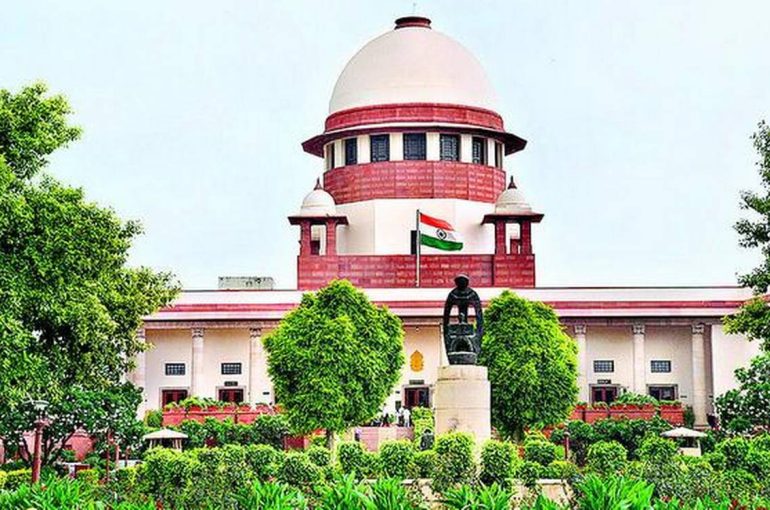
SUPREME COURT HOLDS THAT A CANDIDATE CAN’T BE DISQUALIFIED MERELY FOR NOT HAVING DEGREE TITLE IF CORE SUBJECT WAS STUDIED

The Supreme Court of India gave Judgment in a recent case titled ‘Laxmikant Sharma v. State of Madhya Pradesh and Others’ (Special Leave Petition (Civil) No. 18907 of 2025) interpreting the educational qualifications in recruitment matters, the application of constitutional principles to contractual employment and the imperative of natural justice in administrative proceedings. The Two Judge Bench comprising of Justice Sanjay Karol and Justice Vipul M. Pancholi were hearing an Appeal challenging the Division Bench decision of the High Court of Madhya Pradesh that had upheld the termination of contractual services of the Appellant as a Monitoring and Evaluation Consultant.
Factual Background
The Appellant, Laxmikant Sharma, applied for the position of Monitoring and Evaluation Consultant with the Water Support Organization (W.S.O.), State Water Mission (S.W.M.), Public Health and Engineering Department (P.H.E.D.), Bhopal, pursuant to an advertisement issued on November 7, 2012. The Advertisement stipulated a minimum qualification requirement: a postgraduate degree in Statistics from a Government-recognized university with at least 60 percent marks or equivalent grade.
The Appellant possessed a Master of Commerce (M.Com.) degree from Chhatrasal Government Postgraduate College, Panna, Madhya Pradesh (affiliated to Dr. Harisingh Gour University, Sagar), completed in 1999. Significantly, his curriculum included Business Statistics and Indian Economic Statistics as principal subjects. Following physical verification of his educational qualifications and work experience, the Appellant received contractual appointment on April 26, 2013 and commenced his duties on May 16, 2013. He completed approximately one year of service without any adverse remarks from his superiors.
Despite successful performance, an eight-member inquiry committee submitted a report dated September 24, 2013, concluding that the Appellant lacked the requisite qualification for the position. Relying on this report, the State terminated the Appellant’s services on October 10, 2013. The termination marked the beginning of protracted litigation spanning multiple rounds of judicial proceedings.
Court’s Decision and Analysis
The Supreme Court undertook a meticulous examination of the core issues: the correct interpretation of “postgraduate degree in Statistics” as prescribed in the Advertisement, and whether the State’s decision satisfied standards of fairness and non-arbitrariness.
The Court recognized that the critical distinction lay between substantive content and formal nomenclature. The Court observed that insisting solely on the degree’s title, without examining the curriculum substance, constituted “elevating form over substance.” This pivotal finding shifted the analytical framework from rigid formalism to purposive and contextual interpretation. The Court held that the expression “postgraduate degree in Statistics” must be understood contextually, particularly where the Appellant pursued Master’s studies with Business Statistics and Indian Economic Statistics as principal subjects.
The Supreme Court identified two infirmities vitiating reliance on the Inquiry Committee’s Report. First, the Committee’s conclusion that “none of the subjects mentioned in the mark sheet submitted by him is related to Statistics” stood objectively contradicted by the university certificate dated March 30, 2019, confirming the Appellant’s M.Com. Degree included Business Statistics. Second, the Report was prepared without affording the Appellant an opportunity to be heard, thereby violating fundamental natural justice principles.
Most significantly, the Court emphasized that subsequent termination orders dated November 2, 2018 and May 14, 2020, perpetuated reliance on a defective report without examining material documents on record, rendering these orders “arbitrary, uninformed and unsustainable in law.” The Court accorded substantial weight to the expert opinion of the Director, W.S.O., issued November 23, 2019, which categorically opined that the appellant satisfied the advertised requirements and recommended service continuation. The Court held that once a competent domain authority takes a considered view regarding eligibility, the State must provide rational grounds to disregard such expert assessment.
The Court rejected the Respondents’ “negative equality” argument, clarifying that the Appellant did not seek parity with unqualified persons but claimed similarity with other candidates possessing degrees with Statistics subjects who remained in service. The Court found that absent reasonable classification or intelligible differentiae, singling out the Appellant while retaining similarly qualified candidates violated Article 14 guarantees.
The Court further elucidated that contractual employment does not diminish the State’s constitutional obligation to act fairly and reasonably. Citing GRIDCO Ltd. v. Sadananda Doloi (2011) 15 SCC 16, the Court clarified that writ courts may examine contractual terminations for illegality, perversity, unreasonableness, unfairness or irrationality, though such review cannot extend to appellate scrutiny of administrative decisions. The Court distinguished the present case, holding that where contractual termination rests on alleged ineligibility, Courts are entitled to examine whether such grounds are factually correct and whether relevant materials received proper consideration.
Conclusion
The Supreme Court allowed the Appeal, setting aside the impugned Division Bench judgment dated September 20, 2024 and the Single Bench Judgment dated January 29, 2024. The Court held that the Appellant possessed the requisite academic qualification when reasonably construed in context and that the State’s decision became arbitrary upon ignoring the expert Director’s certification and the university’s confirmation. The Court directed the Appellant’s restoration to service as Monitoring and Evaluation Consultant within four weeks, with all consequential benefits.
This Judgment establishes the crucial principle that educational qualification requirements in recruitment must be interpreted purposively, considering substantive content rather than mere nomenclature. It reinforces that administrative authorities remain constitutionally bound by fairness and rationality principles even in contractual matters and that expert departmental opinions backed by documentary evidence cannot be arbitrarily disregarded. The Judgment provides significant protection to individuals subjected to arbitrary administrative action grounded in formalistic adherence to qualification criteria where substantive qualifications are demonstrably met.
YASH HARI DIXIT
LEGAL ASSOCIATE
THE INDIAN LAWYER AND ALLIED SERVICES
Please log onto our YouTube channel, The Indian Lawyer Legal Tips, to learn about various aspects of the law. Our latest Video, titled “Rights of Husband in False Matrimonial Cases | 498A Misuse | 2025 Judgments Explained|” can be viewed at the link below:

Leave a Reply